The Serbian Progressive Party’s written embrace of the Chinese Communist Party has placed before the European People’s Party a question its foundational identity was constructed to exclude.
by Ngadhnjim Brovina (Pristina)
The transnational party family is, in the scholarly literature on European political integration, treated as one of the more consequential institutional innovations of the postwar European project. The structure assumes that political parties operating within a shared ideological tradition, when organised into a federated transnational grouping, will exercise mutual discipline over the conduct of their members. The assumption is not naive. It rests on a specific mechanism. A member party whose domestic conduct departs from the values of the family will encounter friction from the other members of the family, friction that operates through the reputational economy of the European Parliament, through the allocation of committee positions, through the informal channels of leader-to-leader contact, and ultimately through the procedural instruments by which a member party can be suspended or expelled. The system was designed for parties that wished to remain members in good standing. It assumed that the cost of expulsion was high enough to constitute a disciplinary instrument in itself.
The empirical record of the past fifteen years has progressively eroded the assumption. The case that most fully documents the erosion is Fidesz, and the case that now demands attention is the Serbian Progressive Party. Between the two cases sits the question of whether the European People’s Party retains the institutional authority to enforce the values it formally professes, or whether the authority has migrated elsewhere while the formal architecture continues to circulate the language of a discipline it can no longer exercise.
The Fidesz case is instructive in its specific procedural shape, though the reading offered here is the most plausible reading of the available record rather than the only reading the record can support. Viktor Orbán’s party remained a member of the European People’s Party for more than a decade after its domestic conduct had already produced sustained published critique from European institutions, from European Parliament rapporteurs, and from the constitutional courts of multiple member states. The Tavares Report of 2013, the Sargentini Report of 2018, the Article 7 procedure initiated by the European Parliament in 2018, and the successive Commission rule-of-law assessments accumulated over an institutional record that any disciplined party family would have been expected to act upon. The EPP did not act. The eventual departure of Fidesz in March 2021 was not an expulsion. It was a withdrawal, executed by Orbán himself, on his own timing, in anticipation of a suspension vote whose outcome had become uncertain only after threshold conditions for a procedural majority had finally been reached after years of accumulated pressure. The Fidesz exit was a managed departure of a member party that had decided the costs of remaining inside the EPP exceeded the benefits, not a disciplinary action by a party family that had decided otherwise.
The distinction matters. It suggests that the EPP’s disciplinary mechanism activates only when the member party in question has already become a domestic liability for the larger Christian Democratic parties whose electorates are watching. Electoral attention from inside the family, not the substance of the member party’s conduct, is the threshold. The substance can be extreme, and was extreme, and the mechanism remained inert until a different precondition was met.
The Serbian Progressive Party case has the substance and lacks the precondition.
The documentary record of the week of 24 to 28 May 2026 supplies two layers of substance that any reading of the European People’s Party’s foundational political identity must register. The first layer is the SNS delegation’s communiqué from the Museum of the Communist Party of China, published on the party’s official website on 24 May 2026, under the signature of party president Miloš Vučević. The text adopts the formal Chinese self-designation “socialism with Chinese characteristics,” credits the Communist Party of China with “unprecedented success in the history of mankind,” and commits the Serbian Progressive Party to ironclad friendship with the party that authored the doctrine. The communiqué was not leaked. It was published by the party as ordinary outward communication.
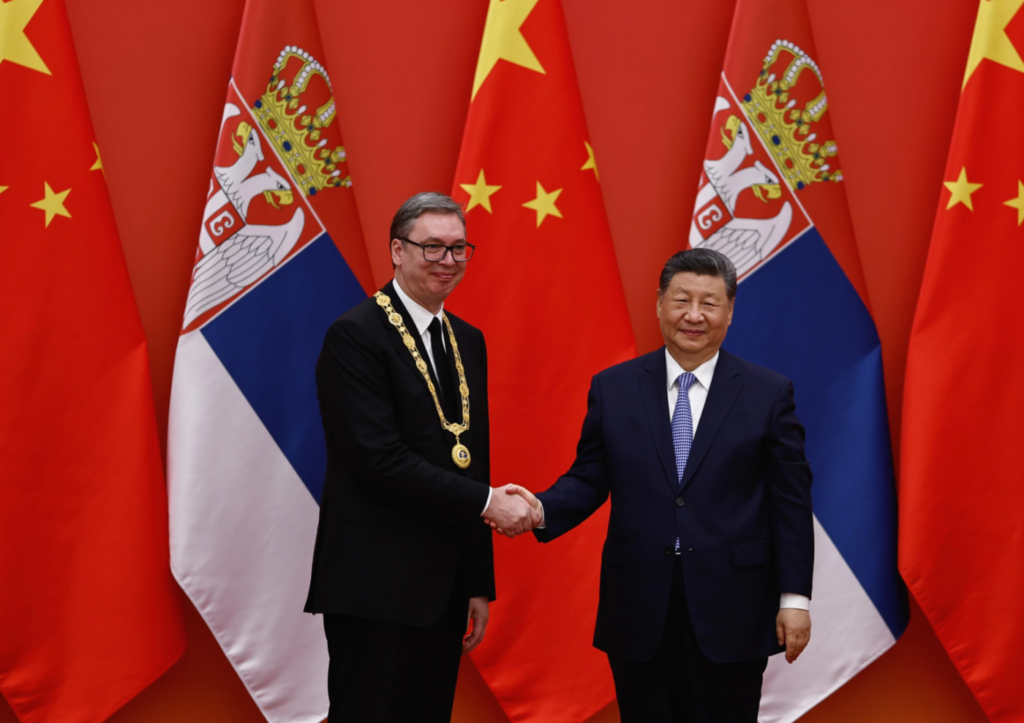
The second layer is the document the President of Serbia, in his capacity as head of state, signed in his own hand in the Museum’s official Book of Honoured Guests on 26 May 2026. The published text of that entry, reproduced in the Serbian press the same morning, commits the signatory’s name to admiration for Xi Jinping’s leadership in “strengthening their faith in Marxism and communism, in socialism with Chinese characteristics and confidence in the great rejuvenation of the Chinese nation.” The phrase is not diplomatic boilerplate. “Faith in Marxism and communism” is the ideological self-designation of the Chinese state’s doctrinal commitment, registered by the head of state of a European Union candidate country in writing in the museum that codifies that doctrine, on the morning of his decoration with the Order of Friendship by the General Secretary of the Communist Party of China.
The two documents together remove the analytic option of treating the alignment as a party matter distinct from the state position. The party committed to ironclad friendship. The head of state committed his name to faith in Marxism and communism. The party leader and the head of state are the same individual operating across two capacities, and the documentary record of the week records both capacities producing convergent commitments to the same doctrinal partner.
The implication for the European People’s Party is not a matter of foreign policy disagreement within an otherwise coherent ideological community. The Christian Democratic political tradition was constituted in its postwar form as an explicit ideological alternative to Marxism and to the Marxist-Leninist parties of central and eastern Europe. The founding figures of the tradition, Adenauer, De Gasperi, Schuman, articulated a political identity defined in conscious opposition to communist doctrine. The European People’s Party, as the institutional heir of that tradition, retains in its statutes and in its public self-description the language of that opposition.
Whether that statutory language continues to operate as a binding ideological commitment, or whether it now functions as inherited rhetorical inventory inside an institution that has migrated toward managerial and electoral coordination, is itself part of the question this piece is asking. The honest reading is that both are partially true. The EPP retains, in its formal self-description, the anti-communist civilizational identity of its founders. It also operates, in practice, as a parliamentary coordination structure whose decisions are governed by electoral arithmetic rather than doctrinal coherence. The membership of a party whose leader has signed his name to faith in Marxism and communism is incompatible with the first and unsurprising in the second.
That tension matters for the structural argument. If the EPP were still the doctrinal organism its founders constructed, the documentary record of 24 to 28 May 2026 would have produced an immediate institutional response. It has not. If the EPP were already an entirely hollowed managerial structure, the contradiction would generate no friction at all. It has generated some, registered in Stefanović’s intervention and in the procedural questions now circulating in Brussels institutional channels. The institution sits between the two states. It can no longer act as a doctrinal organism. It cannot yet operate without reference to the doctrinal language that defined it. That intermediate condition is the operational reality of the EPP in 2026.
The accumulated substance in the Serbian case exceeds the Fidesz precedent on the measurable axes the comparison makes available, with the qualification that the two cases are not fully commensurable. Fidesz never endorsed the Chinese Communist Party in writing on party letterhead. No Fidesz leader committed his name in a Chinese state institution to faith in Marxism. The Hungarian state’s foreign policy drift through the 2010s and into the 2020s registered, on the EPP’s own internal threshold, as the upper limit of what the family could tolerate before the procedural precondition activated. The Serbian case clears that limit on substance, but does so against a domestic political backdrop, an accession context, and a regional security configuration that differ from the Hungarian case in ways that affect how the EPP can read its own response options.
The precondition is absent. No major Christian Democratic electorate inside the European People’s Party is paying sustained attention to what the Serbian Progressive Party does. German CDU voters are not following the Beijing visit. ÖVP voters in Austria are absorbed in domestic coalition arithmetic. New Democracy’s electorate in Greece is oriented toward the Aegean and the eastern Mediterranean. The Partido Popular’s voters in Spain do not include the Western Balkans within their political horizon. Smaller member parties whose electorates do follow Serbian conduct, principally those of the immediately neighbouring states, do not possess the procedural weight to force activation on their own.
The reading offered to this point treats EPP behaviour as institutional incapacity. The reading is partial. A second mechanism operates in parallel, and an honest analysis must register it. Major member states behind the largest EPP parties have strategic interests in Serbia that operate independently of party-family discipline and that may be the more decisive variable in the absence of EPP action. Germany’s lithium supply chain for the European automotive transition runs through Serbian deposits and through the agreement signed with Belgrade in 2024. The Western Balkan electricity grid, on which the Federal Republic and Austria depend at the margin, is structured around Serbian transit. Managing Kosovo as a problem the Federal Foreign Office prefers to keep dormant requires a working relationship with Belgrade that conditionality pressure on the SNS would complicate. Containing full Russian penetration into the Western Balkans is, in Berlin’s reading, served better by keeping Serbia inside the European orbit than by treating Serbian conduct as disqualifying.
What looks like EPP institutional incapacity may therefore be, in part, calculated tolerance authorised by the major member states for strategic reasons that lie outside party-family logic altogether. Party-family analysis identifies one mechanism. Strategic accommodation analysis identifies another. They are not mutually exclusive, and the available record does not yet permit a clean attribution of weight between them. Both are operative. The question of which is dominant is one this piece cannot settle and one the documented record of the next eighteen months will substantially clarify.
A further qualification is owed to the reader. The structural reading offered here abstracts from a great deal of operational texture that the working reality of European political behaviour contains in abundance, the factional drift inside national parties, the personality clashes inside the Brussels institutional ecosystem, the bureaucratic improvisation that produces outcomes no participant fully intended, the contingent role of individual rapporteurs and committee chairs in shaping what becomes procedurally possible at any given moment. Comparative political science is permitted to abstract from that texture in the service of identifying the patterns underneath it. The reader should hold the analysis offered here against the understanding that the patterns are real but never operate as cleanly as the analysis suggests they do.
This is the institutional environment into which Borko Stefanović’s intervention of 25 May 2026 was launched. The Vice-President of the National Assembly of Serbia, addressing the European People’s Party from the platform of the Serbian democratic opposition, with the standing of a former chief negotiator and a recognised transatlantic interlocutor, placed before the European political institution most directly implicated in the SNS membership question a register of the documented record and a request for response. The intervention is procedurally precise. It is empirically grounded. It is addressed to the correct formal recipient. It will not receive an answer at the institutional level, because the institutional level is not where the answer, if it comes, will be generated.
The empirical reading of this situation has been articulated, from inside the dynamic, by the head of state whose conduct produces the question. Asked by journalists in Beijing on 26 May 2026 about a Bloomberg framing suggesting that Serbia was approaching a “red line” in its cooperation with China but that confrontation might be avoided because Brussels was preoccupied with other matters, President Vučić responded with contempt that disclosed a precise institutional observation. He had been reading and hearing such formulations for ten or twelve years. The European institutions had evidently, in his phrasing, found nothing more useful to do. Serbia would continue to act in accordance with its own interests, and he invited the Union to compile a list of which interlocutors he was and was not permitted to meet. The surface is rhetorical dismissal. The substance is the empirical report of a candidate state that has tested the disciplinary capacity of the European architecture across a decade and arrived at the operational conclusion that the architecture does not act. The structural finding produced by comparative analysis of party-family discipline converges with the practical finding produced by ten years of conduct-level experimentation. The candidate state has confirmed the diagnosis from the inside.
The European People’s Party in 2026 functions as a parliamentary group within the European Parliament that retains the brand, the secretariat, and the procedural footprint of a transnational party family while having lost the disciplinary capacity that defines a party family as something more than a parliamentary group. Membership in the EPP constitutes participation in a parliamentary coordination structure. It no longer constitutes a binding ideological commitment, because the family has demonstrated, across multiple cases over fifteen years, that it cannot enforce the commitment when the cost of enforcement exceeds the cost of inaction, and because the cost of enforcement, in the Serbian case, is calibrated not by the EPP’s internal preferences but by the strategic calculations of the member states behind its largest member parties.
The question Stefanović placed on the table therefore migrates. It moves to the member parties of the European People’s Party as individual political actors, and behind them to the national chancelleries of which those parties are the parliamentary expression. The Christian Democratic Union of Germany possesses the institutional weight to raise the SNS question inside the EPP and force activation of the disciplinary mechanism, if the Federal Republic’s strategic calculation shifts to make activation desirable. The Austrian People’s Party, the Greek New Democracy, the Spanish Partido Popular each possess fractions of that weight, conditioned on equivalent strategic calculations in their respective capitals. The question is answerable at the level of the member parties whose electorates and chancelleries can be brought to align in attending to it.
The Western Balkans observer should draw from this finding a structural implication. The expectation that the European institutional architecture will, of its own institutional momentum, eventually arrive at a coherent response to the documented conduct of the Serbian state and the Serbian ruling party is grounded in an assumption about how European party families function that the past fifteen years have not validated. The architecture does not act on its own. It acts when the electorates of its largest constituent member parties have been brought to attend to the question that requires action, and when the chancelleries behind those electorates have decided that the strategic costs of action are lower than the strategic costs of continued inaction. Until both conditions are met, the institutional response that the documented record would seem to demand will not arrive, regardless of how comprehensively the record accumulates.
What is required is not further documentation. The record is sufficient. It was sufficient by 2023, and has been sufficient throughout 2024, 2025, and the first five months of 2026. The week of 24 to 28 May 2026 has now placed in writing, in two convergent documents bearing the signatures of the party president and the head of state, evidence of an ideological commitment that the European People’s Party’s foundational identity was constructed to exclude. The candidate state has, in the same week, publicly registered its own observation that the architecture will not respond. What is required is the political work, conducted inside the member states of the European People’s Party, that brings the electorates of those member states and the chancelleries behind them to register the inconsistency between the values their parties profess, the conduct their party family tolerates, and the strategic accommodation their governments have authorised. That work is not the work of the European institutional architecture. It is the work of journalists, of researchers, of opposition political actors, and of the diplomatic representations of the states whose security is most directly implicated.
The European People’s Party will not answer the Stefanović question at the institutional level. The answer, when it arrives, will come from the member states whose strategic calculations currently sustain the tolerance, and it will arrive through a political process that the European institutional architecture neither initiates nor controls. That process may take years. It may not arrive at all. The documented record of the week of 24 to 28 May 2026 has placed before any observer willing to read the institutional shape of the European political order without the comforting assumptions that the architecture itself encourages a question that the architecture cannot resolve from within.
Ngadhnjim Brovina is a political scientist at the University for Business and Technology in Pristina, where his research addresses party systems, democratic consolidation, and transnational party organisation in postcommunist Europe.