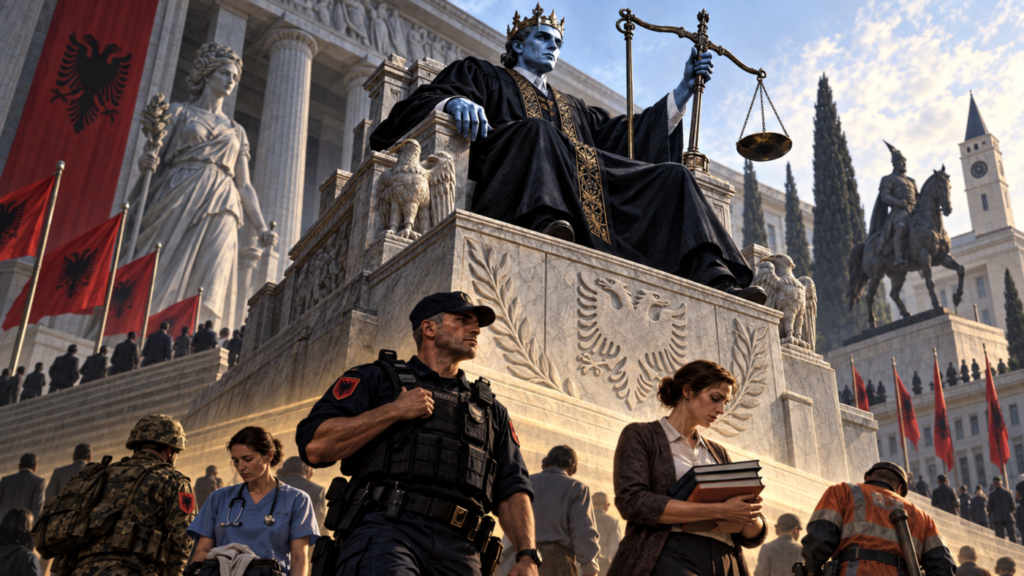
When a judge earns ten times what a police chief earns and twelve times what a teacher earns, the argument has stopped being about judicial independence. It is about a caste the state itself is minting.
By Ylli Manjani (Tirana)
Editor’s note:This piece follows the author’s 27 August essay on the “independent republics” of the Albanian state. On 26 August the High Judicial Council set a new magistrate reference salary of 222,425 lekë a month, plus a 14,000-lekë qualification supplement, effective 1 August and with arrears back to April 2023. It did so after the Constitutional Court struck the previous formula in February and required Parliament to legislate a new one by 31 July. Parliament did not. The Ministry of Finance has since declined to execute the new payrolls, and the government says the matter will be settled in the new parliamentary session. The figures below are the author’s, in gross monthly lekë. Magistrates at SPAK and the special courts also carry an 80 percent difficulty supplement under Law 96/2016, which is how the top of the scale is reached.
The salaries of magistrates are no longer a debate about the independence of justice. They are now a debate about the social discrimination the state itself is producing.
A police station chief is paid around 90,000 lekë a month. A prosecutor or judge, under a system he has set for himself, is paid 900,000 lekë a month and more.
A tenfold difference.
An absurdity that has made itself at home.
The station chief is on call twenty-four hours a day, seven days a week. Nobody asks him whether it is Sunday, night, or a holiday. He goes out to accidents, murders, protests, brawls, police operations. Risk is part of his working day. One wrong decision can cost him his life.
And the prosecutor?
He starts work at eight. By nine he has had his first coffee. At lunch he is in a restaurant. He usually turns up in court unprepared. By four in the afternoon the office is closed. His work carries great legal responsibility, of course, but the physical risk, set against the policeman’s, is close to zero.
Yet he is paid ten times more.
This is no longer a pay gap. This is the proclamation of castes.
The irony is greater still when you consider that without the policeman’s work the prosecutor’s file does not exist. It is the policeman who gathers the evidence, tracks the perpetrators, makes the arrests, exposes himself in the field. The prosecutor builds the charge on the police’s work. And in the end the policeman remains the apprentice while the prosecutor becomes the king.
When the difference reaches tenfold, it is not only the pay that changes, nor only the hierarchy. The colour of the blood changes too. The policeman has red blood. The magistrate has acquired blue.
And the teacher?
The teacher, who educates the generations, receives around 75,000 lekë a month. The judge receives at least 900,000. More than ten times as much.
With a single pay decision, the Republic of the KLGJ has declared that the one who condemns a man is worth ten times more than the one who educates him.
Then we wonder why the schools empty and the prisons fill.
Society pays the executioner more than the educator.
That, too, is the message these salaries send.
Let us be clear: good salaries are a guarantee of judicial independence. Nobody denies that the judge and the prosecutor should be well paid. But independence is not privilege. It is not a title of nobility. It is not a licence to build a financial aristocracy inside the public administration. It is not a decree of social distinction.
Independence means being free of political influence. It does not mean being independent of the state that pays you.
Today the magistrates have in practice told the Republic: we are its highest stratum. Above the policeman. Above the teacher. Above the doctor. Above the soldier. Even above the member of parliament. Above the head of state, it goes without saying — though He is a story for another day.
The MP, who votes the laws the judge and the prosecutor are bound to apply, is paid around 300,000 lekë a month. Nearly three times less.
So it is not only above the administration. The magistrates have raised themselves above the legislative power as well.
This is not separation of powers. This is a self-proclaimed social hierarchy.
And here the constitutional and political problem begins.
Salaries cannot be built on the logic of castes. It cannot be that each branch of power assigns itself the place at the top of the pyramid. Otherwise, tomorrow every institution will declare itself the most important in the Republic.
Parliament has the duty to restore the logic of the state. To build an integrated pay system in which responsibility, workload, risk, and public importance are weighed with the same measure for everyone. Not a system in which each branch places the crown on its own head and then asks the citizens to call this “independence.”
Because there is no independence from the state.
There is only independence within the state.
And in a republic, nobody’s blood can be blue.