Two decades of reform and strategic loyalty have left Albania treated not as a future member of the European Union but as a permanently managed candidate, inside a process whose conditions evolve faster than its promises.
by Albatros Rexhaj (Tirana)
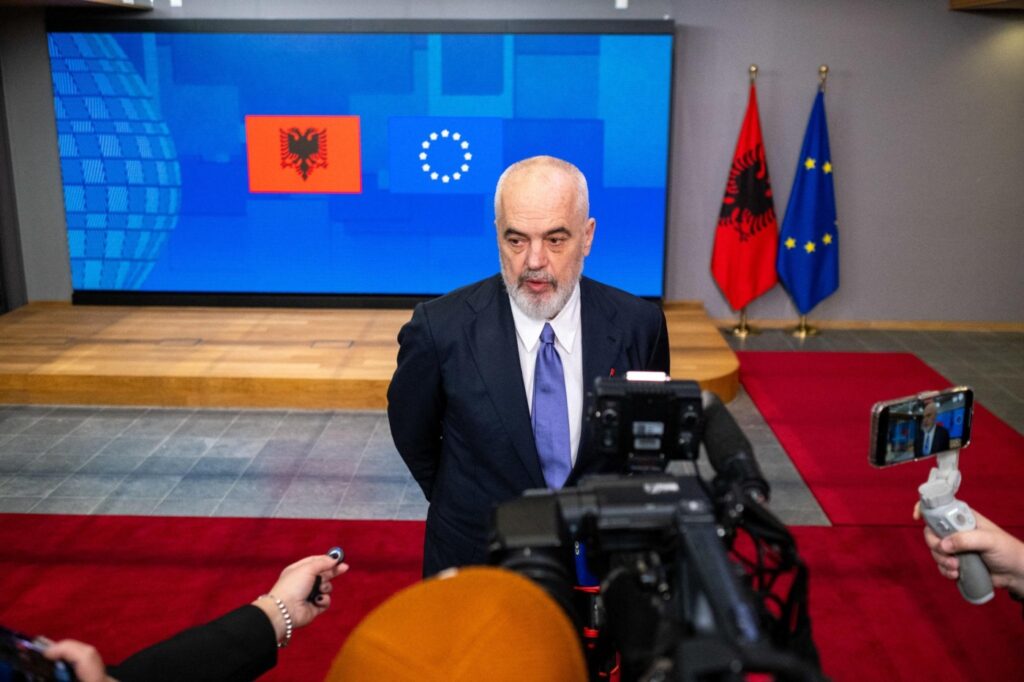
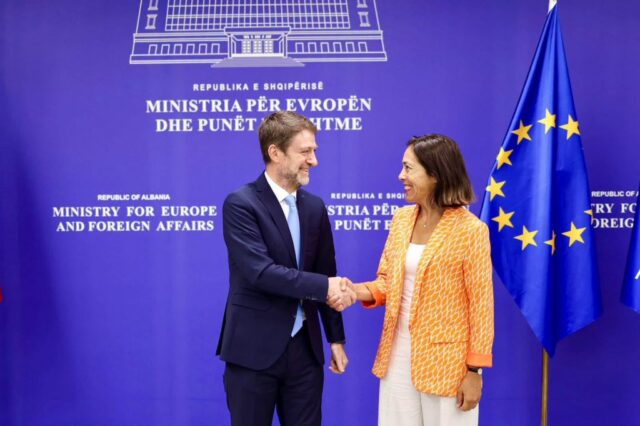
Today the Council Working Party on Enlargement cleared the EU Common Position on Albania’s IBAR without objection. Friday the ambassadors will rubber-stamp it as an I-item. Monday Edi Rama will fly to Brussels for the eighth Intergovernmental Conference and stand at a podium with phrases about the European family and historic days and the trajectory toward 2030. The handshake photographs will be filed under “Albania-EU enlargement, May 2026” in three press archives and forgotten by Wednesday. He will be lied to with great courtesy, and he will repeat the lies with great enthusiasm, and the country he governs will be no closer to membership in the European Union on Tuesday than it was on Sunday. This needs to be said clearly, because nobody else in Tirana is willing to say it, and because the cost of the silence is borne by an entire generation that has been told for twenty years that its future is European when its future is, in fact, a waiting room.
Let us be honest about what Brussels is and what it is not. The European Union is a structure of interests, not a structure of values. It uses the language of values because the language of values is convenient. When the interests align, the values are met. When the interests do not align, the values are deepened, refined, made more demanding, extended into new domains, until the candidate country finds that the goalposts it was instructed to reach last year have been moved into the next county. This is not a theory. It is a method. It has been applied to Albania since 2003, the year of the Thessaloniki summit at which the Western Balkans was promised a European perspective, and it has been applied with such consistency that anyone who continues to take the promise at face value has either stopped paying attention or has a personal interest in pretending not to.
The seriousness of the institution can be measured by its actual decisions, not by its press releases. This is the same Union that admitted Bulgaria and Romania in 2007 without either country having met the conditions that are now imposed on Albania with the gravity of holy writ, and that then spent the next fifteen years constructing a Cooperation and Verification Mechanism to manage the consequences of an admission it had already made. It is the same Union that admitted Cyprus while the northern half of the island was under Turkish control, importing into the bloc an unresolved territorial dispute with a NATO ally, and that has since watched the Republic of Cyprus operate as one of the more accommodating jurisdictions in Europe for Russian capital and for the laundering of money that Brussels claims to be fighting elsewhere with such conviction. It is the same Union that demanded the Republic of Macedonia change its constitutional name, abolish its self-understanding, accept a hyphenated identity engineered in Athens, and submit to Bulgarian veto rights over its language and history, and that having extracted these concessions has delivered, in return, precisely nothing. Skopje paid in full and received an empty seat. The Albanian government should be studying that transaction with greater care than it apparently has been.
The mechanism deserves description in its own language. Accession to the European Union proceeds through six clusters of negotiating chapters, opened by unanimity of the twenty-seven member states and closed by unanimity of the twenty-seven member states. The Commission proposes; the Council disposes. Every individual member state holds a veto at every individual stage of the process, which means that bilateral disputes between a candidate and any single existing member are absorbed into the accession framework as conditions to be resolved before the next procedural step can be taken. Greece used this veto against Macedonia for twenty-seven years. Bulgaria used it against the same country, after the name change, for another four, and may yet find another. The Netherlands used it against Albania and North Macedonia for years to obtain reforms unrelated to the candidates’ performance and related instead to Dutch domestic politics. France has periodically invoked enlargement fatigue as a structural objection requiring no specific country to have done anything wrong. The Interim Benchmark Assessment Report mechanism was itself an instrument added to the methodology in 2020, did not exist when the negotiating framework was designed, and represents a new procedural gate that did not have to be cleared by Croatia or by any earlier candidate. The methodology, in short, is not fixed. It evolves. It evolves in one direction only, which is the direction of additional conditions, additional gates, additional opportunities for bilateral leverage to be applied against candidates with no recourse. This is the system within which Albania has been told to be patient.
Look at what Albania has actually done. All six negotiating clusters opened in under eighteen months. CFSP alignment at one hundred percent. NATO infrastructure on the ground. Troops sent to allied operations the bloc itself struggled to staff. Afghan refugees taken in when European interior ministries were turning their heads. Russia sanctions held without a single wobble, even on issues where Albania paid a real economic price. A justice reform whose vetting process is closer to completion than the equivalent reforms in several existing member states. This is the file. This is the performance. And the response from twenty-seven member states this week is a document setting out the conditions Albania must now meet in order to be permitted to begin closing chapters. Not to close them. To begin closing them. The reward for the work is more work, and the new work is harder than the old work, and the new work was not the work that was originally asked.
Now consider Serbia. The Vučić government passed the Mrdić media package in 2024, a legislative bundle that Reporters Without Borders catalogued alongside the Hungarian model as a procedural template for regulatory capture of independent broadcasters. Its security services maintain working relationships with the Russian Federation that any honest reading of the structure would describe as integration rather than cooperation; the most recent illustration is the integration of former FSB-linked personnel into Serbian intelligence functions under arrangements the Serbian government has neither denied nor explained. Its economic policy treats Beijing as a strategic partner and the European single market as a venue for extraction, with the EXPO 2027 contract architecture distributed through Chinese state-owned construction firms and Russian-linked subcontractors operating outside European procurement norms. Its President shares civilizational frames with Milorad Dodik, hosts the Russian foreign minister with full state honours, and sponsors a commemorative infrastructure that denies the Srebrenica genocide and erases the Albanian victims of Serbian violence in Kosovo. Political violence against journalists and political opponents is routine and unpunished. Belgrade conducts active and undisguised destabilisation operations against Montenegro, a sitting NATO member and the supposed frontrunner of the enlargement process, and has done so for years in full view of every European chancellery. None of this has prevented Berlin from treating Belgrade, throughout, as the indispensable interlocutor of European diplomacy in the region, the partner whose cooperation must be cultivated, the capital whose sensitivities must be respected.
This contrast is not an accident, and it is not a passing phase. It is structural. Germany, the principal commercial and political weight in the Council on enlargement matters, has determined that Serbia is too geopolitically consequential to lose and that Albania is too geopolitically reliable to require courtship. The reliable ally is taken for granted, lectured about benchmarks, instructed to perform reforms whose substance is decided in foreign capitals. The unreliable partner is courted, indulged, granted strategic patience. This is the same Germany that for two decades enabled the flourishing of pro-Russian governments in a number of member states because German short-term commercial interest favoured keeping those countries inside the bloc on terms that suited Berlin, and that is now lecturing Tirana on rule of law from the same podium. The mechanism through which Berlin’s preferences become Council outcomes is not omnipotence. It is the dull fact that no other capital with a serious enlargement portfolio is willing to spend political capital confronting Berlin on a Western Balkans file, because the Western Balkans is nobody else’s chosen hill to die on. Paris would rather not. The Hague has its own arithmetic. The Nordics manage their files quietly and move on. The result is that Berlin’s strategic calculation operates as Council policy by default, and Berlin’s strategic calculation is that Albania’s accession should not precede Serbia’s. The reasons for this calculation will be revised, reformulated, and codified into the methodology as needed. Brussels will not admit Tirana before Belgrade because to do so would collapse the leverage that the slow negotiation with Serbia provides. The order of accession is fixed by the geopolitics of the Western Balkans, and the geopolitics requires Albania to wait. This is the part that has never been said aloud in any Albanian cabinet room, and it is the part that determines everything.
This brings us to the Prime Minister. Edi Rama is a true believer. People can say what they want about his record, but his commitment to the European integration project is sincere, ideological, and personal in a way that the commitments of most European leaders to that same project no longer are. He believes the speeches. He believes the trajectory. He believes that the sacrifices he is being asked to make today will be redeemed tomorrow by a Brussels that respects the discipline of those who paid the price. Precisely because he believes, he is willing to give away a great deal, and the things he is willing to give away are not his to give. They belong to the country. Albania does not owe Berlin the indulgence of its elitist appetites. Albania does not owe Brussels the satisfaction of serving as the experimental subject on which conditions are tested that the same Germany would never dare to impose on Serbia, on Hungary, on any member state whose departure from European norms is too commercially or geopolitically inconvenient to confront. The Prime Minister should not be permitted to mortgage the constitutional and institutional substance of the Republic against a promise that the historical record indicates will not be honoured. He believes the promise. The rest of us are not required to.
The verdict is simple, and it carries its own instruction. The European Union, as currently constituted, will not admit Albania. It will not admit Albania before Serbia, and it will not admit Serbia. The mirage of 2030 is a mirage. Monday’s conference is theatre, and on Tuesday the cameras will have moved on. None of this means that Albania should stop reforming itself, and none of it relieves the country of the obligation to build the judiciary, the democracy, the public administration, and the economy that its citizens deserve. The reforms that matter are the ones Tirana would pursue if the European Union did not exist. Those reforms are the building of a republic. The rest, the procedural choreography, the moving benchmarks, the experiments imposed on Albania that the same Germany would not dare to ask of any country it cannot afford to lose, are not reforms at all. They are tribute. The line between the two must be drawn, and it must be drawn by Albania itself, because no one in Brussels has any interest in drawing it on Albania’s behalf. The sooner Tirana stops believing the fiction, the sooner it can govern itself like a country rather than a candidate.
Albatros Rexhaj is an author, playwright, and analyst with a background in national-security studies and nearly three decades of experience with international organisations dealing with political and security affairs.