The Joint Colleges rewrote Albania’s pretrial detention doctrine without touching a single sentence of the 2011 precedent. That is precisely why it will hold.
By Renada Bici | Legal Desk, Tirana Examiner
On the morning of October 16, 2025, police searched a house in Vinjoll, in the administrative unit of Milot, and found seven kilograms and 350 grams of cannabis sativa. The man who lived there, Begtash Zeneli, was 63 years old, previously convicted but legally rehabilitated, the head of a household whose wife could barely manage the routines of a day without him. He was arrested in flagrance. The prosecution asked for prison. The Lezhë court gave it. On appeal, in November, the measure became house arrest: the age, the rehabilitation, the medical file on the wife. The prosecutor filed a recourse in December, arguing what Albanian prosecutors have argued for fifteen years, that the gravity of the offense, the sentencing margin, and the absence of exculpatory proof from the defendant settle the question by themselves.
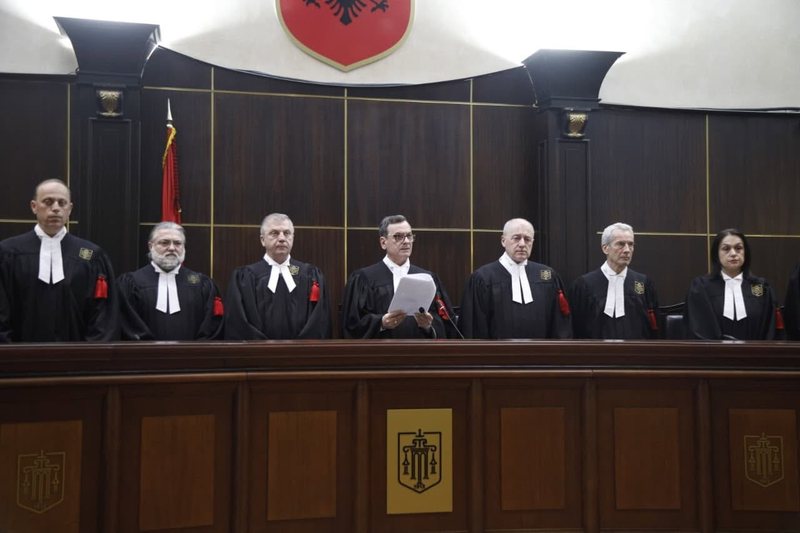
They no longer do. On May 4, 2026, the Joint Colleges of the High Court, sixteen judges convened by Chief Justice Sokol Sadushi, used this most ordinary of drug cases to dismantle the three pillars on which Albania’s pretrial detention practice has rested since unifying decision no. 7 of October 14, 2011. The full 27 page text, decision no. 00-2026-736 (80), was released on July 7 and sent for publication in the Official Gazette. Its effect in every courtroom in the country is immediate.
What 2011 had built
To understand the weight of what changed, recall what the 2011 decision had been read to permit. First, a court ordering prison arrest had no obligation to analyze why lighter measures would not suffice; it was enough to reason that the chosen measure was appropriate. Second, the “special dangerousness” of the act and its author, the statutory gateway to prison arrest under Article 230 of the Code of Criminal Procedure, could be inferred from the nature of the offense itself: serious crime, serious perpetrator, and the syllogism closed. Third, and most consequential in practice, the inadequacy of prison arrest could be accepted only if the defendant or his counsel produced “positive proof” that the state of risk did not exist.
Read together, these formulations built a presumption in favor of the cell. The offense classified the person, the person carried the burden, and the reasoning wrote itself. Anyone who has read Albanian detention rulings knows the paragraph: gravity of the act, margin of punishment, natural human inclination toward liberty, therefore risk of flight, therefore prison. The Lezhë first instance decision in the Zeneli case reproduced it almost verbatim, down to the citation of decision no. 7/2011 itself.
What the Colleges did
The Joint Colleges answered three questions put to them by the Chief Justice’s interlocutory decision of March 9, and to each they attached a formal rule of law under Article 441/2 of the Code.
On the first question, the rule at paragraph 33 holds that the 2011 formulation relieving courts of any duty to analyze alternatives is incompatible with Articles 228 through 230 and 245/1, letter “ç”, of the Code, and with Article 5 § 3 of the European Convention. Courts must genuinely examine the less restrictive measures and state expressly why they are insufficient in the concrete case, in reasoning that is individualized, fact bound, and reflective of a concrete risk under Article 228/3. The sanction is not rhetorical: under Article 245/1, a decision that fails this test is invalid.
On the second, the rule at paragraph 52 declares prison arrest exceptional by nature. Special dangerousness cannot be derived solely or mainly from the nature of the crime or the sentencing margin. It must emerge from an interwoven assessment: the specific facts, the manner of commission, the consequences, the personality and conduct of the accused, his family and individual circumstances, everything that bears on the real procedural or social risk he presents. The offense no longer classifies the person.
On the third, the rule at paragraph 65 relocates the burden. Justifying the need for prison arrest, both at imposition and at every renewal, belongs to the prosecution, which must argue concretely why the risk exists and why no lighter measure contains it. The court verifies and reasons at every stage. And the decisive sentence: the court’s decision cannot be conditioned on whether the defendant produces “positive proof.” The accused bears only the burden of raising the personal, family, or health circumstances he himself invokes in favor of a lighter measure.
Applied to the case at hand, the Colleges upheld the Court of Appeal. Seven kilograms of cannabis is a serious matter; it is not, by itself, an argument about Begtash Zeneli. The recourse leaned on the nature of the offense, the margin of punishment, and the alleged criminality of the man’s sons, one arrested in Spain, one wanted. Paragraph 70 disposes of that last argument with a principle worth committing to memory: dangerousness is assessed individually, and the conduct of other persons, even family, cannot be imputed to the person whose liberty is at stake.
The elegant fiction
The most interesting feature of the decision is not what it changes but how it claims not to. The Colleges insist, repeatedly, that the unifying sentences of decision no. 7/2011 remain untouched. What required intervention, they say, were “certain formulations of the reasoning” that had generated uneven readings. The doctrinal vehicle is the proposition, drawn from Constitutional Court and Strasbourg jurisprudence, that a judicial decision is a single logical and legal act whose binding force flows from the reasoning necessary to its ratio decidendi, not from the typographical placement of its conclusions.
Call it what it is: a reversal dressed as a clarification. The three formulations “clarified” were the operative core of how 7/2011 functioned in practice, and each of the three new rules of law states flatly that the old reading is incompatible with the Code and the Convention. Even the deputy prosecutor general, Arqilea Koça, arguing before the Colleges, conceded that the offending passage of 2011 carried orientative rather than binding value, an admission that the edifice was already standing on air. But the fiction serves a purpose. By framing the intervention as continuity, development, and harmonization rather than rupture, the Colleges protect the authority of the unifying mechanism itself, and deny future litigants the argument that everything decided under 7/2011 rested on repudiated law. It is institutional prudence, and on balance the right call.
Strasbourg’s long shadow
The decision does not pretend the initiative was spontaneous. Its reasoning is scaffolded on three condemnations of Albania in Strasbourg: Hysa (2023), where the Court found that domestic decisions declared alternatives inadequate without any substantive assessment of them; Muçaj (2023), restating that the seriousness of the offense is not an independent justification for detention; and Gëllçi (2025), where voluntary return, self surrender, and family ties went unweighed while courts recycled the formulas of the initial ruling. Behind them stand the Grand Chamber anchors, Buzadji, Merabishvili, and Ilijkov, the last of which holds that any system of mandatory detention is per se incompatible with Article 5 § 3.
The Colleges, in other words, have domesticated a standard Albania was already losing cases under. They did so against a backdrop that made the exercise unavoidable: by the end of 2025, reported figures put 2,569 pretrial detainees among 4,503 people behind bars, well over half the prison population held on measures that are supposed to be exceptional. A doctrine of ultima ratio that produces a majority of ultima cases is not a doctrine. It is a habit with a Latin name.
What follows, and what does not
For prosecutors, the operational change is immediate. A request for prison arrest built on the offense, the margin, and a paragraph of boilerplate is now structurally deficient, and Article 8/a of the Code, which the Colleges pointedly invoke, obliges the prosecution to present the exculpatory circumstances alongside the inculpatory ones. Risk must now be documented the way facts are documented.
For judges, the discipline runs through Article 245/1, letter “ç”, with invalidity as the price of formula. But the Colleges were careful, at paragraphs 24 and 32, to refuse the opposite formalism: no mechanical catalog of alternatives, no obligatory paragraph per measure, substance over structure. That is doctrinally sound and practically dangerous, because Albanian judicial culture has a proven capacity to convert any reasoning requirement into a new template. The test of this decision will not be its text. It will be whether appellate panels start striking down “individualized” reasoning that is individualized in vocabulary only.
For the high profile docket, the citations have already begun; defense filings were invoking the April session before the full text existed. That is as it should be, and it will produce discomfort. A standard that shifts the burden to the prosecution will be claimed by defendants the public has no sympathy for, in SPAK files, in corruption cases, in matters where pretrial detention has functioned as an advance on punishment. The measure of the courts will be symmetry: the rule protects Begtash Zeneli and it protects the former minister, or it protects no one.
Two sobrieties, finally. The decision changes no statute; the tools were in the Code since the 2017 amendments, unused. And its softest joint is execution. The General Prosecution argued that house arrest ordered without reasoned supervision arrangements is confinement by honor system; the Colleges answered, at paragraph 73, that Article 237 and law no. 79/2020 supply the machinery. On paper they do. Whether a prosecutor in Lezhë has the means to verify, nightly, that a man in Vinjoll is where the dispositive says he is, is a question the doctrine cannot answer and the budget must.
Still, the center of gravity has moved, and it has moved in the correct direction. For fifteen years the question in an Albanian detention hearing was whether the accused could prove he deserved his liberty. As of July 7, the question is whether the state can prove he must lose it. Liberty is the rule and the cell is the exception: the Code always said so, Strasbourg kept saying so, and now, at last, the High Court has said it in a form no trial judge can misread. The burden has come home to the party that asks for the key.
Renada Bici is a Tirana-based lawyer practicing in civil, criminal, and administrative law. She holds a law degree from the University of Tirana and has experience in both private legal practice and public administration. She writes in her private capacity.