Albania’s restraint is the conduct of a confident European state. It should not be mistaken for consent.
Editorial Board
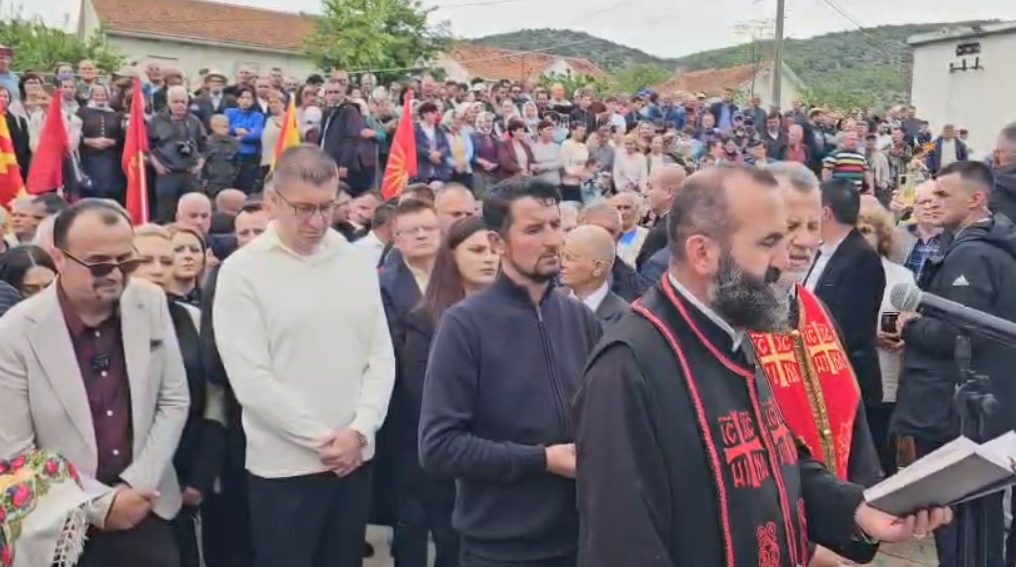
On 20 August, in the square at Pustec, a formal standing line assembled for the opening of a Macedonian folklore festival: the Prime Minister of North Macedonia, Hristijan Mickoski, beside him local officials, behind them Orthodox clergy, dancers in traditional costume, and a stage dressed in the symbols of his state. One anthem was performed. It was not the anthem of the Republic of Albania, on whose territory every person in that square was standing.
We have seen this before, and recently. On 10 May, at the inauguration of a monument to Macedonian fighters in the village of Tuminec, in the same municipality, only the Macedonian anthem was played. Mr. Mickoski spoke in Macedonian with no Albanian translation provided. His press office declined questions from Albanian journalists. The mayor of Pustec was present and was given no speaking slot. Albanian symbols were absent from the staging then as well. What happened last week was a repetition, and repetitions carry information that single events do not.
The mayor, Pali Kolefski, requested the official program in advance from the organizers, the chairman of a VMRO-linked association in Albania, and insisted that the Albanian anthem be played alongside the Macedonian one: “We are Albanian citizens, we live here, and the anthem must be respected.” He was ignored. He then apologized publicly for a failure he did not cause. We want to be precise about what that sequence shows. The elected voice of the Macedonian minority defended the symbols of the Albanian state more firmly than anyone else on that stage, and his community loses nothing by his doing so. That is what integration looks like when it works.
Readers abroad may notice what has not happened since. No Albanian government official has responded with nationalist theatrics. No MP of the governing majority is demanding retaliation, and nobody in Tirana is agitating the large Albanian community in North Macedonia, whose grievances are real, to answer a ceremony with unrest. In a region where some capitals treat kin communities as fuel, this restraint deserves a correct reading. We are not restrained out of fear, and we do not carry an inferiority complex into our neighborhood. We are restrained because Albania is a democracy that takes its European ambition seriously as a matter of values, and a state that intends to lead by example does not answer a protocol failure with a mob.
It is possible, we concede, that none of this was addressed to Albania at all. The public record suggests another audience. In the results of the 2023 census published by INSTAT, 7,057 citizens declared Bulgarian ethnicity, while those declaring Macedonian ethnicity fell to roughly 2,300 from 5,512 in 2011, and the two neighboring states have contested the identity of these communities ever since Albania recognized a Bulgarian national minority under Law 96/2017, “On the Protection of National Minorities,” of 13 October 2017. A festival saturated in the symbols of one claimant may be a message meant for the other. If so, the discourtesy to Albania is not softened. Our territory is not a stage for other states’ contests, and our citizens are not the trophy.
The same law we cite above guarantees the Macedonian community of Prespa e Vogël its language, its culture, and its festivals, and we would defend those guarantees against anyone. That obligation runs in both directions. An event attended by a foreign head of government has a public character regardless of who prints the invitations, and the host state’s anthem has an obvious place in it. Once, we were prepared to file under carelessness. Twice, after a written request from the only Albanian public official present, we file differently.
Our institutions will say what they have to say through the channels that exist for the purpose, at whatever level they judge right. We are content to wait for that. We simply note, for the organizers of the next ceremony, that our patience has now been used twice, and that we are keeping the receipts.