By Ylli Manjani (Tirana)
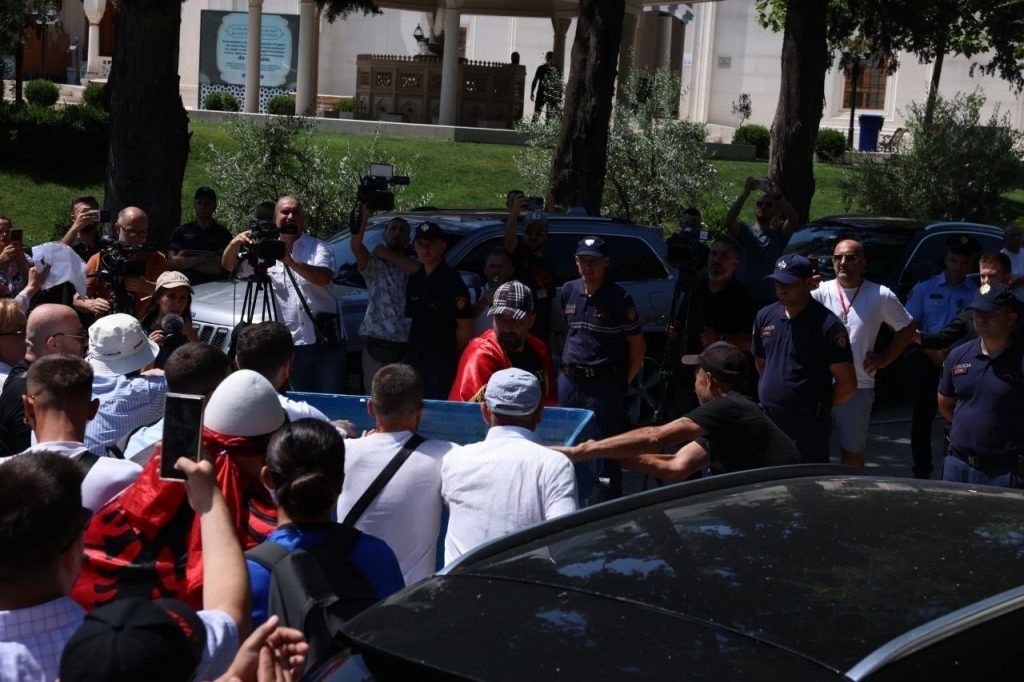
There are commentators who say it with a strange calm: “Come on. They only threw eggs. No harm done.”
Very well. What exactly must happen before we agree that we are looking at violence? Must bombs be thrown? Must there be casualties? Or does violence earn its name only once it is too late to stop it?
This is the most dangerous logic now being normalised in our public debate. Violence is not measured by the kind of object the aggressor holds. It is measured by the act of striking another person. The object decides only one thing: how grave the act becomes.
I understand that in a climate where four words in five are insults, verbal violence grows hard to see. I understand, too, that where we speak more of death than of life, intimidation, public lynching and collective bullying begin to look like ordinary features of the landscape.
But there is a line that needs no interpretation.
When you follow a man on foot and strike him with whatever you are carrying, that is physical violence. The more dangerous the object, the heavier the consequence. When weapons enter, we have crossed into crime. This is how the scale of violence works, from its lightest rung to its last.
So throwing eggs, or bottles, or water, is not humour. It is not performance. It is not protest as art. It is physical violence. Lighter than the other forms, but violence still.
Faced with violence, the state has a duty to answer. Some individuals were taken in by the police, and up to that point nothing stood outside the law. The problem lay elsewhere. The police reacted after the attack instead of preventing it. Correct in procedure, then, but far less effective in the one mission that matters most: prevention.
More troubling still is the growing inability to halt, in time, even the attacks on private property. This breeds a sense of insecurity that can push people toward defending themselves, and, in the end, toward taking justice into their own hands. History has shown us where that road leads. It begins at the edge of tragedy.
Yet the strangest thing of all is the moral logic now being built.
If you are a protester, then apparently you have every right to be violent.
If you are a police officer, an official, or simply a citizen who happens to be standing there, then apparently you have no right at all, neither to defend yourself nor even to respond.
That is not democracy. It is the privilege of violence. No society can stand on such a principle.
The rule is simple, and as old as civilisation itself. Insult, and you will be insulted. Use violence, and you will meet the force of law. Kill, and you will be punished. It makes no difference whether you call yourself protester, revolutionary or activist. The law does not ask after the slogan in your hand.
From the lex talionis, the first law that ever tried to hold vengeance to proportion, to the modern rule of law, one thing has never changed: violence draws a response. What changed is that the modern state labours to put law in the place of revenge. This is precisely why police and courts exist.
The task of the state is to keep man from colliding with man. For the chaos of that collision is the most savage form of violence there is. Even when the state itself errs on the side of disproportion, it can be checked, tried and punished. Chaos cannot be put on trial. It is paid for in wounds, in lives, and in the ruin of the trust that holds a society together.
And so, if we mean to avoid that point of no return, we must refuse to normalise any act of violence, however small it may appear.
The egg thrown by the “chickens of the revolution” is not food. It is the emblem of a political culture that would trade argument for humiliation, debate for assault, and the law for the crowd.
And history has taught us that revolutions which begin with eggs rarely end with eggs alone.
Ylli Manjani is an Albanian lawyer and former Minister of Justice (2015–2017). Since his dismissal from government — after which he publicly accused the Rama administration of protecting corruption — he has returned to legal practice and become one of Albania’s most persistent critics of prosecutorial overreach and judicial dysfunction.