A declaration with plenty of words, and the only word that mattered was not among them.
Albatros Rexhaj
For twelve years the European Union has told Albania what the rule of law is. It is a state that protects its institutions. It is a police force that is accountable and a justice system that does not let violence go unpunished. It is the inviolability of diplomatic premises, which the Union has reminded this government of more than once. It is the ability to say, without a lawyer, that a man who throws a petrol bomb at a ministry has done wrong. Every one of these lessons is in a Commission report. Chapter 23 is built on them.
On Wednesday the Union was asked to apply them to one night in Tirana, and it could not.
There is one word for what happened on Tuesday. The Albanian foreign ministry used it before nine on Wednesday morning, about the flag of the Holy See torn from the Apostolic Nunciature: “condemn”. At 12:46 the State Police called the violence unacceptable and punishable by law and told the crowd to step away from the masked men. Nine minutes later the European Union Delegation produced seven sentences, first for a television channel and later on its own account, and the word was not there.
What was there was “concern”. Concern about an escalation that happened on its own, with no author. Concern that respected the right of assembly, which nobody had attacked. Concern that “took note of the allegations” against the police and expected them investigated as a matter of priority. Concern that encouraged “all sides” to de-escalate and recommended dialogue as “the only way forward”. Seven sentences, each true the way a sentence about the weather is true, and not one of them pointed at a man with a petrol bomb in his hand.
The Union teaches accountability: it demanded it from the police and from nobody else. The Union teaches that violence against institutions is a crime: a ministry was stoned and set on fire, and the text calls it an escalation. The Union teaches the inviolability of diplomatic premises: a mission in its own city lost its flag to a crowd, and the text does not mention it, although the Delegation’s own protection in Tirana rests on the same rule. The Union teaches that journalists must be safe: its one sentence about journalists concerns the police, half an hour after reporters had been stoned by the crowd. The Union teaches that a state and a mob are not the same thing: the text asks “all sides” to calm down.
Every standard the Union has ever set for Albania fails in its own seven sentences. The Delegation did not have to take a side. It had to apply, for one afternoon, the test it has applied to this country for a decade, and it did not.
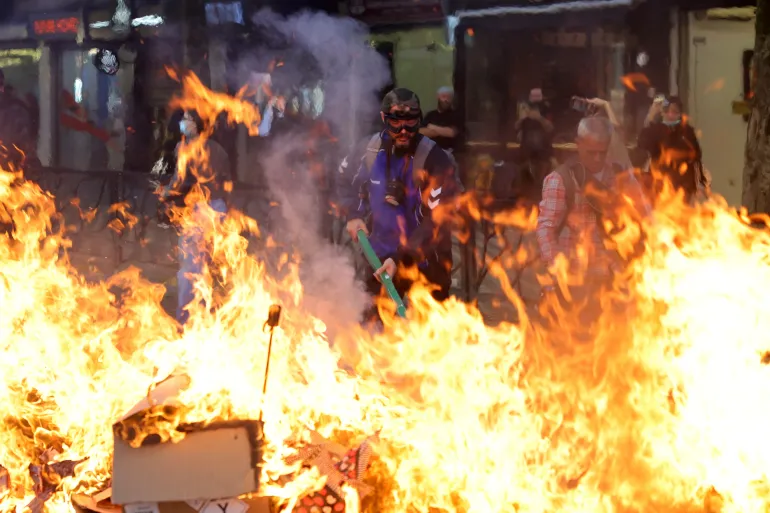
And the afternoon went on with the statement on the Union’s account. A bank on Rruga e Durrësit was kicked in, then set alight. A molotov set fire to an office on the first floor of the Ministry of Education. A burning bank is not a negotiating position, and “all sides” treats a police line and the people throwing petrol at it as two delegations. A text that will not condemn violence is read, by the people who are inclined to it, as the next best thing to permission.
There is also a party watching the fires with interest. The Democratic Party cancelled its parliamentary group meeting on Wednesday to join the protest. Its deputies spent the morning with the detained and came out calling their arrest proof of a state strong with the weak. By two in the afternoon it had filed a complaint with SPAK against the Interior Minister and the police chief for state terrorism against students, while a bank was burning two streets away. The party has not won an election in thirteen years. It has now found a few hundred masked men who can do what the ballot box will not, and the Union’s seven sentences gave it something it could not have written for itself: a European text that scrutinises the police and spares the petrol. When a statement will not say who did wrong, the people who want the government to fall by Friday read it as a hand on the shoulder.
Fourteen words would have met the standard. “The European Union condemns the violence of 13 October, including the attack on the Apostolic Nunciature.” The police could still have been told to stay proportionate; nobody disputes that. But the masked men would have known Brussels had seen them, and the deputies who spent Wednesday morning with the detained would have known the Union was not going to carry their account for them.
The Tirana Examiner has asked Commissioner Kos and High Representative Kallas, in writing, whether the Union condemns the violence and whether its Delegation’s text meets the standard of Chapter 23. The answer will be published.
The word is still available. It costs nothing and binds nobody to anything but the law. The capitals say they want Albania in the Union; the missing word is how they prove it in Tirana. And if it stays unsaid, every embassy in this city should know that the next statement it issues about Albanian prosecutors, Albanian judges or Albanian police will be read against this one, and found to weigh exactly as much.