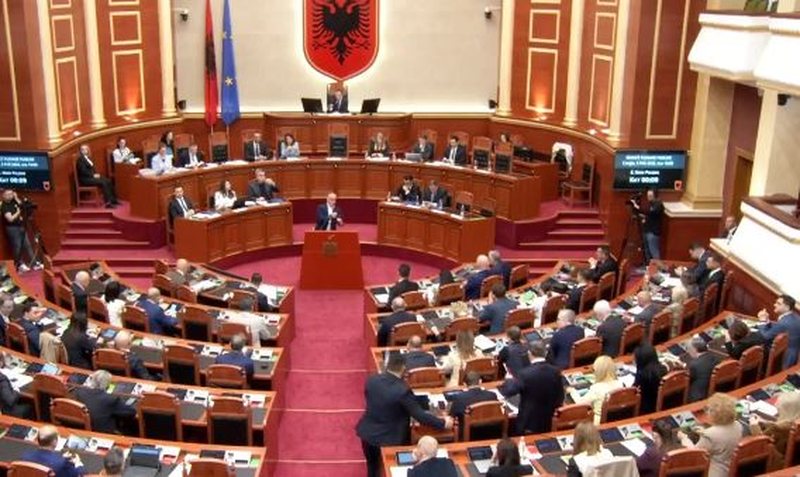
Parliament spent the first of June arguing about Zvërnec as if the line ran between government and opposition. It did not.
The plenary convened around a single coastal project and left three incompatible arguments lying on the floor. None of them belonged cleanly to a party. That is the fact the headlines will bury by tomorrow, and it is the only fact worth keeping.
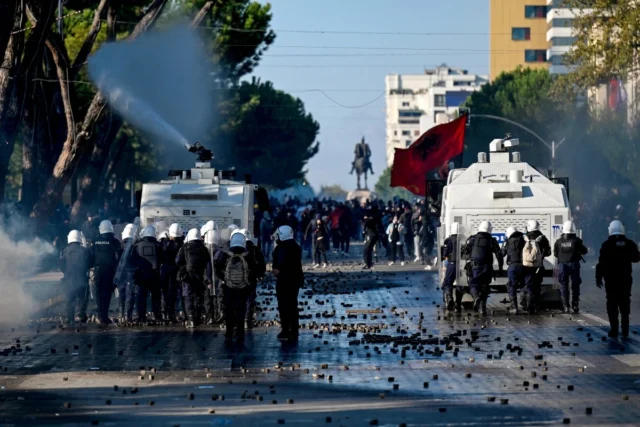
The project is the resort planned for Zvërnec, inside the Pishë-Poro protected zone on the Gulf of Vlora. Rama puts the figure at four billion euros, the financing at Qatar, and the legal question to rest with a single reading: category five protection that permits construction. The chamber did not assemble to test that reading. It assembled because of what happened on the thirtieth of May, when private security in black hoods dragged citizens along the ground and emptied pepper spray into the faces of protesters and the uniformed police standing beside them. The police did not move. The Interior Ministry has since pulled the firm’s licenses and moved against a Vlora police director. The state acted. It acted before Athens said a word, and that sequence matters more than anyone in the room admitted.
Read the benches and the partisan map dissolves.
Taulant Balla carried the majority and made the case a question of magnitude. Largest investment in the country’s history. It will proceed. Foreign direct investment lifted from 666 million euros in 2012 to 1.64 billion in 2025, the economy near tripled to 27 billion, the Vlora airport almost finished, the first intercontinental flight from Rinas to Toronto days away. He congratulated Berisha for his re-election at the head of the Democratic Party with the smile of a man who knew the answer before the contest, folded in Peter Bayer’s congratulations with every meaning intact, and returned, again and again, to the line that became the day’s refrain. The neighbor envies the neighbor. Perhaps not first, but others abroad would want the investment for themselves.
Anila Denaj gave the majority its procedural shield: the property dispute belongs to the courts, not the plenary, a process opened in 1991 and inherited by every administration since. Pirro Vengu reduced the whole session to one sentence. Albania does not have the luxury of refusing investment of this order.
Then Berisha stood, after two days of silence, and crossed his own party. He called the project the most serious investment in thirteen years and accused the Socialists of driving away the only foreign investor the country has left. He argued that once the state approves a project, the investor carries no responsibility for the disputes that follow, and that the citizen who claims injury must face the state, which owes him market value and owes the forgers the full weight of the law. That is not the speech of an opposition leader attacking a government project. It is the speech of a man who agrees with the project and disputes only who gets the credit. When the head of the opposition and the head of the government argue from the same premise, the real fault line is not between them. It runs between development and the property file, and Berisha drew it himself.
His own deputies refused to follow. Ina Zhupa described masked men hauling Albanian citizens while the State Police stood by, the most incapable force in the world, she said, because the assailants wore the state’s protection. She named it abuse of office and called the suspension what it is, a fortnight at home dressed up as discipline. Bujar Leskaj, deputy for Vlora, placed the cause upstream: Rama generated the changes to the protected-areas law that opened Zvërnec to this, so the violence is not the excess of two or three private guards but the yield of misgovernance. Tomorr Alizoti widened it into a thesis on autocracy married to oligarchy and read Rama’s own appearance as fear. Redi Muçi of Lëvizja Bashkë brought the chamber its most dangerous sentence, carried in from the village: the residents told him all they had left was to take up the gun. Outside, the crowd was chanting both names to prison. The street, he reminded everyone, answers to no party’s script.
The Greek dimension is where the quarrel stopped being about land and started being about who reads the land. Iris Luarasi argued that the synchronized arrival of pages and personalities who were indifferent to Zvërnec a week ago points to orchestration, with the environment, ethnicity, and culture serving as the preferred vectors for actors tied to Chinese, Russian, and regional interests. Ardit Bido put the question to the Interior and Foreign Ministries without softening it: who sent the three buses that came from Greece, and why were they never declared. He named Fredi Beleri’s claim of a Greek minority in Zvërnec and Narta losing its rights and read it as an attempt to reproduce the Himara contest those same actors lost two years ago. Leskaj, from the opposite bench, condemned the same framing, calling it ugly to mount unfounded historical and demographic claims on the back of a single act of violence. On this, the chamber did not split. The cross-party rejection of the minority frame is the strongest signal the session produced, and it cuts directly against Athens.
The property substance came from Bido alone, and it is the part of the day that will outlast the speeches. He divided the protest in two. The first group, residents with a real claim, in favor of development, contesting the 2009 decision of the Property Restitution Agency that handed the land to the Sheh of Kanina, a decision issued, he noted, under a figure tied closely to the Democratic Party. They claim the land for the Balliu line under a sale contract from the 1930s. The agency refused that claim in 2009 on reasoning that, Bido conceded, does not hold. His logic ran to one conclusion. The land ends with the 2009 certificate, or with the Balliu line, or, if both titles fail, with the residents under Law 7501. Nothing stays public. Erion Braçe traced the tangle to 1993 and the same law, to the conversion of forest into agricultural land for distribution to those who now declare themselves Greek, and placed himself as the first to denounce the Vlora seizures a quarter century ago.
Even Vangjel Dule, who speaks for the minority’s interests, asked only that the investment be suspended until the truth of ownership is settled. Not abandoned. Suspended.
So the verdict writes itself from the record. The chamber’s true division was never government against opposition; it was development against an disputed property file, and Berisha confirmed it by standing nearer to Rama than to his own benches. The majority’s most effective work was not Balla’s arithmetic but Bido’s analysis, which granted the residents their grievance and denied the project’s opponents the ethnic frame in the same breath. The opposition’s firmest ground was the thirtieth of May, which no one defended and which the government’s own revocation of licenses conceded. And the weakest link in the majority’s case is the one Bido nearly said aloud: a 2009 restitution decision that may not hold, signed under an administration the Democrats ran.