A candidate for EU membership has promised state honours to a genocide convict. Diplomats who file that under Bosnia should read what Tirana said in July.
by Albatros Rexhaj (Tirana)
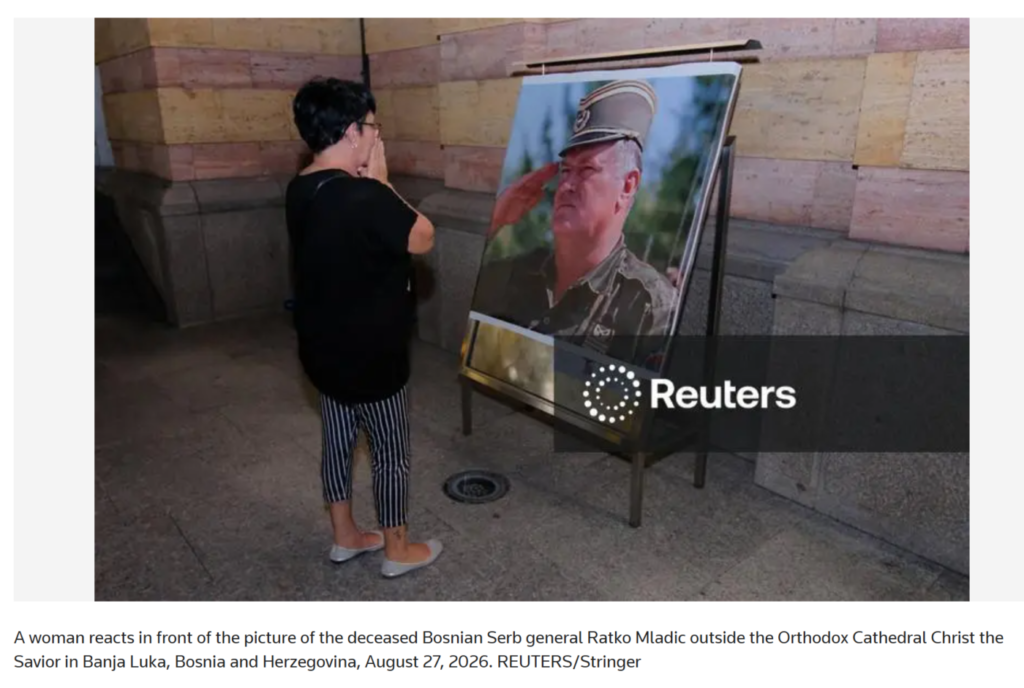
On 28 August, in the square in Pale, people queued to kiss a framed photograph of Ratko Mladić propped against a wall beneath the flag, candles piled at its foot. He had died the previous morning in a prison hospital in The Hague, under a life sentence for genocide. Within a day of the death Serbia’s justice minister, Nenad Vujić, went on Bosnian Serb television and said that General Mladić is a general and the protocols are known. A Belgrade tabloid, citing the Presidency, reported that a plot at Topčider was being arranged. The parish priest of Srebrenica announced that the bells had rung in all six churches of his parish and called the dead man, in English, the liberator of Srebrenica. A bishop at Piva placed him among the spiritual knights of the Serbian people. Then Aleksandar Vučić stepped out at a rally, said the press had the honours wrong, promised a funeral “dignified and proper,” called the tribunal’s refusal to release the dying man “uncivilised,” and added that he had never believed in justice from The Hague. Asked about all this, the European Commission answered that it was for the Belgrade authorities to decide what role they would play in the funeral, and that glorifying war criminals had no place in the Union or among candidates.
I know how this reads from Tirana, and in the embassies here. A Bosnian war, a Bosnian crime, a Bosnian Serb general, mourned in Republika Srpska and Serbia. Sarajevo’s grief, Kosovo’s grievance, and for a capital whose foreign policy consists of keeping the Balkans quiet long enough to get into the Union, somebody else’s file.
It was Belgrade’s file before it was anyone’s.
For thirty years Serbia argued, before the International Court of Justice and with everything the state had, that the Army of Republika Srpska was another army, and in 2007 it won: the Srebrenica genocide could not be attributed to Serbia because the force that committed it was not an organ of the Serbian state. That judgment is the shield between ordinary Serbs and collective guilt, and I am not lowering it. Serbia’s justice minister is. When the question was liability, Mladić served another army; now that the question is honour, Belgrade reaches across the Drina for the general, the rank and the protocols of the Serbian state. It has a claim. Every star Mladić wore was signed in Belgrade, the last in June 1994, thirteen months before Srebrenica. He was on the Yugoslav Army’s payroll in the week of the massacre and on its pension rolls through his years as a fugitive. In January 1991 he was a logistics colonel in the Prishtina garrison.
There is a second reason The Hague is Tirana’s business this month. On 16 September the Specialist Chambers deliver judgment on Hashim Thaçi, and Serbia’s president has already previewed it as “mostly acquitting.” The Mechanism across town, which convicted Mladić, he says never delivered justice. The tribunal he never believed in was created by the Security Council under Chapter VII, fifteen votes to none, Russia’s included; the same Council, under the same chapter, produced Resolution 1244, which Belgrade has cited since 1999 as binding on the whole world. The court that cleared Serbia in 2007 is authority; the same court’s 2010 opinion that Kosovo’s independence broke no rule of international law was dismissed the afternoon it was delivered. A state that keeps the whole system of international law and reserves the choice of which parts are in force this week has a policy, and Albania, whose diplomacy lives inside that system and has no other, should know it.
The church is where Albania stops being a spectator. The Serbian Orthodox Church has been at work on this man since August 1994, when Patriarch Pavle came to Pale, broke bread with Karadžić and Mladić and blessed them. In his sixteen years as a fugitive it never once, on any record I can find, asked him to go to The Hague. When he was convicted, Patriarch Irinej attacked the judgment and called the memorial at Potočari, in essence, a military cemetery. This week its priests rang the bells and its bishop named the knight, while the Patriarchate, in six days of posting feasts and homilies, did not say the general’s name. But it had spoken in June. On 30 June Patriarch Porfirije personally conferred the Order of Saint Sava on Danica Marinković, the Milošević-era judge who ruled that the dead of Reçak were combatants, with a citation honouring her for exposing an “invented massacre of Albanian civilians.” A church that decorates the denial of one massacre in June has told you what it thinks of the conviction for another in August, and the vocabulary it uses, the new Lazar, the martyr, the heavenly kingdom chosen over the earthly one, was cut from Kosovo’s ground.
I have watched that vocabulary work before. In 1988 and 1989 the relics of Prince Lazar were carried from monastery to monastery across Serbia and Bosnia, drawing crowds, and arrived at Gračanica in time for Vidovdan 1989. I was fourteen in 1988. I had grown up believing in Brotherhood and Unity and could not understand where the hatred was coming from. Ten years later, on 28 July 1998, in the village of Hade, I stood in front of an execution squad and survived it. Iconography comes first. It teaches a people what it is owed and by whom, and the army arrives when the lesson has settled. Nothing obliges the sequence to repeat. But Serbia is buying its army now: forty fighter jets promised, Chinese HQ-9 air defence confirmed in June, a drone factory to open in September, a defence budget up from 1.7 to 2.3 billion dollars between 2022 and 2024 by Stockholm’s count, and money in the 2026 budget to restore conscription. In 1997 Serbia’s president told a German interviewer that Serbs would be patient in order to regain their land; on 18 August, asked about a bridge over the Ibër (Ibar), he said the world was changing, though not as fast as had been hoped. The waiting is no longer empty handed, and the land in that sentence has an address.
Albania’s foreign ministry said something in the last days of July, as excavators went into a wartime mass grave at Kaludra in Kosovo, that no other government in Europe managed to say: “Pa të vërtetën nuk mund të ketë pajtim të qëndrueshëm.” Without the truth there can be no durable reconciliation. The same week, standing beside Croatia’s foreign minister, Ferit Hoxha said that normalization in the region cannot rest on historical revisionism, denial of facts or the glorification of war criminals, and that anyone dreaming of a return to the past had remained behind the times mentally. That is Albania’s policy toward Serbia, in the government’s own words, five weeks before the coffin.
It is a policy that has cost this government something, and I will concede what the opposition in Tirana will not. Edi Rama went to Belgrade in 2014, the first Albanian prime minister to do so in sixty-eight years, and told Vučić to his face that Kosovo’s independence was irreversible. He has gone on Serbian television since, and in mid-July declined to join what he called the hysterical chorus over a Belgrade minister’s provocation. For that his own opposition has called him Vučić’s brother since 2020, and Kosovo has accused him of naivety. Whatever one makes of the man, the register did not vary under provocation, and it is the register Brussels prescribes for this neighbourhood. Reconciliation of that kind is an investment, and it presumes a counterparty that means, at some point, to close the ledger. The week since Mladić’s death is Belgrade’s answer. The state Tirana extended its hand to has said, through a minister, through a tabloid citing the Presidency, and through a church that has yet to call a genocide a genocide, that it means to keep the ledger open and to teach from it.
Albania is measured on everything. The Commissioner for Enlargement has asked this government to repeal a strategic-investments law and its 2024 amendments. The special prosecution that Brussels and Washington required has indicted a sitting deputy prime minister on eight counts, and the government has absorbed it. On Albania the standard has teeth, and I am not asking for it to have fewer. I am asking the diplomats who apply it to look at what the same architecture holds for the other candidate. In Tirana the repeal of a law is a demand with a Commissioner’s name on it. In Belgrade a minister’s promise of state honours for a genocide convict, in the year of the state’s pre-accession disbursements, drew one sentence about domestic affairs and, so far, no consequence anyone has announced for the money that candidate receives.
Two dates in September. On the 16th The Hague delivers a verdict on a former president of Kosovo that Serbia’s president has already scored. On the 26th Patriarch Porfirije stands in Pale, in the square that kissed the portrait, in the town where his predecessor blessed the general. Somewhere in that month the body will come home and the protocols the minister says are known will be performed. Tirana said its sentence in July, in Albanian. The capitals with embassies in Tirana, which hold this country to every word of its commitments, will be asked in September whether Belgrade is held to any.
Albatros Rexhaj is an author, playwright, and analyst with a background in national security studies and nearly three decades of experience in political and security affairs.