What the choice of Eden tells us about the people who planned the drone, and what Berlin’s “either side” tells them about the Alliance.
By Drizan Shala (Security Desk)
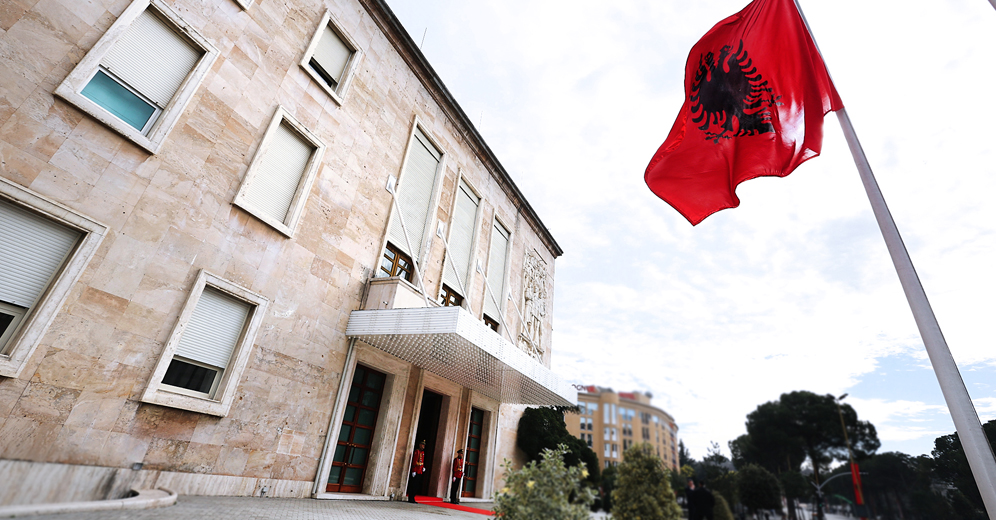
Friedrich Merz condemned the violence in Tirana on Thursday, from the podium of the Berlin Process summit in Budva, and this publication thanks him for it. Then he finished the sentence. “When we face protests in the European Union or here in the region, violence must never be an option for either side.” Edi Rama was in the room, a week after a drone carrying explosives had been stopped over his office. There were no two sides, Mr Chancellor. There was a country under attack, under the cover of a legitimate protest, and a state that put the fire out. What was aimed at the Kryeministria, the Prime Minister’s Office, that Friday had no side in any protest. It had a target.
The Prime Minister named it himself. “A drone with explosives, meant to hit the Kryeministria and set fire to the inner courtyard, where that wooden structure is, and God knows with what consequences.” The wooden structure is Parku Eden, and once you know what it is, you know what the people behind the drone wanted and how much they knew.
Eden is the three-dimensional garden Rama built in the inner courtyard of the Prime Minister’s Office, designed by the Austrian studio Precht, built by the company Fusha for the Albanian Development Fund at 398 million lek, about €3.6 million, and shown to the public for the first time in his New Year greeting of 2025, filmed walking through it. It is a lattice of cross-laid prefabricated timber beams on a 4.8-metre grid, six modules long, three deep and four high: roughly 29 metres by 14, and 19 metres tall. Inside the lattice are planted gardens, trees, fish tanks, rectangular and spiral stairs, corridors, a terrace at the top, and a tribune with a seating ramp for conferences by day and lectures, concerts and theatre by night. Rama said it was not an artwork but a working space and an events venue that would be opened to the public.
No bill of quantities is public. From the project document, conservatively: a lattice of that size has about 337 beam segments of 4.8 metres, some 1,600 linear metres of structural timber; at the sections such spans require under planted decks, that is 90 to 150 cubic metres in the frame alone. Decks, stairs, the tribune, railings and planter boxes on a structure of this kind add at least as much again. Call it tens of tonnes of dry timber. That is the floor, and nothing in the drawings argues for less.
Now put a fire in it. A timber lattice burns faster than a timber wall, because every beam has air on four sides. The planting through it, the wooden tribune, the planter boxes and, in October, a season of leaf litter are the kindling. The courtyard is enclosed on all four sides by the government building, so a fire inside it is a fire in a chimney: the walls drive the draught upward and reflect the heat back onto the structure, and the only ways out for anyone inside run through the building. And the lattice is 19 metres high, which puts flame against the upper-floor windows of the Kryeministria on every side at once. A courtyard fire becomes a building fire within minutes. A charge of a few hundred grams on a commercial quadcopter is enough to start it. The target supplies the rest.
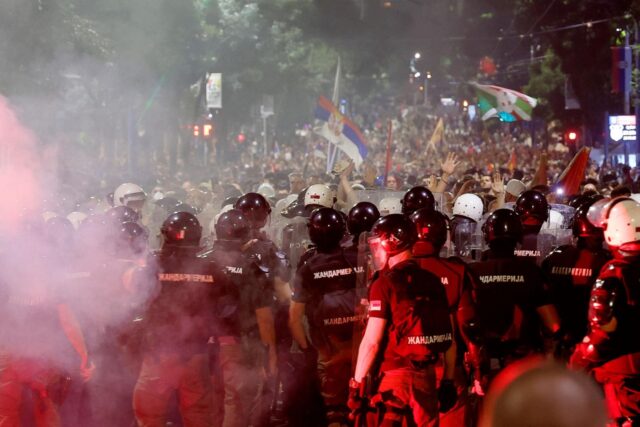
That is why the choice of target is the most informative fact in the whole affair. The rioters were already attacking the Prime Minister’s Office that week, with stones, flares and molotovs, from the boulevard, against the façade. Whoever planned the drone did not join them. They chose the one point in the complex that the crowd could not reach and where a small charge would do the most: enclosed, self-feeding, timber, planted, nineteen metres high, and alight against the building on four sides. The choice belongs to someone who knew the courtyard, knew what stood in it, understood how fire behaves in an enclosed space, and had worked backwards from the effect they wanted to the smallest payload that would produce it. No crowd thinks that way. The airframe is cheap, the charge is small, and the intelligence goes into the target.
Eden is inside a working government building, and the building was full that week. Where there is fire and there are explosives there are also casualties. This publication will not go further into that; the arithmetic is obvious enough. The man who was first asked to launch the drone and refused, as this publication reported on Saturday, refused for exactly that reason. He was not being asked to make a point. He was being asked to burn people.
Eden was not the objective. It was the fuse. Nobody plans a drone strike on a garden. They plan it on the building the garden sits inside, and they pick the garden because it is the fastest way to set the building alight: tens of tonnes of timber in an enclosed courtyard, flame at the upper windows on four sides within minutes, the fire brigade unable to reach the seat of it through a riot. The goal was the Kryeministria burned to the ground, on camera, during a week in which the crowd outside was demanding the resignation of the man inside. Europe has seen that picture before. On the night of 27 February 1933 the Reichstag burned, and the fire was not the end of anything; it was the beginning. A burning parliament became the licence for everything that followed. A burning Kryeministria, with Albania’s EU negotiations open and the cameras of five days’ rioting already in place, was meant to be the same kind of picture: the state’s own seat in flames, and the question of who governs the country decided by fire rather than by the people who had voted a year earlier.
From the target alone: they had reconnaissance, of the courtyard, of what was in it, of how the building encloses it; expertise, in fire and in the economics of small drones, which is the expertise of a very specific war; intent, the largest possible effect, people included; and a purpose beyond damage, the seat of government in flames, as the image that ends one political order and opens another. None of this names them, and this publication is not going to. The investigation has the telemetry and the intercepted communications; what it does not have, it will get from partners.
Which side was that, Mr Chancellor? The students had a side; they had grievances and a boulevard and the right to both. The people who chose Eden had a target. Putting them in one sentence with the police who stopped them gave the planners the one thing they needed from Europe after the drone failed: a reading of Tirana in which an attempted arson of the seat of government is a protest that got out of hand, with responsibility shared. The fire was stopped. The reading was not. Washington and Brussels have had the same week to say otherwise and have not. The silence of the allies and the two sides from the podium are the same thing: the Alliance declining to say that one of its members was attacked. That is what Aleksandr Dugin, who hailed the riot week from Moscow the day after the drone was stopped, won in this affair, and it is worth more to Moscow than the fire would have been: a NATO capital attacked with Moscow’s method, and the Alliance, through its largest European power, telling the victim it was half responsible.
Germany knows the difference. It has been explaining it to its own public for two years. The chancellor’s own formula for the age is that Germany is no longer at peace, if not yet at war; his defence minister’s is that the country must be kriegstüchtig, fit for war, by 2029. When drones closed Munich airport twice in one week last October, the federal government did not look for the other side. It moved to let the Bundeswehr shoot drones down over German soil, set up a federal drone-defence centre, and called the sightings what they were: hybrid attacks by a hostile state. A drone that closes an airport in Bavaria is hybrid war. A drone carrying explosives over the seat of government in Tirana is, in the same government’s vocabulary, one side of a protest. The vocabulary is accurate, and Albania would be glad of it. The problem is who it is reserved for.
So apply it here, Mr Chancellor, in your own words. If Germany is no longer at peace because of what Russia does to its airports and its warehouses, then Albania was at war for one Friday in October, and nobody in Berlin noticed. If the Federal Republic needs to be fit for war by 2029, Albania needed to be fit for it on the sixteenth of October, and was: the drone was stopped. What the Alliance has not shown it is fit for is the sentence after the drone. Those are the words that an attack on an ally is an attack, that there is one side to it, and that the side is the Alliance’s. Until a German chancellor can say them about Tirana as easily as he says them about Munich, every small ally on NATO’s edge will draw the conclusion the people who chose Eden have already drawn: that the guarantee is a vocabulary, and that the vocabulary stops at the old borders of the Union. An alliance that works like that is a myth its members recite to one another. The planners knew the building was built to burn. Berlin is showing them the Alliance is built the same way.
Read also: The Man from Kukës Said No