Kreshnik Spahiu says Sali Berisha cannot legally run for PD leader. He also says the opposition played both sides on Iran. And he’s been making arguments like this for thirty-six years.
by Aurel Cara (Tirana)
It was a Monday evening in Tirana, and the parliament had just done something it rarely does cleanly: voted. The resolution designating Iran a state sponsor of terrorism passed without drama. Outside on Rruga e Kavajës, the Democratic Party was preparing a press conference to announce that Iran was a state sponsor of terrorism.
The party had not voted.
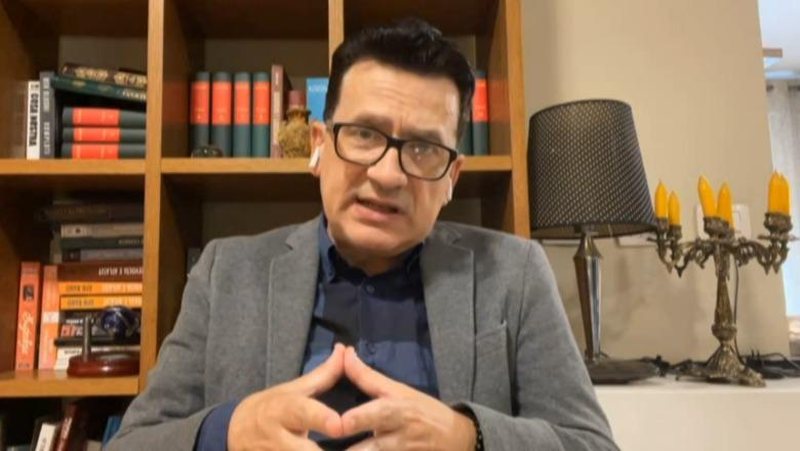
Kreshnik Spahiu, watching from the Repolitix studio on Report TV, had seen enough Albanian political theatre in his career to know what he was looking at. He reached, as he usually does, for the precise word. “The most immoral,” he said.
It was, even by the standards of a week that also produced Sali Berisha’s confirmation that he would seek re-election as PD chairman, a remarkable evening. By the time Spahiu had finished with journalist Denis Minga, he had delivered three separate indictments: one statutory, one political, one historical. Together, they formed something close to a complete anatomy of what ails the Albanian opposition.
The Statute Argument
Berisha made his announcement that afternoon, answering reporters with characteristic confidence. Of course he would run for the PD chairmanship in the May 23 internal vote. What kind of a question was that.
Spahiu’s response was to open the party statute.
His case rests on what he calls the “Basha article” — a provision written into the Democratic Party’s rules in the aftermath of Lulzim Basha’s leadership that conditions eligibility for the chairmanship on having won elections. The logic of the provision was straightforward: a party leader who loses should step down, and the statute encodes that expectation.
Berisha, Spahiu argues, cannot clear this bar. Not because he lost — Berisha and his allies have spent months insisting that May 11, 2025 was stolen — but because claiming manipulation is a different thing from claiming victory. “Not a single Democrat says Berisha won the elections,” Spahiu said. “They say there were manipulations, but in no case is anyone certain that PD won.”
The trap is of Berisha’s own making. If May 11 was a farce, as he insists, he cannot claim the mandate that would make him eligible. If he claims the mandate, he concedes the legitimacy of the result he has spent months contesting. The “Basha article” closes either door.
Spahiu’s advice to the other candidates now in the race — Ervin Salianji, Evi Kokalari, Alesia Balliu, all of whom announced within the same twenty-four hours — was unambiguous: do not enter while Berisha is on the ballot. Seek an injunction. He noted that Albanian courts have precedent from four smaller party disputes involving the unlawful election of leaders, and that since party statutes are approved by Albanian courts, the judiciary has clear standing to enforce them.
Whether anyone will follow this advice is, for now, another question. Sources close to Salianji indicate he intends to run regardless. Berisha dismissed the statutory question with characteristic finality — the “Basha article” needs no revision, he said, because May 11 “was a farce.”
He appeared not to notice the circularity.
The Iran Double-Game
The second indictment is harder to dismiss, because the sequence of events is simply a matter of record.
When parliament convened to vote on the Iran resolution, the Democratic Party group was absent. No votes in favour, no votes against, no abstentions. An empty row. Then, within the hour, the same politicians walked to party headquarters and held a press conference announcing their own designation of Iran as a terrorist-sponsoring state.
For Spahiu, this was not tactical confusion. It was a window into something structural — the gap between what Albanian politicians do in the rooms where it counts and what they say in front of cameras. “PD in parliament is with Iran,” he said. “At the party headquarters, it is with the United States.”
He extended the critique to the Socialist majority as well, describing their support for the resolution as a performance of loyalty toward Washington — noting, with evident dryness, that Donald Trump would in all likelihood never learn that the Albanian parliament had passed it. But the sharper edge remained directed at PD. Having an anti-American position can occasionally be principled, he allowed. The problem is something else: the performance of two incompatible positions simultaneously, calibrated for two entirely different audiences.
“This double-faced position is the most immoral,” he said. No qualifier, no hedge.
Thirty-Six Years of Ambassadors
The third thread is the shortest, and in some ways the most revealing.
Berisha had attacked Silvio Gonzato, the head of the EU delegation in Tirana, calling him Edi Rama’s personal lawyer in Brussels — a man who, Berisha claimed, misrepresents PD’s positions to European institutions. The EU delegation responded to Report TV with four words: “We don’t comment on speculation.” The exchange had the quality of a dispute that has happened before.
Because it has. Spahiu placed it in a sequence stretching back to the early 1990s — the same attacks, directed at the American and European ambassadors of multiple generations, whenever they failed to deliver what Berisha needed. Former US Ambassador Vlahutin, he recalled, was accused of buying villas and called a prostitute. The current attack on Gonzato was, by those standards, relatively mild.
“Fatkeqësisht” — “unfortunately” — is the word Spahiu used. Not outrage, not surprise. Something closer to a diagnosis repeated so many times it has become resigned.
A Note on the Source
Kreshnik Spahiu is not a disinterested observer, and he would likely not claim to be.
He is, depending on how you count, at least three things: a lawyer; a former vice-president of the High Council of Justice who resigned in 2012 after what he described as the “capture of justice by the majority” — forced out, by his account, after clashes with the ruling Democratic Party over corrupt judges; and the founder of the Red and Black Alliance, a nationalist political movement that found audiences in the diaspora but never broke through electorally, and has since receded into commentary.
His critique of Berisha is genuine. It is also not without its own alignment. A weakened, divided, constitutionally contested PD is not merely a problem — it is, for those who want Albanian politics to reset, a precondition for something else. When Spahiu says Berisha’s re-candidacy “pleases only Edi Rama,” he is articulating a view widely held in Tirana’s political establishment. He is also the one who says it on television, which has always been its own kind of political position.
None of this invalidates the statutory argument. The “Basha article” either applies or it does not, and that is ultimately a question for Albanian courts, not for Monday night television. But Kreshnik Spahiu has spent three decades making arguments that are legally precise, politically pointed, and timed for maximum effect. He knows when a statute has teeth, and he knows when to bite.
Monday was one of those evenings.
Aurel Cara, an engineer by training, is devoted to writing on the policies and events that shape Albania’s EU trajectory.