The disinformation flooding Albanian feeds is not an argument about a resort. It is the ground a hostile state prepares before someone moves, and a former Secret Service agent has read this file before.
Robert Ferguson
In November 2024, the Justice Department unsealed something that should have stopped the country cold. An operative of Iran’s Revolutionary Guard had been tasked with drawing up a plan to assassinate the president-elect of the United States, on American soil. Not a soldier, not a defector, but a man weeks away from the Oval Office. The same network had been directed to surveil two Jewish Americans in New York and offered half a million dollars to murder one of them. It was not a first. Two years earlier, the Department charged a Guard member in a plot to kill a former National Security Adviser, with a former Secretary of State named as the second target. For years before that, the regime had been trying to kidnap and kill an American journalist in Brooklyn for the offense of telling the truth about Tehran.
I spent my career on the other side of files like those: doing the advance work, standing the post, thinking for a living about how a hostile state turns a name into a target. So when I watch what Iran is doing to Albania this week, I do not see an online squabble. I see advance work.
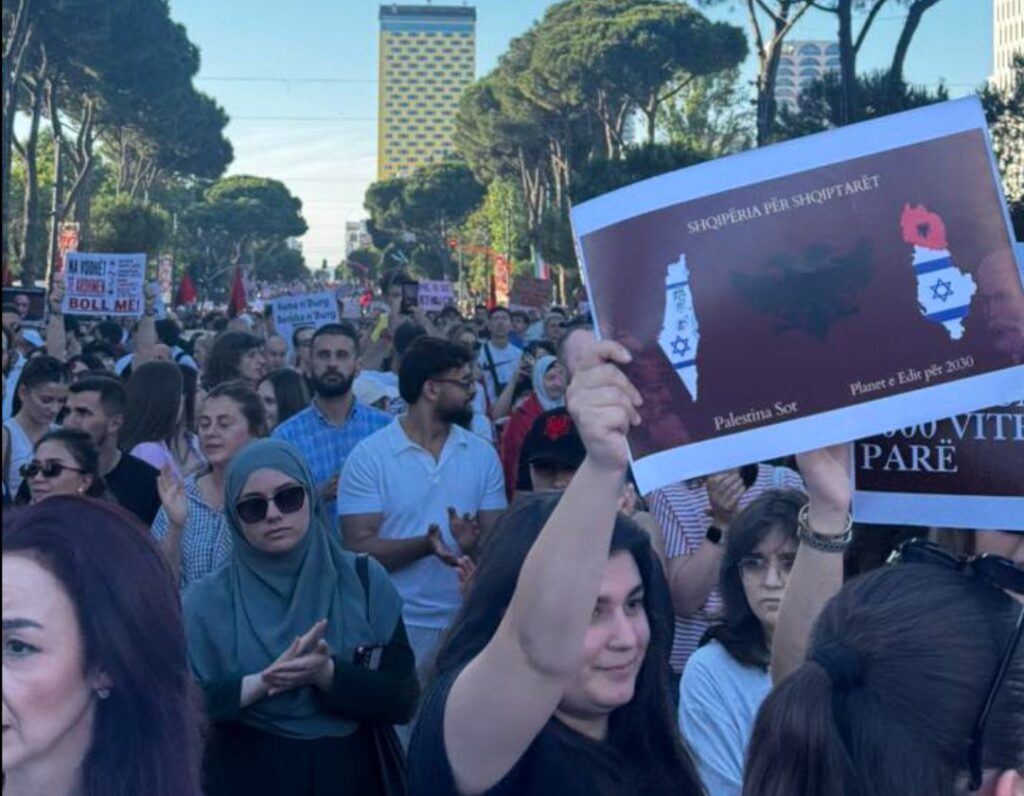
A coordinated campaign is flooding Albanian feeds with one manufactured story: that Albania has been “sold” to the United States and Israel, that its coastline is being “colonized,” that “Jewish billionaires” must be driven from the capital. The images are fabricated. The accounts carry the branding of Iran’s own military. Albania’s prime minister has named it for what it is, a hybrid-war disinformation campaign against his country, and on this point the threat picture and the politician agree.
There is, I should say plainly, a genuine dispute buried under the lie: a coastal resort project tied to Jared Kushner, the president’s son-in-law, real questions about a protected lagoon, an open corruption inquiry by Albania’s own prosecutors. Albanians can protest every bit of it. That is their right and none of my concern. What is my concern is the operator standing behind them in the dark, pressing a far uglier script into their hands than the one they showed up with.
Why Albania? In my line of work you ask two questions: who benefits, and who holds the grudge. This is the small NATO country that gave refuge to the Iranian regime’s most committed opposition, and that in 2022 became the first nation on earth to cut diplomatic ties with Tehran over a state-sponsored cyberattack, embassy emptied inside a day. Iran does not forgive that. And today Albania hands Tehran an irresistible frame: a single image that ropes together the American president, his family, and Israel into one villain. For a regime at open war with the United States and Israel, reeling from the killing of its supreme leader and unable to so much as produce his successor in public, desperate to put points on the board somewhere, that is not coincidence. It is opportunity, and they are taking it.
Here is what the threat files taught me that a policy paper will not. Iran’s online demonization is never merely talk. It is the soft front edge of a campaign whose hard edge is a man with a weapon. In all my years I never saw a state dispatch someone to kill a person the public regarded as a neighbor. First the target has to be made into something else: a colonizer, an occupier, a thief of nations. The narrative is not decoration; it is the permission slip. By the time an operative, a recruited proxy, or a self-radicalized stranger finally moves, the ground has been prepared in public, for months. That preparation is precisely what is being laid in Albania now: not against a building, but against the human beings the story paints as enemies, and against the trust between Albania and its Western partners that Tehran would love to see collapse. Closing that gap between rhetoric and a rifle was my job for decades. I am telling you it is being widened on purpose.
I served administrations of more than one party, and I will say what the people who do this work understand in their bones: the threat does not check your voter registration. An Iranian plot against a president-elect is not a Republican problem, any more than a plot against a journalist in Brooklyn is a Democratic one. This is a homeland problem and a sovereignty problem, Albania’s and ours alike, and anyone who treats it as a partisan football is performing a kind of unilateral disarmament.
So to the Albanians sharing these images in good faith, I’ll put it the way I’d brief it. I am not asking you to abandon your cause. I am asking you to notice whose hand is on your shoulder. The regime feeding you that picture of flags planted in Vlora is the same one that hangs its own citizens from cranes and sends killers across borders to silence its critics. When you forward the image, you are not standing post for Albania. You are doing the advance work for Tehran, for free.
I read threat assessments for a living. This is one. I would advise treating it like one.
Robert Ferguson served eighteen years as a U.S. Secret Service Special Agent, from 1980 to 1998, and has since led international threat-assessment and corporate security work, including protective operations for a private principal. He writes here in a personal capacity.