by Marinela Pole (Tirana)
Albania’s Ombudsman monitored Sunday’s opposition protest across its full itinerary, visiting hospitals and police stations, receiving a complaint of police violence from a detained protester, and calling on security forces to exercise restraint and transparency over the protocols governing tear gas deployment. The institution said at least 12 adults were detained and four minors released after questioning. A detailed report will follow the conclusion of its administrative investigation.
The statement is a partial record of a violent afternoon.
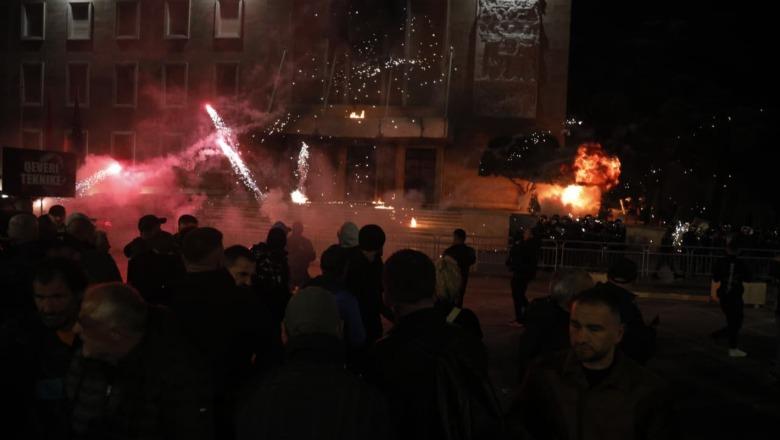
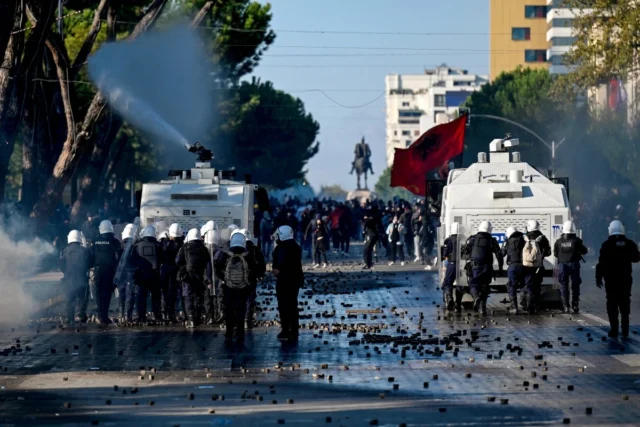
What the Ombudsman did not document, and did not mention, is that police officers have been injured at every major protest in this cycle. On January 25, authorities reported 11 officers wounded. On February 10, the figure rose to 16. On February 20, more than 30 protesters were arrested, an opposition MP was among those injured, and tear gas drifted into the Democratic Party headquarters and the capital’s main mosque, drawing criticism from opposition figures and civil society alike. On Sunday, demonstrators threw Molotov cocktails at ministry buildings and police vehicles before authorities deployed tear gas and water cannons. Clashes spread from the Prime Minister’s Office to the AKSHI building, the Tirana Municipality, nearby ministries, and the Socialist Party headquarters. The number of officer injuries from Sunday has not yet been confirmed by authorities.
The Ombudsman’s mandate is to monitor state conduct. That mandate does not require it to defend the government or sympathize with the Democratic Party. It does require it to account for what actually happened. When an institution charged with documenting a confrontation records one complaint from one side while saying nothing about a documented pattern of officer injuries across four consecutive protests, it is not being neutral. It is being selective.
The statement’s call for police “restraint and professionalism regardless of the dynamics of the protest” is not wrong on its face. The question of proportionality in tear gas use is legitimate and deserves scrutiny. But that call lands differently when issued in a vacuum, with no acknowledgment that officers have been receiving Molotov cocktails, stones, and pyrotechnics for three months. Restraint is a reasonable standard to hold the state to. It is not a complete account of events.
The detailed report, when it arrives, will be the real test. If it documents use of force protocols, proportionality questions, and the treatment of detainees while also accounting for the conditions under which officers operated, it will be a serious contribution. If it reproduces the logic of Sunday’s statement, it will tell us something important about the institution itself.
Marinela Pole writes on hybrid warfare, influence operations, and state resilience in the Western Balkans.