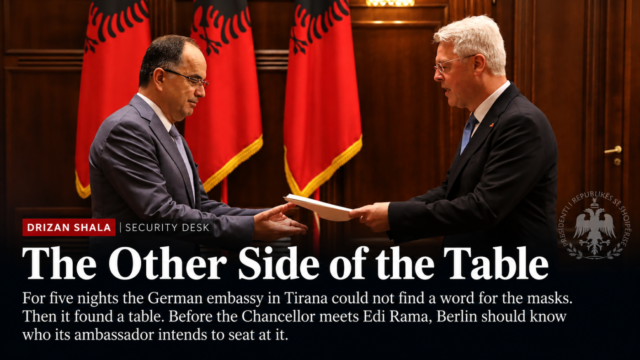
Washington’s Balkan calendar prices uncertainty. Albania has none to sell.
by Albatros Rexhaj (Tirana)
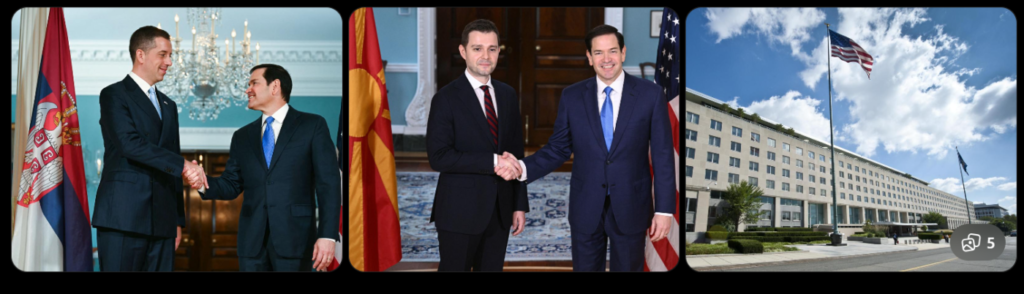
Go to state.gov and search the spokesperson’s releases for the three Western Balkan foreign ministers who matter to this story. For Skopje you will find a readout dated 29 May 2025: Secretary Rubio met North Macedonia’s Timčo Mucunski, discussed trade and investment, and pressed the five percent defence target. For Belgrade you will find a joint statement dated 17 July 2026: Secretary Rubio and Marko Đurić led the first U.S. and Serbia Strategic Dialogue, energy memorandum attached. For Tirana you will find a line in the public schedule of 6 February 2026: at 8:30 in the morning, Under Secretary Hooker met Albania’s foreign minister at the Department, closed press.
That is the whole record. The Secretary for the country that buys Chinese air defence, the Secretary for the country negotiating a trade deal, and the third-ranking official, before nine, for the NATO ally. I write from Tirana, but I have spent enough time around the American policy process to know that a State Department calendar is a price list, and to read one. What I want to do here is read the prices, and then say why an ally should refuse to be on the list at all.
The ledger
Start with what Albania brought, because a Washington reader will assume the answer is “not much” and the record says otherwise.
A NATO member since 2009 that hosts what State’s own country strategy calls the first long-term American military presences on its soil. A Security Council member in 2022 and 2023 that co-held the pen with the United States on Ukraine. The country that took in more than 2,000 Afghans in August 2021 when the airlift needed somewhere to put them. A candidate the European Commission has scored at one hundred percent alignment with EU foreign policy declarations and sanctions every year since 2017, which for a Washington audience translates as: every Russia sanction, no exceptions, no lobbying for carve-outs.
Then the Trump-era ledger, which is the one this administration reads. Albania signed the Charter of the Board of Peace on 21 January, the day before the Davos ceremony, and its parliament ratified it on the 22nd. State’s depositary table records Albania’s consent to be bound on 25 February, ahead of Hungary and Indonesia. It was one of two Western Balkan signatories, with Hungary and Bulgaria the only EU members to sign. On 28 April, with the American ambassador to Greece in the room, Tirana signed a twenty-year agreement to buy American liquefied natural gas through Venture Global and Aktor, put by the ambassador at about six billion dollars, feeding the Vertical Corridor that Washington wants for its LNG. Kimberly Guilfoyle called Albania that day “a steadfast partner of the United States and a country of extraordinary strategic importance.” In December 2024 the government’s strategic investment committee granted strategic-investor status to a firm affiliated with Jared Kushner’s Affinity Partners for a 1.4 billion euro resort on Sazan, with a second project at Zvërnec.
And the cost of that ledger, which is real and worth stating precisely. One part was imposed from Brussels: the Commission told Tirana the Sazan project could affect accession, and construction is suspended pending an environmental assessment. One part is domestic: the special prosecutor’s office has a file open, and the protests that began on the Vlora coast in June have not stopped. The third is only reputational, so far: commentators in Brussels have read the Board of Peace signature as a conflicting signal from a candidate. Three different bills, all of them arriving because of choices made with Washington in mind. It would be strange if Washington did not count them at all.
What the calendar prices
It does count them, and here is how. In May the State Department sent Congress its report on Western Balkans policy. The document says the administration “plans to hold 2026 dialogues with North Macedonia and Serbia.” It says market access is foundational. It names the reciprocal trade negotiations with Skopje and Belgrade and describes State working with the Development Finance Corporation, the Export-Import Bank and the Trade and Development Agency to close investment deals. It lists China and Russia as malign actors exploiting instability, corruption and weak governance in the region.
Read the two dialogues against that text. North Macedonia’s second round on 7 April produced an LNG memorandum, five million dollars from DFC to restart antimony mining, a one-stop shop for American business and an invitation into the Three Seas Initiative. Serbia’s first round on 17 July produced an energy memorandum, an American welcome for the Đerdap III dam, a fifty-million-dollar EXIM guarantee for Telekom Srbija’s 5G network with “trusted suppliers,” and a Serbian request to buy American defence articles.
So ask the question Tirana keeps asking in private and I will ask in print. What does Marko Đurić bring to the seventh floor that Albania’s minister does not?
The honest answer is uncertainty. Serbia might buy the Chinese HQ-9 or might not; its president announced in June that it will. It might normalise with Kosovo or might not. It holds an oil company under American sanctions, leverage over Bosnia’s stability through Banja Luka, and a channel to the White House that predates the Secretary. Every one of those is a lever. Washington likes levers. A Strategic Dialogue is what it costs to get a hand on one. Skopje’s uncertainty is smaller, same kind: a government to anchor, a trade deal to open, and a five percent pledge to display at the next summit.
Albania has none of that to sell. There is no China to pull it away from, no Russian energy to wean it off, no wavering to reward it for ending. In a calendar that prices uncertainty, the ally who has already decided has nothing left to trade. Nobody in the building calls this ingratitude. They call it prioritisation. The effect is the same: the instrument spends itself on the hedger and books the ally as a sunk cost.
From Tirana the asymmetry is hard to miss. From Washington it may look like scheduling.
The test Albania passed anyway
There is an easy argument available here, and Washington would be right to ignore it: allies deserve gratitude. Gratitude is not a foreign policy. So use Washington’s own price instead.
So take the transactional rule at face value and apply it. The May report’s currency is American energy, American investment, and access to American markets. Albania signed a six-billion-dollar LNG deal with the administration’s own ambassador present. It granted a firm affiliated with a Trump-family fund strategic-investor status for Albania’s largest island, undeveloped since the base closed, the designation under Albanian law that unlocks expedited permits and state participation in the project. It ratified the President’s signature international project inside a day. By the administration’s own pricing, Tirana paid. In April. Three months before Belgrade’s round.
There is still no date for a second U.S. and Albania Strategic Dialogue. The first, and only, was held on 25 October 2022 under the previous administration, and was announced then as an annual mechanism. Albania’s own embassy website still lists it as the sole entry.
That is the finding. Albania met the transactional price and the meeting still did not come. Transactionalism explains why Washington spends its time on countries it needs to persuade. It does not explain why reliability buys no institutional access at all. Which is a defensible choice, if someone in the building has decided to make it. It is not a defensible thing to leave unsaid to an ally who has just bought six billion dollars of your gas.
Why we refuse the price
The Secretary’s hours are finite. Belgrade’s choices matter more immediately to the region’s stability than Tirana’s. An instrument built to pull hedgers toward Washington will be spent on hedgers. On efficiency alone, the calendar makes sense.
But the calendar teaches. Serbia’s president watched Washington launch a Strategic Dialogue with him six weeks after he had announced a Chinese long-range missile purchase. Whatever lesson he drew, every capital in the region can read the sequence for itself, in the same readouts I read. The instruction they contain is that alignment is discounted and ambiguity is rewarded, that the way to the Secretary’s office runs through a Chinese arms fair. Keep paying the premium and eventually every capital learns to manufacture uncertainty. Washington will have built a region of negotiators where it thought it was building a region of allies.
Americans used to know this better than anyone. The durable alliances of the last century worked because the underlying commitment was not repriced at every meeting; what could not be bought could not be outbid. The moment an alliance has a price, it has a market, and Beijing is a buyer with deeper pockets than the Export-Import Bank. Albania can pay, and has. We refuse the transactional logic for a different reason: a bought alliance belongs to whoever pays next.
What would fix it
A meeting bought with six billion dollars of gas, or with an island, or with a signature at Davos, would fix nothing; a Dialogue on those terms would be the transactional logic winning with Tirana’s help. The case is the opposite one: access to the Secretary has to carry institutional value for reliability itself, on a schedule that does not depend on what a capital has recently sold or recently threatened, or Washington will keep paying that access out as the premium on unreliability, and the region will keep learning the rate.
Washington needs no new mechanism; it has an old one it stopped using. The 2022 Strategic Dialogue was announced as annual. Holding it annually, with a readout, for every ally that has already chosen, costs the Department a morning each and withdraws the discount in one stroke. Not holding it is also a policy, and everyone between the Adriatic and the Danube is reading it.
From the one capital in the region that has nothing to hedge with, take this as a warning about what the others are being taught.
Albatros Rexhaj is an author, playwright, and analyst with a background in national security studies and nearly three decades of experience in political and security affairs.