How Europe talks to Serbia about reforms it never demands.
by Elmi Berisha (New York)
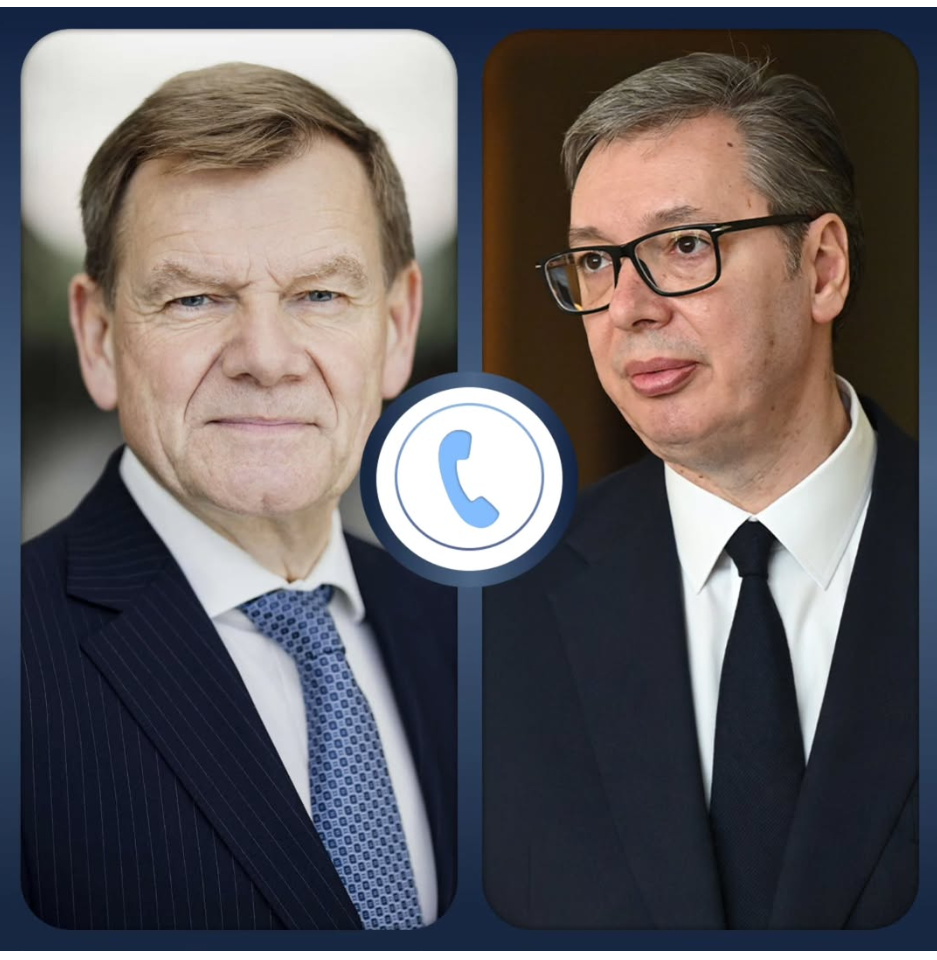
Aleksandar Vučić posted about the phone call on Instagram, as he always does after these calls. He had listened carefully to the German foreign minister’s concerns, he wrote. Serbia would work hard on reforms. Especially in the rule of law.
Johann Wadephul said nothing publicly that suggested he found any of this insufficient.
This is what the European reform conversation with Serbia looks like in March 2026. It looked the same in 2023, and 2020, and 2017. A call. A post. A promise. No cost for breaking it.
Serbia opened EU accession negotiations in 2014. The rule of law chapters, 23 and 24, are the load-bearing columns of the entire structure. They were designed to be opened first and closed last, a sequencing lesson drawn from the pre-2004 enlargement, when countries joined before their democratic foundations were real. More than a decade later, neither chapter has been provisionally closed. The European Commission’s annual progress reports have recycled the same language with the reliability of a printing press: some progress, limited progress, concerns about judicial independence, concerns about media freedom, concerns about anti-corruption enforcement.
The concerns are never resolved. They are carried forward to the next report.
What Serbia has delivered in return is paper. Action plans. National strategies. Reform roadmaps. The Venice Commission has noted, with the careful language of an institution that cannot afford to be ignored, that executive influence over the courts remains structurally embedded. Reporters Without Borders has noted, less carefully, that press freedom has moved in the wrong direction. OSCE election monitors have written, mission after mission, about the abuse of state resources, media capture, and the absence of genuine political competition.
Vučić reads these reports. He has read every one of them. He posts on Instagram anyway.
To understand why this continues, look south, and then ask why Berlin looks away.
Albania opened accession negotiations in 2022, eight years after Serbia. It is already moving through clusters at a pace Serbia has not matched in a decade. The first cluster, the one covering rule of law, is the hardest. SPAK prosecutes sitting and former ministers. The vetting process removed a substantial portion of the judiciary. The difference between Serbia and Albania at this stage of the process is not one of degree. It is one of category. Serbia has produced strategies. Albania has produced facts.
Serbia has no equivalent institution. No equivalent process. No equivalent track record. The Commission’s own reporting reflects this. The language is careful. The conclusion is not.
Germany knows this. Wadephul knows this. The asymmetry in how Berlin handles Tirana versus Belgrade is not a function of what the evidence shows. It is a function of a calculation, made and remade at every level of the German foreign policy establishment, that Serbian stability is worth more than Serbian compliance.
That calculation may be defensible as realpolitik. It is not defensible as enlargement policy. What it produces is the sustained willingness of the EU’s most powerful member state to accept Serbian promises as a substitute for Serbian performance. The Commission sets the standards. Germany decides whether they apply.
In 2018, the European Commission published a strategy that named Serbia and Montenegro as potential EU members by 2025. That date has come and gone. No serious person in any European capital believes accession is imminent for either country. What nobody has done is draw the obvious conclusion from the gap between the promise and the reality, which is that the enlargement framework as applied to Serbia is not a process. It is a holding pattern dressed in the language of a process. Countries with geopolitical leverage receive managed engagement. Countries without it receive conditionality. The Western Balkans has read this clearly for years. The lesson it has learned is not the one Brussels intended. Reform is a variable, not a requirement. Strategic ambiguity outperforms institutional delivery. The phone call matters more than the chapter.
Vučić has understood this longer than most of his interlocutors would find comfortable to acknowledge. He has built a political career on the distance between what Europe says it demands and what it is prepared to enforce. The Instagram post after every phone call is not a formality. It is a receipt. Europe calls it a dialogue. The receipt says otherwise.
Elmi Berisha is a prominent Albanian-American community leader and businessman based in the New York area, best known as the President of the Pan-Albanian Federation of America “Vatra”, the oldest Albanian American organization in the United States, founded in 1912.