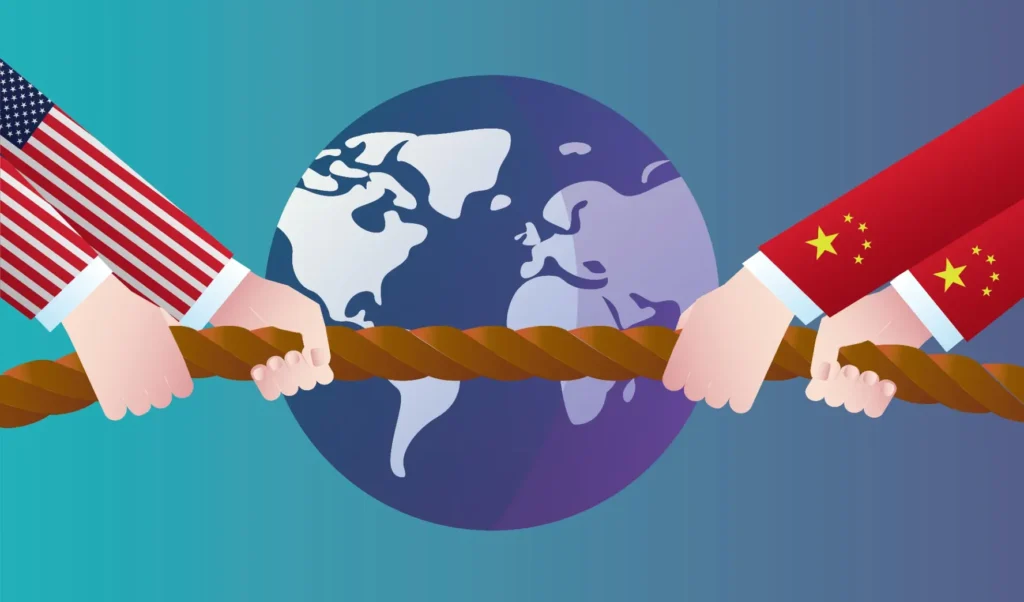
As Brussels reduces dependence on Beijing, candidate states across the Balkans remain embedded in Chinese and Russian strategic networks the accession methodology still does not formally measure. The Balkans are no longer outside the US–China rivalry. The problem is that the EU enlargement system still behaves as if they are.
by Ngadhnjim Brovina (Pristina)
The strategic competition between Washington and Beijing has produced a body of analysis concerned with semiconductors, naval posture in the Indo-Pacific, dollar dominance, and the architecture of global supply chains. The Western Balkans appear in that literature almost not at all. Yet the region sits inside the European Union’s external policy environment, depends on EU accession for its political trajectory, and contains the most developed Chinese economic presence on the European continent outside Hungary. The rivalry has already reached the Balkans. The accession framework has not yet been updated to reflect the fact.
The argument of this analysis is a single proposition. The Union’s de-risking trajectory, codified across the Economic Security Strategy of June 2023, the FDI screening regulation in force since October 2020, the Anti-Coercion Instrument operative from December 2023, the Critical Raw Materials Act of 2024, and successive export control coordination with Washington, has produced a body of policy whose substantive content the enlargement methodology does not translate into accession conditionality. The result is an unacknowledged asymmetry. Candidate states have locked in Chinese economic, infrastructural, and security dependencies during a period in which the bloc they intend to join has been systematically reducing those same dependencies. The methodology continues to assess transposition of the acquis and the quality of institutional reform. It does not assess strategic alignment. The gap will not hold.
The Serbian case documents the asymmetry most fully. HBIS Group’s acquisition of the Smederevo steelworks in 2016 placed one of Serbia’s largest industrial assets under Chinese ownership. The 2018 transfer of RTB Bor to Zijin Mining moved majority control of the country’s copper sector, a commodity that appears on the European Union’s critical raw materials list, to a Chinese state-linked enterprise. The Belgrade and Budapest railway, financed substantially through China Exim Bank and constructed by Chinese state contractors, integrates Serbian transport infrastructure into a corridor whose European terminus, Budapest, has become the principal Chinese industrial entry point into the Union through investments such as the BYD plant in Szeged and the CATL facility in Debrecen. Huawei’s Safe City deployment in Belgrade has installed facial recognition infrastructure whose data governance standards are incompatible with the provisions of the European Artificial Intelligence Act on biometric surveillance. The Serbian armed forces operate the Chinese FK-3 surface-to-air system, the CH-92A unmanned aerial platform, and ancillary Norinco equipment. A bilateral free trade agreement, signed in 2024 and the first such agreement concluded between China and a European state outside the Union, completes the structural picture. The Jadar lithium project, suspended in 2022 and revived in 2024 under European pressure for diversified critical mineral access, illustrates the inverse vector: a project Brussels needs, embedded in a political economy that has otherwise oriented itself toward Beijing.
This Chinese layer sits inside a prior Russian political architecture, not alongside it. The energy core was built first. Naftna Industrija Srbije, majority-owned by Gazprom Neft and Gazprom affiliates, has been the operational link between Serbian fuel supply and Russian state ownership since 2008. That link is currently being severed under American pressure, not European. The January 2025 US Treasury sanctions designation of NIS, after successive waivers expired in October 2025, produced a refinery shutdown by November and a binding agreement signed on 19 January 2026 by which Hungarian MOL, with ADNOC as minority stakeholder, acquired the Gazprom and Gazprom Neft holdings. The outcome is instructive on two levels. The dependency itself was unwound by extraterritorial American statecraft, not by the European instruments nominally designed for this category of risk. And the asset moved into Hungarian ownership, that is, into the political economy of the member state whose strategic orientation Brussels has been least able to discipline. The energy core has changed nominal hands. Whether it has changed strategic orientation is a separate question.
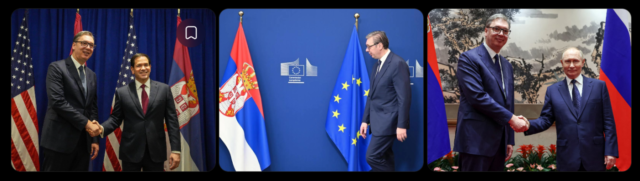
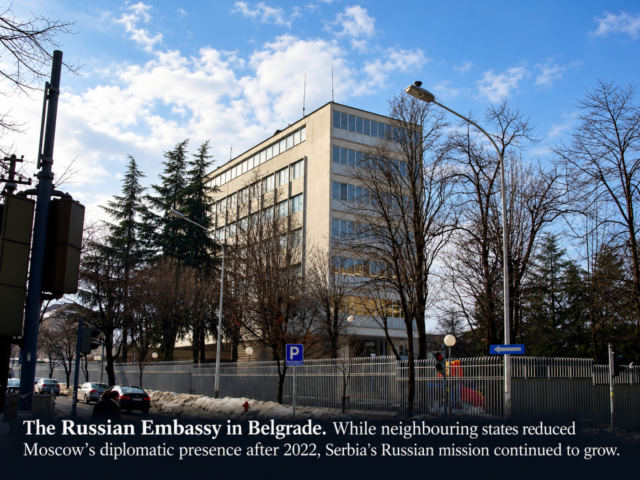
The remainder of the Russian architecture has not been touched by these instruments at all. The diplomatic infrastructure that sustains the five EU non-recognizers’ position on Kosovo runs through Moscow as much as through any other capital, operationalized at the UN Security Council and across Russia’s residual influence in non-aligned states. The security and intelligence relationships that predate the Chinese economic layer continue. The Serbian Orthodox Church’s institutional linkages to the Moscow Patriarchate remain. President Aleksandar Vučić’s January 2026 framing of the international order, delivered to the National Security Council after the United States operation in Venezuela, that “international public law and the United Nations Charter no longer function” and that global affairs are governed by “the law of force,” tracks the analytical framework Moscow has been promoting since 2022. The Chinese economic presence in Serbia thus operates inside a political ecosystem Russia built and continues to maintain. The hedging strategy is not bilateral between Brussels and Beijing. It is at minimum trilateral. The trilateral structure complicates any analogy to Hungary, which retains a distinct historical and confessional matrix and operates within the bloc rather than outside it.
The pattern extends, at reduced density, to other candidate states. Montenegro’s Bar to Boljare highway, financed through China Exim Bank, produced a debt sustainability crisis that the European Investment Bank ultimately intervened to mitigate. North Macedonia’s Kicevo to Ohrid highway, contracted to Sinohydro, has generated similar disputes over cost overruns and arbitration exposure. Republika Srpska has cultivated infrastructural relationships with Chinese contractors in the energy sector. None of these dependencies approach the Serbian density. All of them register on the same vector.
Albania occupies a different structural position again. The Chinese economic footprint in Tirana is materially limited and concentrated in a single sector. Bankers Petroleum, operator of the Patos-Marinza field and the largest foreign investor in the country, passed under Geo-Jade Petroleum ownership in 2016, placing the operator of approximately ninety-five percent of Albanian crude production under Chinese state-linked control. The asset has generated sustained regulatory disputes, including a Competition Authority investigation and a fine exceeding one hundred and twenty million euros, but the strategic content of the case is governance rather than supply security. Albanian crude output is negligible relative to Chinese consumption, and the Patos-Marinza field functions for Geo-Jade as an upstream portfolio investment rather than as a Chinese energy security asset. Beyond this acquisition, the structural picture thins. The Albanian government joined the United States Clean Network initiative in August 2020 and signed a formal Memorandum of Understanding on 5G security with Washington in June 2021, formally excluding Huawei and ZTE from telecommunications infrastructure. Albania has been a NATO member since 2009 and operates fully within the transatlantic procurement and intelligence framework. Strategic alignment with the bloc’s de-risking direction is, in operational substance, the strongest among the Western Balkan candidates.
Albania’s accession trajectory has been treated accordingly. The accelerated processing of the Albanian dossier since 2022, the opening of negotiation clusters, and the public framing of Albania in Brussels as a forward case reflect informal strategic considerations the methodology does not formally codify but in practice accommodates. The constraints on Albanian progression are of a different character entirely. The COELA deliberations on the IBAR assessment, the SPAK institutional dynamics, the Article 242 question on parliamentary immunity, the broader judicial reform trajectory: these are variables the methodology was designed to assess, and is assessing, with the institutional friction such assessment always generates. The Albanian case therefore clarifies the actual operating logic of the framework. Strategic alignment is recognized in practice on the positive side. It is not recognized in practice on the negative side. The framework accelerates aligned candidates informally. It does not slow misaligned candidates informally. The de-risking architecture, which is fundamentally about identifying and addressing risks rather than rewarding their absence, therefore has no institutional pathway into accession decisions at all. It operates only where its absence has already been informally read as a positive indicator.
The European response over the past five years has been substantively coherent on paper and procedurally fragmented in conduct. The Economic Security Strategy identified four categories of risk: supply chain resilience, the physical and cyber security of critical infrastructure, technology leakage, and the weaponization of economic dependencies. The Critical Raw Materials Act set diversification targets that aim, in operational reality though not in legal text, to reduce dependency on China. The FDI screening regulation provides member states with a cooperation mechanism through which Chinese acquisitions in sensitive sectors are reviewed. The Anti-Coercion Instrument supplies the Union with retaliatory tools against third-country economic pressure of the kind Beijing applied to Lithuania over Taiwan in 2021. At the level of legal text, the substantive direction of policy is unambiguous.
At the level of member state conduct, it is not. The Anti-Coercion Instrument has not been used. The FDI screening cooperation mechanism produces national decisions that diverge sharply across capitals on what constitutes a sensitive sector and what threshold of Chinese presence requires intervention. German industrial exposure to China differs structurally from the French declared posture, and the French declared posture diverges from German behavior more than it diverges in legal text. The Italian trajectory, having entered the Belt and Road Initiative in 2019 and exited it in 2023, demonstrates that even formal participation in Chinese strategic frameworks does not produce stable member state alignment. Hungary functions as the operational counter-pole, having absorbed the largest single Chinese industrial investments in Europe and recently acquired the NIS holdings from Gazprom. The bloc’s strategic direction is therefore an artifact of the legal architecture, not of the political reality. Member states have agreed on instruments. They have not agreed on what alignment under those instruments substantively requires.
This is the structural problem the enlargement methodology cannot accommodate. The technical framework reflects the older settlement. Chapter 30, on external relations, and Chapter 31, on foreign, security, and defence policy, contain language on alignment with Common Foreign and Security Policy declarations. The 2020 revised methodology grouped chapters into clusters and introduced the principle of reversibility. It did not introduce a substantive economic security dimension. Chinese investment screening capacity, the presence or absence of Chinese surveillance infrastructure, exposure to Chinese state-linked acquisitions in critical sectors, alignment with European export controls on dual-use technology: none of these are assessed as conditions of accession in the way that judicial reform or anti-corruption performance are assessed. Candidate states are evaluated against the acquis as it stands on paper. They are not evaluated against the strategic environment the bloc has constructed around itself, in part because the bloc has not agreed on what that environment substantively requires of its own existing membership.
The asymmetry produces three diagnostic consequences.
First, Serbia presents the Union with a candidate whose external economic alignment is, in operational substance, inconsistent with the policy direction the bloc has codified for itself. Brussels has two options. It can require Belgrade to unwind significant elements of its Chinese exposure as a substantive condition of progression, which would mean explicitly importing strategic alignment into the methodology, and would in turn require prior agreement among the existing membership on what such alignment looks like in conduct. Or it can absorb a member state whose economic dependencies the bloc has, in its internal policy, identified as risks. The Hungarian case suggests the second option is operationally tolerable for the Union as currently constituted. The recent NIS transfer to Hungarian ownership suggests the arrangement can absorb even Russian-energy assets under sanctions pressure, provided they remain inside a tolerated member state. The Hungarian case also suggests the arrangement is corrosive. President Vučić’s refusal on 13 January 2026 to receive an EU delegation, and the absence of Serbian representation at the 2025 EU-Western Balkans Summit, indicate that the calculation in Belgrade has shifted. It is now expected that the methodology will tolerate the contradiction.
Second, the rivalry has imported into the Balkans a layer of conditionality that does not run through Brussels at all. The American export control regime, in particular the October 2022 advanced semiconductor controls and the October 2023 expansions, operates extraterritorially. Foreign direct product rule extensions reach actors well beyond the United States. The NIS episode demonstrates that American economic statecraft can compel ownership change in a sensitive Balkan asset where European instruments did not. Candidate states that wish to remain inside the transatlantic technology and defence ecosystem face informal alignment expectations whose enforcement mechanism is American, not European. The accession framework formally requires alignment with European foreign policy. The operating environment requires alignment with American economic statecraft. The two requirements overlap substantially. They are not identical. Where they diverge, candidate states have no procedural framework for navigating the divergence.
Third, the Kosovo case illustrates what the absence of Chinese exposure makes possible and what it does not, but it does so through a different mechanism than Albania. Pristina has no significant Chinese investment footprint. The Kosovo Security Force operates within a transatlantic procurement framework. Telecommunications infrastructure has not been built on Chinese vendor equipment at a scale comparable to the Serbian deployment. The informal positive recognition of strategic alignment that has supported Albanian progression does not, in the Kosovo case, translate into comparable movement, because a separate veto mechanism intervenes. The political content of European enlargement decisions concerning Kosovo continues to be determined by the five non-recognizers and by the residual diplomatic architecture of the dialogue with Belgrade, not by the comparative alignment posture of the two candidates. Strategic alignment has not produced accession dividends for Kosovo because the variable blocking Kosovo’s progression is recognition, which sits outside the alignment frame entirely. The framework’s failures are therefore asymmetric. It does not penalize Serbia for misalignment with the bloc’s strategic direction. It accelerates Albania for alignment, informally and without admitting that strategic considerations are doing the work. It does not reward Kosovo for alignment, because alignment is not what is blocking Kosovo’s progression. The framework assesses what it was designed to assess. The strategic environment, and the political environment that surrounds it, have moved past what the framework was designed to handle.
The structural question this poses for European policy is whether enlargement remains a primarily technical exercise, in which candidate states are evaluated against the acquis and admitted when transposition is complete, or whether it has become, in operational substance, a geopolitical instrument that requires geopolitical conditions. The current arrangement attempts to maintain the first formulation while operating inside the second reality, and does so under the additional constraint that the existing membership does not agree on what the second formulation substantively requires. The output is a methodology that produces analytically coherent assessments of variables that no longer carry the strategic weight the framework assumes they do.
For the Balkans, the implications are practical. Candidate states cannot reasonably plan their external economic posture under the assumption that the rivalry will not, eventually, reach the accession dossier. The bloc’s de-risking instruments are not separable from its enlargement framework in the medium term, regardless of whether they are formally linked in the short term. Dependencies accumulated during the unipolar interval, when Chinese investment was treated as neutral capital, will become liabilities under conditions of intensifying strategic competition. The Russian architecture that predates and surrounds those dependencies will become liabilities of a different and older kind. The Belgrade leadership has, to date, calculated that hedging across Beijing, Moscow, Brussels, and Washington produces optimal flexibility. The calculation depends on two assumptions: that the bloc will continue to tolerate the contradiction, and that the contradictions within the bloc itself will prevent any coherent enforcement of alignment. The Hungarian precedent supports both assumptions. The substantive content of European economic security policy does not.
For Albania, the implications are paradoxical. The Albanian dossier has benefited from the informal strategic considerations the framework does not formally acknowledge, and the quality of alignment with the transatlantic posture has visibly shaped the pace of Tirana’s accession movement. This dynamic carries a structural risk. It can conflate alignment with reform in both the Albanian political discourse and the Brussels assessment process. The institutional content of the methodology, the SPAK consolidation, the judicial reform trajectory, the Article 242 question, the broader rule-of-law architecture, continues to operate as the formal terrain on which accession is contested. The informal acceleration produced by alignment does not substitute for that institutional content; it conditions the political environment in which the content is assessed. The strategic dividend depends on circumstances Albania does not control, including the broader trajectory of the rivalry itself and the durability of the transatlantic framework that gives Albanian alignment its current value. The institutional consolidation depends on choices Albania does control. The two timelines should not be allowed to converge in such a way that the first is consumed before the second is complete.
For Kosovo, the structural position is different and unstable in a different direction. Pristina has aligned its external posture with the bloc’s strategic trajectory more closely than several existing member states have. The alignment has not yet been recognized as accession-relevant. The political content of European enlargement decisions concerning Kosovo continues to be determined by the five non-recognizers and by the residual diplomatic architecture of the dialogue with Belgrade, not by the comparative alignment posture of the two candidates. The methodology, again, assesses what it was designed to assess.
What the rivalry has produced in this region is a strategic environment whose central features the European accession framework does not formally measure, and whose central tensions the existing membership has not resolved among itself. The framework was constructed for a world in which the bloc’s external strategic posture and the substantive content of accession were largely separable, and in which the bloc’s internal alignment was assumed rather than contested. That world has ended. The framework has not been rebuilt. The asymmetry will be resolved, eventually, by one of two paths: the formal politicization of enlargement around strategic alignment, conditional on a prior internal agreement that does not currently exist, or the de facto extension of the Hungarian arrangement across additional accession states. Neither outcome is presented in the methodology as currently drafted. Both are visible in the operating environment.
The rivalry, in this region, is not an external phenomenon European policy must respond to. It is an internal phenomenon European policy has already responded to, asymmetrically and incoherently, without acknowledging that the response carries enlargement consequences. The Balkans are inside the rivalry. The methodology has not caught up.
Ngadhnjim Brovina is Assistant Professor of Political Science at the University for Business and Technology (UBT) in Prishtina. His research focuses on international relations, international law, public diplomacy, intelligence and counterintelligence, and peacebuilding in the Western Balkans, with particular attention to Kosovo’s post-independence institutional and foreign policy development.