Belgrade buried a general, Brussels defined a funeral, and a foreign minister explained that everyone is guilty. Tirana is in the audience.
Ngadhnjim Brovina, Regional Affairs
Belgrade buried a general, Brussels defined a funeral, and a foreign minister explained that everyone is guilty. Tirana is in the audience.
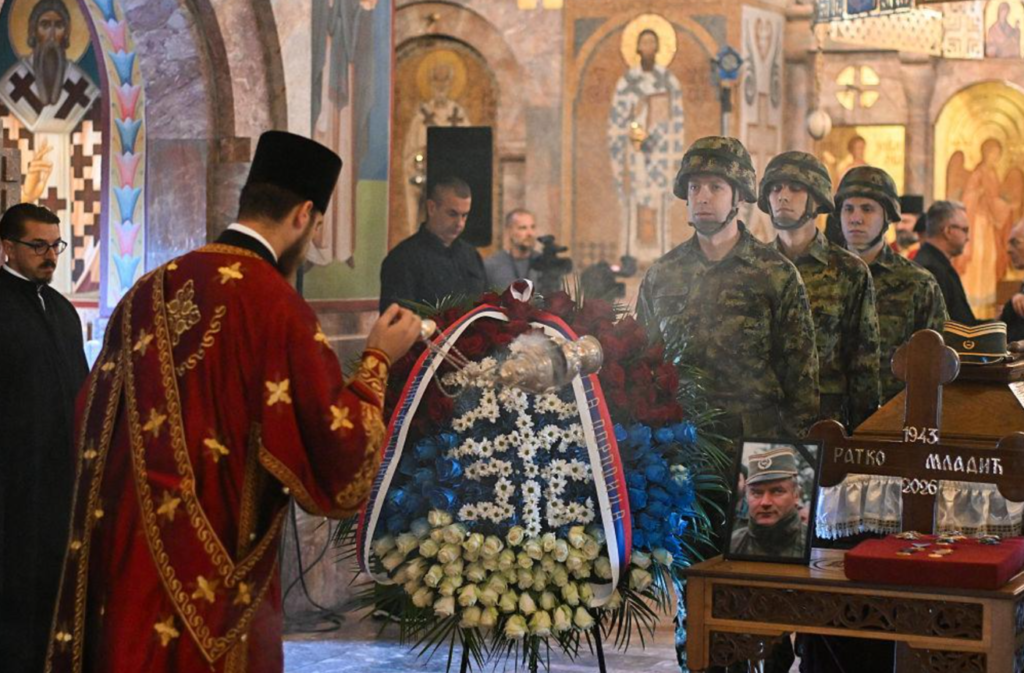
There was no decree. That became Belgrade’s defence before anyone had finished the accusation: Ratko Mladić had not been given a state funeral, Serbia’s president said, and the arrangements belonged to the family.
A Serbian government aircraft brought the body from Rotterdam with the justice minister aboard. Serbian Army soldiers carried the coffin off the aircraft, draped in the flags of Serbia and Republika Srpska. Gendarmerie officers lined along the motorway saluted the convoy as it passed. At the Army House a retired general told the commemoration that the Serbs would be free on the day a poem about Mladić appeared on the first page of a school primer. On Monday five ministers of Serbia’s government went to the church. The Patriarch conducted the rite. Serving soldiers stood around the coffin and carried it out, and an honour unit accompanied it to the grave and fired three volleys. Aleksandar Vučić stayed away; that afternoon his government asked him to dissolve parliament.
So there was no decree, and none was needed. Every act a decree might have ordered was carried out anyway, by the institutions and the officials it would have instructed.
Brussels looked at the same scene and, for a day, managed not to see it. On Monday evening the Commission’s spokesperson said that “we had heard that there was a funeral foreseen with state honor, and that has not been the case”, and, asked about the soldiers, the ministers and the flag, said it was for Serbia to decide how to organise a funeral. Sonja Biserko, from Belgrade, called that one more indulgence of Serbia’s president and said the Commission had become hostage to fifteen years of the same policy. Croatia’s prime minister was less diplomatic: at nine that evening he said a spokesperson’s reaction was not enough. At a quarter past nine the next morning Ursula von der Leyen and António Costa published one text under two names. The images were “shocking”; the “elements of official support” were “regrettable”. Brussels had corrected Brussels.
Little followed the correction. An anonymous diplomat said Cluster 3 was off the table, where it had sat since eight member states blocked it in July. Bosnia withdrew its embassy staff. Washington issued a security alert containing the timetable of events. Twenty years earlier the Union had suspended association talks with Serbia because Belgrade had failed to arrest Mladić. In 2026, after Serbia buried him with soldiers, ministers and volleys, the Union posted.
Belgrade knew what it would say next, because it had been rehearsing all week. Foreign Minister Marko Đurić said Serbia would accept “neither selective justice nor lessons in morality” from those unwilling to face their own past, and named Rasim Delić, the wartime commander of the Bosnian army, convicted at The Hague and buried with military honours in 2010. Serbia’s tabloids had been running Delić since Sarajevo first filed complaints over the glorification of Mladić; by the time the minister used the name, the comparison had been road-tested.
The manoeuvre is old. Put one Hague convict beside another. Remove the scale, remove the charges, remove the findings, remove the war, and keep only the noun. Then declare symmetry. Delić was sentenced to three years for failing to prevent or punish the cruel treatment of prisoners and was acquitted of the killings charged against him. Mladić was sentenced to life, and the first crime listed in his judgment is genocide.
The Hague record keeps particular crimes, particular plans and particular chains of command, and it never issued every side an equal page. The Hague judgments documented organised campaigns of forced removal involving Serb forces in Bosnia, the Krajina and Kosovo. They also found a joint criminal enterprise on the Croat side in Herceg-Bosna, and there is no reason to hide it. In Kosovo the Tribunal found that the army and police of a state executed a common plan of violence and expulsion that drove at least seven hundred thousand Albanians from Kosovo in the spring of 1999. Crimes were committed by forces on more than one side, and the courts said so. What the courts refused to do was turn different crimes into the same crime because more than one community had committed them. That refusal is the equivalence Belgrade now wants the rest of us to supply on its behalf.
This is where Tirana enters a story that at first sight belongs to Belgrade, Sarajevo and Brussels. Albania wants to complete accession negotiations by the end of next year, with membership envisaged by 2030. Every speech made in support of that timetable rests on the same premise: that the European path is a system of conditions rather than a queue, and that the phrase Brussels repeats so often, “the values underpinning the path”, describes something candidates gain by respecting and lose by violating.
Serbia has just tested the premise one border away. Its election is expected in late October. The Commission president’s regional tour is scheduled for the turn of the month, and Brussels has still not said whether Belgrade is on it. The Growth Facility keeps moving money toward candidate governments, half of its six billion euro envelope as loans paid directly into national budgets, while Serbia has taken annual defence spending from below two billion dollars to nearly three in three years, bought fighter aircraft from an EU member state and financed the return of conscription. None of those things alone decides Serbia’s European future, and neither does the funeral. Conditionality, though, exists only where conduct has consequences. If a candidate can place ministers, soldiers and military protocol around the burial of a man convicted of genocide, receive a statement of regret, keep the money flowing and welcome the Commission president a few weeks later, then Brussels has answered a question much larger than Serbia. It has told every candidate what the values cost to violate, and Albania is spending enormous political capital on the proposition that they cost a great deal.
Tirana has already said what it thinks of Mladić himself. On the day he died, Ferit Hoxha called him a brutal murderer convicted of genocide, said his victims must not be forgotten, and recalled that Milošević died in The Hague without facing full justice. That position is on the record, and it is the right one. Nothing this week requires Albania to say more about Ratko Mladić; The Hague settled who he was years ago. What it requires is that Albania watch what Brussels does next, because the question the funeral leaves behind is what Europe means when it tells every candidate that accession rests on values, and whether those values still carry a price when they are violated in full view of everyone.