Ukraine spent four years teaching small nations that principles do not depend on power. On Saturday one of them learned who the lessons were for.
By Kadri Kryeziu (Prizren)
No leader of this century has preached the morality of borders with more force than Ukraine’s president, and none has earned the pulpit more. To the European Parliament in the first week of the invasion he promised that life would win over death and light over darkness. To the American Congress in December 2022 he said their money was not charity. To every audience since, the doctrine has been constant: values are indivisible, neutrality is a side, silence pays the aggressor. The doctrine was correct. Small nations especially believed it, having no other doctrine that protects them.
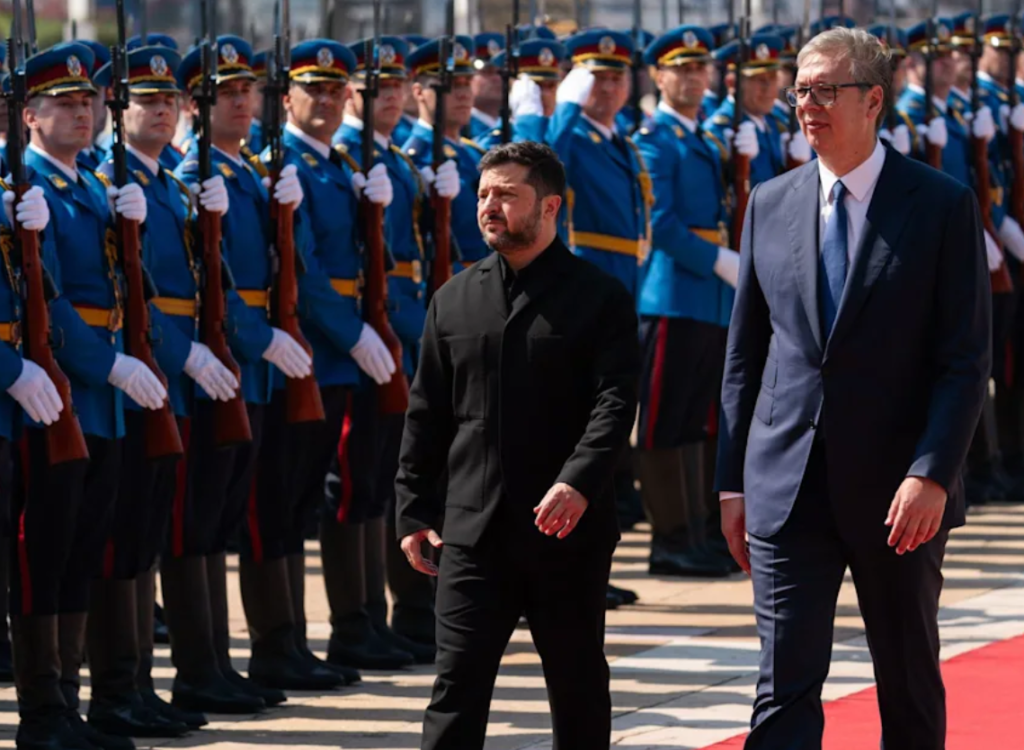
On Saturday in Belgrade the preacher took a question. Serbia’s president had published the condition on Thursday, announcing that Ukraine has not recognized Kosovo and that this must be respected. Asked by RTS whether Serbia’s citizens could count on it still, Ukraine’s president answered, in the translation our desk transcribed: “We respect the territorial integrity of our partners, we respect international law. Therefore, our position on what you said, the unilateral declaration of independence of Kosovo, remains unchanged.” Then the reciprocal clause, gratitude that for Serbia, “Crimea belongs to Ukraine. This position of Serbia is also unchanged, particularly in the UN General Assembly.”
The legal anchor takes one paragraph to remove. The phrase he used is the wording of Serbia’s own referral to the International Court of Justice, and the court’s answer of 22 July 2010 found that the declaration violated neither general international law nor Resolution 1244. Ukraine may withhold recognition for as long as it chooses. What it cannot do is present that choice as obedience to a law that cleared the declaration sixteen years ago. The law was available. What was respected was the condition.
So set the law aside and apply the preacher’s own standard, since he asked the world to apply it everywhere. The doctrine’s entire content was indivisibility; he divided it, on cue, in the capital that had posted the terms two days earlier, and named the venue where the account is settled. The man who called neutrality a side took one. By his doctrine there is no small version of this. He built the doctrine that convicts him, and it convicts him in his own vocabulary, which was always its power.
We were not betrayed on Saturday. Betrayal requires a promise, and none was ever made to Kosovo. What Saturday clarified is narrower and colder. The sermons were addressed to the nations that could arm him. The silence is for the nations that merely believed him. A morality that sorts its audience by usefulness is a foreign policy, and it was a foreign policy all along. The difference is that until Saturday, believing otherwise cost us nothing. Now we know the price of the pew.
Prof. Kadri Kryeziu is a constitutional law expert and co-drafter of the Constitution of the Republic of Kosovo. He served as First Vice President of Kosovo’s Constitutional Court (2009–2015) and is the publisher of The Kosovo Dispatch