Albania’s rapid progress has shifted EU enlargement from a question of readiness to a calculation of political cost, making delay harder to justify inside the Union. On Tuesday, the European Parliament’s Committee on Foreign Affairs endorsed the 2025 report on Albania by a wide margin, a routine procedural step that carries a less routine implication. For the first time in this file, the Parliament has effectively confirmed that Albania’s EU path is no longer defined by what it promises to deliver, but by what it has already accumulated: pace, alignment, and institutional confidence. The debate about whether negotiations can close by 2027 will continue. But the more consequential shift has already occurred. Albania has moved far enough, fast enough, to change the terms on which its accession is judged.
by Aurel Cara (Tirana)
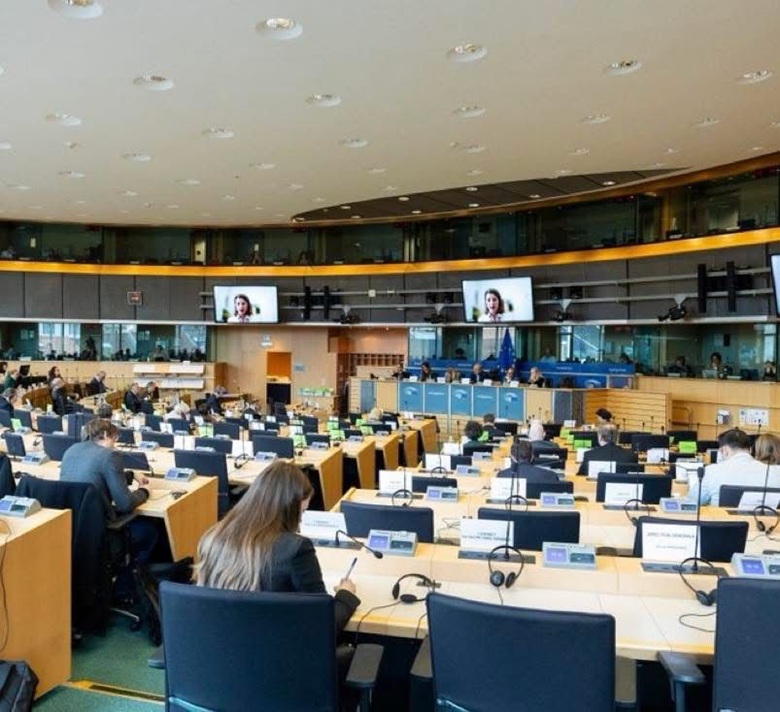
On Tuesday, the European Parliament’s Foreign Affairs Committee adopted the 2025 report on Albania by 58 votes to 7, with 7 abstentions. The rapporteur was Andreas Schieder of the S&D group; the shadow rapporteur Andrey Kovatchev sits with the EPP; the chair, David McAllister, is also EPP. The drafting carried cross-group cover before the vote was held, and the vote ratified the cover. None of this is unusual procedurally. What it captures is the first moment in the Albania file at which the Parliament has confirmed, in writing, that the trajectory has become the substance.
The temptation, in Tirana and abroad, is to read the report as a verdict on the 2027 closure ambition. That is the wrong frame. The 2027 date is a government aspiration that may or may not survive contact with the Council, with the German federal cycle, with whatever shape French enlargement policy takes after the next legislative round. The aspiration is contingent. What has been built underneath it is not. It has already happened, and it is the asset.
Begin with the pace. Albania opened every cluster of accession negotiations between 15 October 2024 and 17 November 2025: thirteen months, six clusters, every chapter on the table. No candidate in the modern history of enlargement has moved through that procedural gate at that speed. Montenegro, which began its accession process nine years earlier, has not closed it. North Macedonia remains paralysed by bilateral dispute. Serbia has spent the period in question moving away from the EU rather than toward it. Albania has done the opposite, on a clock that is faster than the Commission expected and faster than the Council was prepared to accommodate. This is the first case in modern enlargement in which a candidate’s procedural acceleration has outpaced the Union’s political absorption capacity, and that asymmetry is itself a reform of the system, not a reward inside it. The Union does not enlarge on promises. It enlarges on habits that have already become irreversible, and pace, sustained over thirteen months, is a habit.
The political conditions that produced Tuesday’s report matter as much as the content of the report itself. Schieder is the rapporteur most likely, in the present configuration of the European Parliament, to write Albania a sympathetic resolution; Kovatchev is the shadow rapporteur most likely to sign off without forcing dilution; McAllister is the AFET chair least likely to allow the file to be slowed by procedural friction. The cross-group alignment around Albania, S&D drafting and EPP shadowing under EPP chairmanship, is the structural condition that lets the file move without ideological cost. Most enlargement files do not have this. Serbia does not. Georgia does not. Even Ukraine generates more group divergence in committee than Albania’s vote produced. The alignment is broad and durable, and durability is itself an asset.
Then there is the foreign and security policy dimension. Paragraph twenty of the resolution commends Albania’s full alignment with the Union’s common foreign and security policy, including restrictive measures, engagement in CSDP missions and operations, and a constructive regional role. The commendation is brief and is therefore easy to overlook. It should not be overlooked. Albania has maintained one hundred percent CFSP alignment through a period in which Hungary has obstructed enlargement votes, in which Serbia has refused sanctions on Russia, in which the broader European consensus has frayed across multiple files. The geopolitical asset of an Adriatic candidate that holds the line on every Council of Foreign Ministers conclusion is undervalued in domestic coverage and is correctly valued in Brussels.
Add the institutional framing. Schieder, in the room before the vote, repeated the Commissioner’s characterisation of Albania as one of the two leading countries in the enlargement process. The Commission’s own communications keep the ranking implicit; Schieder named it on the record. This is a small thing and a large thing at once. It is small because rankings inside the enlargement basket do not determine when chapters close. It is large because the Parliament’s confidence travels, and confidence that travels affects the cost calculus for any member state that wants to slow the file. A government in Berlin or The Hague that decides to drag its feet on Albania now does so against an explicit Parliamentary expectation, not into a vacuum. This is friction reduction, not guarantee. Friction reduction matters.
The path does not enlarge itself, and the conditions under which it can be slowed are not hypothetical. The Council moves on unanimity, which means any single capital can hold the file for reasons that have nothing to do with Albania: a coalition negotiation in Berlin, an electoral cycle in The Hague, a bilateral irritation in Sofia or Athens, an enlargement-fatigue argument constructed in Paris. The North Macedonian decade is the cautionary precedent and does not need to be named to be present. Each of these is a real risk and each is exogenous to anything Tirana controls. What Tirana controls is the cost of using them. The faster, more aligned, and more reliable the Albanian file becomes, the higher the political price any member state pays for slowing it. The trajectory does not eliminate the veto. It raises the veto’s price. That is the system Albania is operating in, and the system rewards the discipline of execution over the noise of advocacy.
The trajectory, then, is the composite of these things. It is the procedural pace, the political alignment, the foreign policy reliability, the institutional confidence. It is what has been accumulated in the period between Albania’s screening completion in November 2023 and the AFET vote on Tuesday. It exists independently of the 2027 closure ambition. It would exist even if the closure ambition were missed. It is the thing the European Parliament has now ratified in writing, and it is the thing worth defending.
Defending it is the work that remains. The conditions are not hidden in the report; they are named. The OSCE/ODIHR electoral recommendations are to be implemented before the next cycle. The conviction track record on high-level corruption is to be consolidated, which is a function of SPAK’s continued institutional independence. The civil service is to be depoliticised through merit-based recruitment. The environmental file is to register movement that the Commission can register. Social dialogue is to be conducted with frequency and seriousness. None of these is rhetorical. Each is tractable inside a year. Each is the price of the asset holding.
The verdict is therefore narrower and more durable than the vote count suggests. The European Parliament has confirmed, on the record, that Albania has built something of institutional value. What was built can be defended. What was built can also be lost, and the difference between the two will not be settled by the Council, by Berlin, or by the next rapporteur. It will be settled in Tirana, by whether the conditions named on Tuesday are met before they are asked again. The trajectory is the asset. The asset is real. Keeping it is a domestic decision now.