European capitals court Belgrade on the standing assumption that the Albanians are the region’s compliant party, endlessly patient, endlessly available, priced at zero. Ferit Hoxha’s statement of 27 July is notice that the assumption has expired.
by Ardit Rada (Tirana)
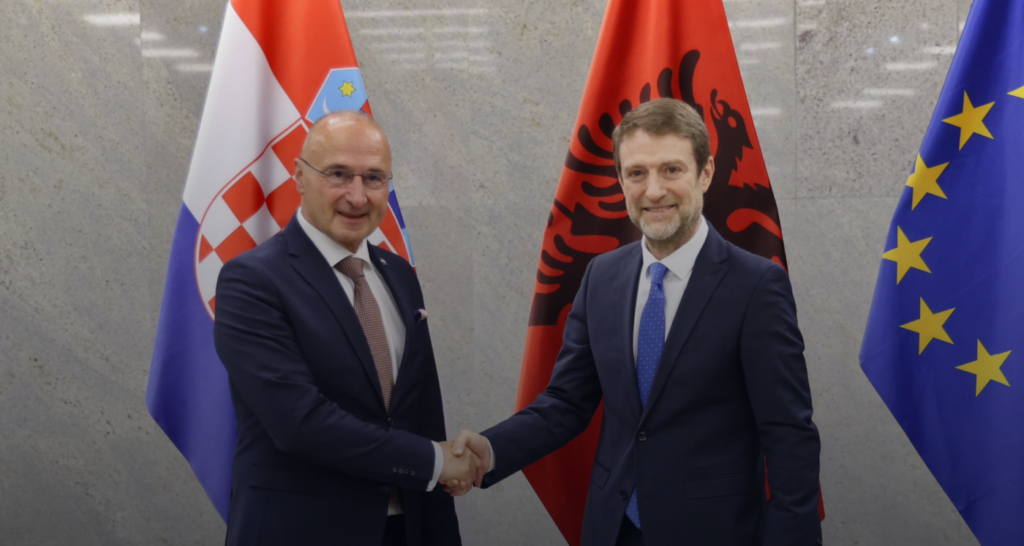
The most consequential sentence Albania’s foreign minister delivered on 27 July was four words of Croatian. “Dobrodošao, Gordane,” Ferit Hoxha said from the podium of his own ministry, welcoming Gordan Grlić Radman, Croatia’s foreign minister, on his second official visit to Tirana in a short span. Greeting a guest in the guest’s own language is an old courtesy of hosts. It is also a quiet display of position. It says the host is at home, unhurried, confident enough to leave his own tongue for a moment because nothing about the occasion threatens him. Everything else in the statement should be read in that key.
On its surface, the readout is the furniture of a good bilateral relationship. A strategic partnership dating to 2018. Plans for a first joint session of the two governments. An economic commission convening in Tirana in October, direct flights between Tirana and Zagreb to be revived, the Adriatic-Ionian gas pipeline, the Albanian diaspora in Croatia praised as a bridge. A foreign ministry could publish such a text any week of the year.
Then, deep in the middle, the register changes. The dialogue between Kosovo and Serbia, Hoxha said, “cannot be built on historical revisionism, the denial of facts, the glorification of war criminals, or on nationalist and divisive rhetoric and unacceptable statements that relativize, justify or lend an echo to war crimes and to policies condemned by international justice and by human conscience alike.” And further on, about the security cooperation Albania and Croatia conduct as NATO allies: such coordination, “bilateral, trilateral or wider,” should “disturb no one, nor be used by anyone, in the region or beyond it, to justify the militarization of country and society, still less to fan the dangerous fires of war and to bring back archaic calls for victory and territorial belonging.”
No country is named in either sentence. None needed to be, but the calendar supplies the address. Days before the Tirana meeting, Serbia’s president, Aleksandar Vučić, presided over the commissioning of the army’s newest officer class at the Military Academy in Belgrade’s Banjica district. His message to the new lieutenants was a promise of “much harder days” and a phrase with a long nationalist pedigree, svoji na svome, our own, on our own land, the grammar in which nation and territory become a single word.
The word “trilateral” has an address too. In March 2025, Albania, Croatia and Kosovo signed a declaration on defense cooperation in Tirana. Belgrade denounced it at once as a provocation and the seed of an arms race, and Russia’s foreign ministry repeated the complaint, which is what “in the region or beyond it” is doing in Hoxha’s sentence. Set beside the commissioning ceremony, the passage stops being general. “Victory” and “territorial belonging” are that ceremony’s two keywords, handed back within the week, wrapped in a diagnosis: “Whoever dreams of a return into the past must understand that in truth he has remained behind, in time and in mentality.”
Belgrade will have understood the message. But the statement’s more important readers sit in Brussels, Berlin, Paris and Rome, and they should read it against an assumption so old it is no longer noticed. European policy in the Western Balkans has long run on a quiet asymmetry. One party is courted, because its defection is priced as a risk: it might turn to Moscow, it might destabilize, it must therefore be kept in the room at almost any cost. The other party is taken for granted, because its loyalty is priced as a given: the Albanians are pro-Western by conviction, have no patron to defect to, and can therefore be asked to wait, to absorb, to accommodate, indefinitely and for free. The logic is not mysterious, and it is not even dishonorable. But it produced a July in which the European Commission recommended opening a new negotiating cluster for a Serbia that openly refuses sanctions alignment, while the reliably aligned states of the region were expected, as ever, to understand. Attention flows to the party that might walk away. The party that never would is billed for the difference.
The assumption has a history, and Europe’s file on Albania was opened in its worst years. In 1997 the Albanian state dissolved in weeks. The pyramid schemes took the savings, the crowds took the garrisons, and a government that could not secure its own arsenals could secure nothing beyond its borders. When Serbia’s war machine turned on Kosovo two years later, the sum of what Tirana could do for the Albanians in its path was to open the border at Morina and make room, nearly half a million people absorbed by one of Europe’s poorest countries, fed in large part by foreign aid. It was a moral achievement and a strategic confession in the same act. Albania could shelter Albanians. It could not protect them. Its diplomacy was a diplomacy of requests. That is the Albania on which the zero price was set. In some capitals, the file has not been updated since.
The 27 July statement is the update, and its most telling feature is what it treats as unremarkable. Albania and Croatia entered NATO on the same day in April 2009 and both now serve in KFOR, the alliance’s force in Kosovo, and in EUFOR, the European force in Bosnia, which means Albanian soldiers stand on Kosovo’s territory under NATO command, a sentence that would have read as fantasy in 1999. The statement discusses Corridor VIII, the Blue Corridor and the Three Seas Initiative and notes in passing that they strengthen “military mobility capacities,” allied logistics described in the tone of a transport annex. It connects the LNG terminals of Vlora and Krk through the planned pipeline, a line about energy that is also a line about a regional energy map drawn without Russia. And it records that Albania closed its first three EU negotiating chapters in Brussels on 14 July, with the technical process targeted to finish by 2027. None of this is announced as achievement. It is furniture. The transformation is complete precisely where it no longer needs pointing out.
Two days before the Tirana meeting, on a Luxembourg broadcast, Hoxha said the merit-based enlargement process “has to work on both ends.” The sentence is usually filed as a candidate’s plea, that reform delivered should be reform rewarded. Read after the statement, it carries a second meaning addressed to the other end. In the same July, one Balkan state closed chapters on its conduct, and another could not assemble the member-state consensus to open them, on its conduct, with Croatia among the governments that withheld it. Merit working on both ends is not only a promise to the diligent. It is a bill to the courted, and Europe’s own calendar has begun presenting it. A policy that continues to price Albanian alignment at zero while paying premiums for Serbian ambiguity is not realism. It is a subsidy, and the statement is a polite notice that the subsidized party’s neighbors have noticed the arithmetic.
Hoxha’s Brussels register has long presented Albania as the diligent applicant, work, work, work, the full package, no menu. The trouble with the applicant’s voice is not its sincerity. It is what it signals: a partner who asks for nothing teaches everyone that he costs nothing, and the eager register has done as much as any European habit to keep the zero price in place. The 27 July text is the other voice. It measures the region from Albania’s own ground, names revisionism and the glorification of war criminals as disqualifying, defends a trilateral defense arrangement without apology, and informs an unnamed but unmistakable neighbor that its dreams have a date problem. The applicant is still present, promising “no pause and no rest” on the road to 2027. But the state is present too, and European readers should register which of the two was speaking when the region’s security was on the table.
They should register something else as well, because the assumption they hold is a softer cousin of one that has failed in this region before, expensively. Through the 1990s, Kosovo’s Albanians under Ibrahim Rugova ran a decade of disciplined nonviolence, parallel schools and parallel institutions instead of armed revolt, and Belgrade read that restraint as incapacity, an absence of options rather than a policy. The misreading invited escalation, and the escalation ended with Serbian forces leaving Kosovo altogether. Reading Albanian calm as weakness is a mistake with a documented record, and it does not improve when made in friendlier capitals with better intentions. Albania’s determination for European coexistence is a choice, renewed daily, by a state that now has other ways to matter. A choice can be honored. It should not be mistaken for permanent acquiescence. Nor is it a natural resource: reliability endures only for as long as it is priced above zero.
One line in the statement is easy to pass over. From the coming academic year, Croatian will be offered as an elective at the Faculty of Foreign Languages in Tirana. A course catalogue entry, a small administrative fact. But hold it beside the greeting that opened the visit, and beside the year 1997, and it becomes a measurement. The state that could not guard its own depots now welcomes its allies in their own language, puts that language on next year’s syllabus, and answers its adversary without raising its voice. The capitals that still keep the old file on Albania should consider this statement a formal request to update it. The weak element of their assumptions no longer exists.