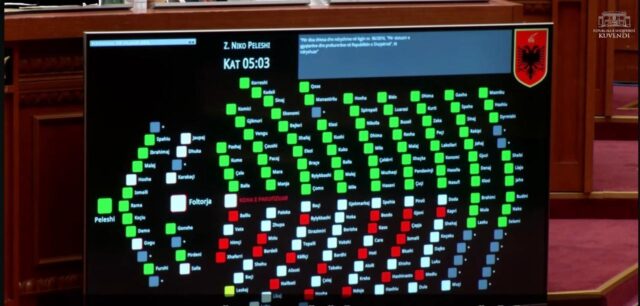
The Constitutional Court gave parliament a duty and the magistrates a fallback. The Judicial Council took a power the judgment gave to no one, and its supporters asked a prosecutor to punish the officials who declined to go along.
By Renada Bici (Legal Desk)
In the first days of September, treasury branches in Kukës and Dibër paid the August salaries of their local judges and prosecutors at the new rate. Every other branch in the country did not. The difference was an e-mail from the Secretary General of the Ministry of Finance, and by the time it reached the districts, two payrolls had already gone through. That e-mail, and the minister’s letter of 2 September that followed it, is what twenty court presidents and the heads of three professional associations brought to SPAK on the 8th, asking that the minister, the Secretary General and the district treasury heads be investigated under Articles 248, 320 and 320/a of the Criminal Code.
The complaint takes care to say what it is not. It “does not seek to replace administrative, judicial or institutional remedies” and does not aim at “pressure on any state institution.” It seeks, in its own words, the identification of whoever “took, transmitted or applied” the decision not to pay.
What was not paid was decision 435 of the High Judicial Council, adopted on 26 August: a reference salary of 222,425 lekë, up from 156,825, applicable from 1 August, with arrears to April 2023. The Council acted because parliament had not. The Constitutional Court, striking down the old formula on 17 February, had given the Kuvend until 31 July to write a new one, and it was precise about why the Kuvend and no one else. Choosing the formula is the legislator’s competence (para 75). The elements and principles of the pay system are fixed by a law of the Kuvend (para 76). Paragraph 109 leaves nothing to interpretation: “it belongs to the Kuvend” to make the changes.
Articles 320 and 320/a punish conduct meant to prevent the execution of a judicial decision and unjustified non-execution by the official charged with carrying it out. Both need a judicial decision to execute. The only one here is 15/2026, whose operative part is an order to parliament and says nothing to the Ministry of Finance. What the Treasury declined to execute was an act of the Council, binding or not, but not a judgment.
Article 248 needs an intentional breach of duty producing the harm the offence specifies. The Secretary General is by statute the First Authorising Officer of the budget system (Law 9936/2008, Art. 18); state payments pass only through the Treasury (Art. 54); where a payment is contested he may suspend it pending verification (Instruction 9/2018, point 35). That provision was written for disputes inside a spending unit, and whether it stretches to the act of an independent constitutional organ is a live question of administrative law, which is where a written suspension with stated reasons belongs. It does not turn into a crime because a judge may one day disagree with it.
On the arrears, the magistrates have the better text.
Paragraph 110 makes the new law’s financial effects run from 1 April 2023 until the law enters into force and provides that, parliament having missed 31 July, the arrears are calculated on the senior-public-official reference from judgment 35/2022. That window is still open; August sits inside it. The ministry has said nothing about this paragraph, and the omission costs it.
Paragraph 110 goes no further. Faced with parliament’s default, the Court prescribed how the arrears were to be calculated and left the salary regime where paragraphs 75, 76 and 109 had put it. Decision 435 fixes the reference salary that governs magistrates’ pay from 1 August onward, which is that regime. A power parliament fails to exercise does not migrate to another organ.
The people asking SPAK to act are the beneficiaries of decision 435. The office they chose is staffed by magistrates whose own pay turns on the same question, and the prosecutors’ association signed the complaint. Naming career treasury officials who followed a written order makes the assurance about pressure difficult to take literally.
The ministry took a shortcut of its own by blocking the Council’s act internally rather than challenging it before the competent administrative court, and it owes an answer on paragraph 110. Neither failing hands the Council a power the Constitution withheld.
Parliament neglected the duty the Court imposed on it, and the Council answered by exercising a competence the same judgment left with parliament. Both are matters for judicial review. Asking SPAK to investigate the officials who refused to recognise the result is not.