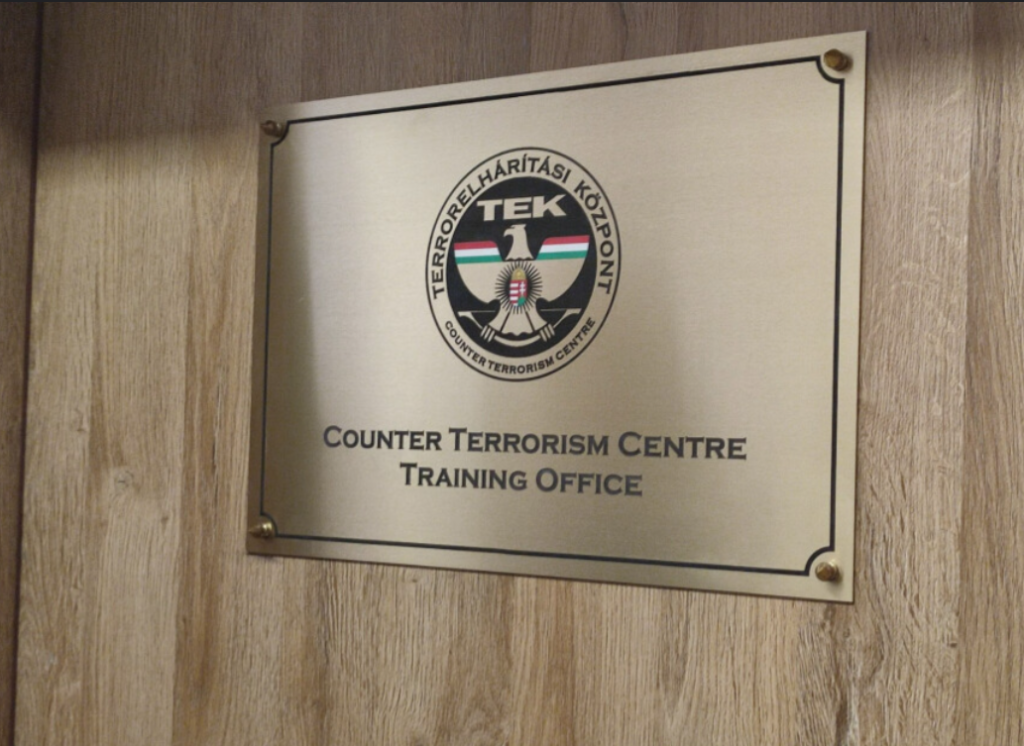
A permanent Hungarian Counter-Terrorism Center office opened inside Republika Srpska on 28 January 2026, without notification to the state institutions of Bosnia and Herzegovina. The Magyar government inherits the file in the first weeks of its term. The case for closure within thirty days is structural.
Drizan Shala
On 28 January 2026, the Hungarian Counter-Terrorism Center, known by its Hungarian acronym TEK, opened a permanent liaison office at the training facility of the Ministry of Internal Affairs of Republika Srpska in Zalužani, on the outskirts of Banja Luka. The minister of internal affairs of the entity, Željko Budimir, and the director of TEK, János Hajdu, presided. The office is the formal product of a memorandum of understanding signed earlier between TEK and the entity-level ministry. The state-level institutions of Bosnia and Herzegovina were not informed.
That is the institutional fact. The Magyar government takes office in approximately two weeks. The Zalužani office is among the first inherited files on the foreign policy desk. The question of whether it continues to operate, and on what timeline a decision is made, sits with the incoming government.
The institutional fact
Bosnia and Herzegovina is a single sovereign state with one international legal personality, as established by the General Framework Agreement for Peace signed at Dayton in 1995. Article III(1) of Annex 4, which is the constitution of Bosnia and Herzegovina, lists foreign policy as a state-level responsibility under subsection (a), and international and inter-entity criminal law enforcement, including relations with Interpol, under subsection (g). The Bosnian institutional reading, asserted publicly by Kemal Ademović and consistent with state practice since Dayton, is that cooperation with foreign security and intelligence agencies falls within these state-level competences. The two entities, Republika Srpska and the Federation of Bosnia and Herzegovina, possess no foreign affairs competence. The principle is contested only in political practice by entity leaderships seeking to manufacture parallel external relations. The Zalužani office is the operational form of that contestation.
The office was established without state-level ratification. The supposed underlying memorandum between TEK and the Ministry of Internal Affairs of Republika Srpska was never submitted for parliamentary approval at the state level. None of Bosnia and Herzegovina’s state security agencies were notified. The Ministry of Security and the Ministry of Foreign Affairs of Bosnia and Herzegovina were neither consulted nor informed. Ademović, in his capacity as president of the House of Peoples of the Bosnian Parliament, has stated publicly that the office was established in a manner that is “completely unconstitutional” and has formally contacted institutions seeking clarification. The constitutional irregularity is on the record at the highest available parliamentary level.
The German Society for Threatened Peoples, through its local representative Belma Zulčić, has called for the involvement of the Council of Europe and the OSCE on grounds of constitutional legitimacy and democratic control. The Sarajevo security analyst Ahmed Kico, writing in Oslobođenje, observed that Hungary maintains no comparable office anywhere else in the world and that no terrorism profile in Bosnia and Herzegovina justifies one in Banja Luka. The cover language fails on its own analytical merits.
The operational record deepens the picture. In February 2025, timed precisely to the announcement of the first-instance verdict that convicted Milorad Dodik for failing to implement decisions of the Office of the High Representative, seventy TEK personnel arrived in Republika Srpska with armored vehicles and a mobile command center under the personal command of János Hajdu. The official cover was a training exercise. Reporting by VSquare raised the question of whether the deployment carried the operational option of extracting Dodik to Hungary should he be detained. Whatever the operational interpretation chosen, the timing produced an unambiguous signal to Bosnia and Herzegovina’s state institutions about Hungarian willingness to deploy paramilitary assets in defense of Dodik’s political position. The Zalužani office institutionalizes that operation.
The historical genus of the template is not obscure. In 2014, a 144-member Russian “dance troupe” visited Republika Srpska under cultural-cooperation cover, an episode documented by Bellingcat in connection with Russian influence operations in the region. The TEK February 2025 deployment fits the same template. Different national colors, identical operational logic.
Five liabilities
The first liability is political and institutional. Article 24(3) of the Treaty on European Union obliges member states to refrain from action contrary to the Union’s external policy interests or likely to impair its cohesive effectiveness in international relations. The EU’s stated position on Bosnia and Herzegovina, expressed through Council conclusions, EUFOR mandate authorizations, and Commission enlargement reports, supports the integrity of the state and the authority of its institutions. The Zalužani office is a Hungarian bilateral arrangement with an entity whose political leadership has declared the dismantling of those institutions as its operational goal. The contradiction is structural. The European External Action Service has not yet formally moved on the file. It will, particularly if any operational incident produces casualties, detentions, or constitutional confrontation. The exposure is political and reputational, cumulative within the EU institutional space rather than directly justiciable, but cumulative is sufficient. The new government’s foreign policy reset cannot begin while the office is operational, because the office defines the position the reset must repudiate.
The second liability is bilateral. Hungary’s foreign minister, Péter Szijjártó, could not land in Banja Luka with a state aircraft in November 2025 and was forced to use a private jet. The state secretary for foreign affairs faced the same denial in March 2025. Hungarian peacekeepers serving under EUFOR were declared unwelcome by Sarajevo in March 2025. A Hungarian private investigator, György Baráth, was arrested in October 2025 on suspicion of espionage. None of these events are isolated. They are the visible portion of a bilateral relationship that has been driven, by Hungarian conduct, into a state of partial hostility with the Bosnian state. The Zalužani office is the operational center of gravity that organizes that hostility.
The third liability is operational risk, and it is the most acute. Forward-deployed Hungarian paramilitary assets in Republika Srpska expose Hungary directly to whatever happens next in the entity. Milorad Dodik has stated, on Bosnian Serb public television, that within days of declaring independence the Republika Srpska will be recognized by fifteen countries. Whether that figure is realistic or aspirational is irrelevant to the Hungarian operational position. If a secession declaration is attempted while the Zalužani office is operational, Hungarian state assets are inside the entity at the moment of constitutional rupture. The legal, diplomatic, and reputational consequences for Hungary in that scenario are catastrophic. They are also avoidable, but only by closing the office in advance of the rupture rather than after it. Closure preserves Hungarian agency over the file. An incident eliminates it.
The fourth liability is institutional and reputational. TEK under Hajdu carries a documented record that the new government will be required to address as part of any rule-of-law reset. The agency’s surveillance functions have been the subject of investigations by Hungarian outlets including Direkt36, particularly the Pegasus targeting of figures including President János Áder’s protective detail and former TEK deputy Zsolt Bodnár. None of these items individually compels closure of a foreign office. Together with the constitutional irregularity at Zalužani, they constitute a pattern that a serious government cannot inherit without addressing. The closure of the foreign office is the first item in that addressing because it is the only one executable by ministerial decision.
The fifth liability is strategic alignment. Hungary is the only EU member state operating paramilitary infrastructure inside an entity that defies the constitutional order of the state in which it sits, the Office of the High Representative, and the Constitutional Court of Bosnia and Herzegovina. Hungary’s position on Republika Srpska secession architecture is shared in the region by Belgrade and beyond the region by Russia and Belarus. It is opposed by every other EU member, the United Kingdom, and the United States. This is not a strategic position any Hungarian government can defend in NATO and EU institutional rooms once the question is asked directly. It has been Hungarian policy only because the question has been suppressed by Hungarian veto and by American distraction. Both conditions are temporary. The position will be defended, or it will be abandoned.
On the bilateral Serbia counterargument
The strongest objection to closure that a Hungarian policy reader will raise is bilateral economic. Hungarian energy interests in Serbia, MOL operations, the agricultural trade, and the Hungarian community in Vojvodina are real and legitimate. The Zalužani file does not touch them. The constitutional architecture at issue is the relationship between Republika Srpska, an entity inside Bosnia and Herzegovina, and the Bosnian state. Closure of the TEK office in Banja Luka leaves the Hungary-Serbia bilateral file untouched. The two relationships are mechanically distinct. A reading that treats Budapest, Belgrade, and Banja Luka as a single axis is the reading produced by the previous government’s framing, not by the legal and operational structure of the files. Disentangling them is part of what closure achieves. The Magyar government’s bilateral relationship with Belgrade is a separate dossier, conducted through ordinary state-to-state channels, and unaffected by the closure of an office that should never have been opened on the territory of a third state in the first place.
Timing
The closure decision is operationally simple. The personnel deployed at Zalužani number in the dozens. The capability they represent can be redirected to Hungarian domestic counter-terrorism functions, where the structural justification for TEK’s existence resides. The bilateral memorandum can be terminated by Hungarian unilateral notice. The diplomatic communication is straightforward: the office was established without proper coordination with the state institutions of Bosnia and Herzegovina, contrary to Hungary’s obligations as an EU member state, and is therefore being closed pending any future arrangement reached through state-level channels.
The thirty-day frame is dictated by the structure of foreign policy signaling. Three reasons recommend it.
First, the signaling value of any reset action decays rapidly after the transition window. Decisions made in the first thirty days are read internationally as the new government’s deliberate posture. Decisions made in months three through six are read as responses to pressure. The same closure executed in May 2026 carries diplomatic weight that the same closure executed in October 2026 will not.
Second, the operational risk of an incident at Zalužani is not zero, and rises with every passing week. Republika Srpska’s political situation is volatile: a contested presidential re-vote was held on 8 February 2026 amid renewed reports of violations, and Dodik has publicly placed a secession declaration on the political horizon. Any operational entanglement of TEK personnel in an internal Bosnian Serb crisis would convert the Zalužani liability from a diplomatic file into a legal one, with consequences the new government would inherit involuntarily. Closure in advance preserves the file as diplomatic. Closure after an incident makes it adversarial and legal.
Third, the Brussels and Washington reading of the new government’s first decisions will determine the institutional credit available for the harder files that follow: the Council vote on the next Ukraine support package, the Western Balkans enlargement framework, the position on Russian sanctions renewal, the conduct of bilateral relations with neighbors. Closure of the Zalužani office costs the new government almost nothing operationally and earns it the institutional credit needed for the harder decisions. The sequencing logic is favorable. The window in which it is favorable closes when the transition does.
The TEK office at Zalužani was opened by an outgoing government in violation of the constitutional order of the host state, without notification to that state’s security agencies, in service of a bilateral alignment with an entity leadership whose declared political goal is the dismantling of the host state. Counter-terrorism is the cover language. The substance is paramilitary forward presence in support of a secession process.
The Magyar government takes office in approximately two weeks. The Zalužani file is on the desk. The closure is operationally simple. The case is structural. Closure within thirty days preserves Hungarian agency over the file. Closure after an incident eliminates that agency. The decision is binary and the timing window is short.
The office exists. Whether it continues to exist is the new government’s first decision in the Western Balkans file. That decision will be observed.
Drizan Shala is a Kosovo-based security analyst covering security affairs in Kosovo and the Western Balkans.