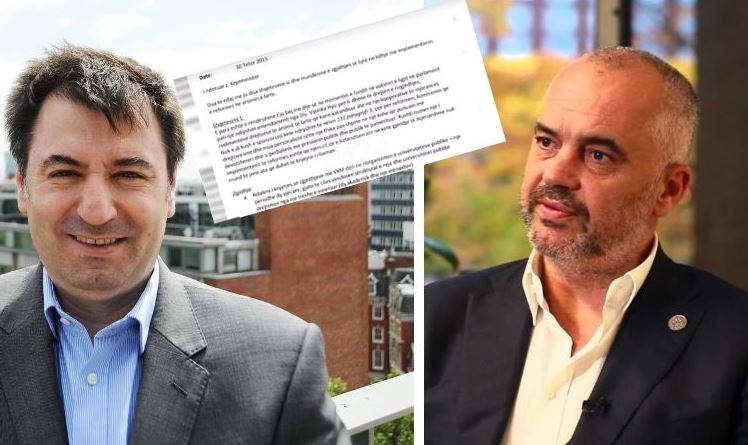
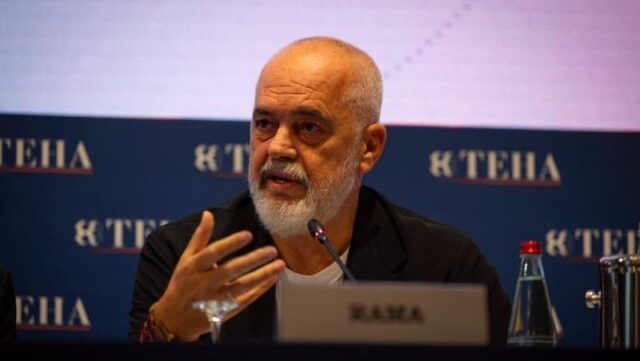
A demographer at the London School of Economics tells Edi Rama what the data actually shows about Albanian emigration — and why the story is more complicated than “everyone has left.”
the Tirana Examiner Media Monitor
The conventional wisdom on Albanian emigration is bleak and loud: the country is emptying, the young are gone, and those who remain are waiting for their turn. It has been repeated so often it has the texture of fact.
Professor Arian Gjonçaj, a demographer at the London School of Economics who has tracked Albania’s population data from 1950 to the present, thinks the picture is more interesting than that — and the data, he argues, is starting to say something different.
In Episode 10 of Season 6 of his podcast Flasim, Prime Minister Edi Rama sat down with Gjonçaj for a wide-ranging conversation that moves from return migration trends and the Berat case study, to the state of the NHS, the Kosovo war lobbying effort in London, and what disagreeing well actually looks like. The transcript is published below in full.
Edi Rama: In Episode 10 of Season 6 of the podcast “Flasim,” I have another very special guest, and what makes his presence even more special is the courage to come here and speak about a completely mined terrain where perceptions and stereotypes are so strong that it is very hard for facts and figures to find their way to the ears of many people in a different direction. Not the direction that eardrum has been beaten into — “they’re leaving, leaving, leaving, everyone’s gone, only old men and women remain.” I am with Professor Arian Gjonçaj — a well-known and highly respected professor in academic circles, with a long academic career at one of Britain’s most important schools: the London School of Economics.
The professor has spoken across many areas in his effort to help Albania, despite having landed on the British peninsula back in 1991 and not physically moved as a resident since — though in body and spirit he has moved continuously between Britain and Albania. But why have I invited the professor today? The reason is a publication made not long ago, because the professor’s main expertise is demography, and the publication concerns Albanian migration and emigration.
Arian Gjonçaj: Thank you for the invitation.
Rama: Thank you for coming. You have accepted the invitation to speak on a completely mined terrain.
Gjonçaj: Yes, that’s true. But let’s start from the beginning. The study is large — it was not done by Arian as an individual. It was done by the World Bank, the ILO, and INSTAT. It is a survey conducted in 2024 dedicated to emigration. I have been covering all of Albania’s demographic data since 1950 to the present. Migration is an element of focus for two reasons: first, because it is harder to analyze since data sources are not accurate; and second, because it is the determining factor in Albania’s population dynamics. In short, population growth is determined by emigration, the age structure and its changes are determined by emigration. Everything is determined by emigration — not by birth or death rates, but primarily by emigration, and it is a phenomenon I return to repeatedly.
In this specific case, I was doing projections based on 2023 census data, and this World Bank/INSTAT survey came into my hands by chance. What happened is that in the 2023 census we captured a very interesting trend: over 12 years, 108,000 Albanians had returned, with 26,000 returning in 2023 alone — an exponential movement. I said to myself: something is happening, but what? I couldn’t explain it without detailed census analysis.
The second thing I noticed was that one of the main districts — Berat — had in the latest census a net migration close to zero, balanced within plus or minus 2%. I asked: what does Berat have going on? Then I remembered — Berat is one of our largest tourism centers, with development in tourism and agro-tourism. I contacted the former mayor, Ervin Demo, and asked him about employment and businesses. He said that during his time as mayor, hundreds of new businesses had opened within the castle walls. Then I checked the business registry and indeed many new businesses had opened. So I started thinking: if people have returned to Berat, it is because there are jobs, new opportunities.
When this survey came out, it was much clearer because it is a dedicated, detailed survey — it captured not only families with migrants or emigrants inside Albania but also followed those abroad. There is no more detailed survey.
Rama: Let’s go into some detail, because there are many figures there, and as I have learned from my role — you know the figures well — figures can always be interpreted in different ways, and without the right guiding principles and trained eyes, you can reach completely different conclusions.
Gjonçaj: If I were to say what three things impressed me most: when two mathematicians make the same mistake, it is no longer a mistake — the problem lies elsewhere. And if two data sources tell the same story, that story is true, it is factual. I mentioned what we were seeing in the latest census, and when I look at this survey without going into the analyzed data, I see first of all that only one-third of families in Albania have either an emigrant who left or one who returned. This surprised us a little because perhaps those who left with the whole family are missing.
But the most notable finding was that the percentage of families with one or more people who left and families with one or more who returned were almost equal — 20% versus 22%. That is interesting. I started reading in more detail, and I went back to Berat to check if it was real. Berat turned out to be the district with the most families with both migrants and return migrants — around 70% of families in Berat had either someone who left or returned. And Berat had about 10-15% more families with returnees than with those who left. So Berat was confirmed by two different sources — a story was forming, and you start to look for the explanations: why is the trend reversing?
When you look at other districts, you see a tendency toward return. It is a tendency. And at the district level, when you compare — Tirana, Vlora, Durrës, Fier — all districts with the highest tourism — had more families with returnees than others.
Berat has two very strong pull factors: renovation of old houses into guesthouses as part of tourism infrastructure, and the agricultural zone with great results — we have some of the best wineries in the whole country in Berat.
Rama: So the Ervin Demo factor is also real here.
Gjonçaj: Yes, absolutely. The human factor matters in every element. What I want to say is that even in Shkodër — which you took over managing later — Shkodër has extraordinary potential because it arguably has all the elements of tourism Albania can offer: the sea, the lake, three rivers, history, one of the oldest castles, beautiful mountains nearby.
I view it in relative terms, over a five to six year period, and you know better than I do that infrastructure is being developed — and when infrastructure develops, why do Albanians come first? The emigrant is a vote for politics. The emigrant is a remittance for the family. But above all, the emigrant is an investor, an investment — in human capital through experience, and in financial capital. These are people who have saved, who come back — and interestingly, it is not just my age group returning, not just those about to retire who will be consumers. Those returning according to this survey are aged 35 plus. Those who leave are 25 to 45, but those who return are 35 plus — meaning at minimum a 30-year-old, who went, built capital, and is now returning.
Rama: What have you seen in the trends of other countries that are ahead of us — that have already entered Europe etc.?
Gjonçaj: We are very similar. Take the Polish case — Poland performed very well economically. At the end of the day, it’s the economy. The economy did well, people returned. Why? It is a balance of real income. Albanians, like all other emigrants, make a calculation: I earn this much here, I spend this much. In Albania I earn this much, I spend this much. How much do I save? Purchasing power.
This is a calculation those who first left do not make — they only look at what they earn there versus what remains in hand. But they don’t know that what remains is no longer much back home. In short, because of improved economic conditions — wage growth, and especially growth in real wages (indexed against prices) — they do these calculations and return.
Take the 1.6 million Poles in England: most who left eventually returned because the Polish economy started to grow — GDP reached around 7%. They are about 10 years ahead of us because they entered the EU 10 years earlier. The most structurally similar case to us is Croatia, a more recent phenomenon — those are the examples I have taken into account. Today I was at INSTAT in the morning analyzing data to make projections.
The Croatian experience is most similar to us in terms of return patterns. And why does this matter? Because we need to know what we have now that is factual: we are seeing a returning trend. This doesn’t mean no one is leaving — people are still leaving — but the net emigration (which is negative) is decreasing. So the question is: when do we reach the balance point?
When I compare this to similar countries in relative terms — Croatia appears among the most comparable. The Berat case will be followed by many other places. We forget that development comes with urbanization. England did it 150 years ago. We are still urbanizing, and urbanization means that some areas will inevitably depopulate.
Rama: I was watching a documentary about depopulated areas in England.
Gjonçaj: Full of them — whole former industrial towns, former mining communities — a great sadness. The differences in house prices between central London and rural villages show where demand is highest. Italy has entire villages for sale for almost nothing — and Italy today has debates about villages that are world cultural heritage sites with only a handful of elderly people, and they want to create mechanisms to bring young people to care for the elderly, hoping they will settle and build something around tourism etc.
Coming back to something specifically Albanian: this abandonment phenomenon in Italy has caused house prices to drop — you can get something much better in a semi-abandoned zone in Italy than a semi-abandoned zone in Albania, where some balance has started to establish itself. There is a stagnation of sorts.
Rama: You come here for the first time in a certain sense as a witness to two great transitions — Albania’s economic transition and Britain’s political transition. What impression did you have of London when you arrived, how has it changed over the years, and how do you see Albania today?
Gjonçaj: The human mind, as we say, functions in a cross-sectional way — we compare Albania today with Greece, Italy, Kosovo, Croatia, Germany, England — and we forget that England went through the Industrial Revolution 150-170 years ago, that it has had a democratic system for 600 years, 300 years consolidated, courts for centuries, an administration for centuries.
A country without a constitution but with laws built over centuries — I used to follow Tony Blair and New Labour closely. When I asked him about the transition into office, he told me that the United Kingdom had only 44 positions in the entire system that could be changed when a new party came to power.
Only 44 people. Those were political advisers at various points. You cannot touch the Permanent Secretary of a ministry.
Rama: And those positions were in Downing Street?
Gjonçaj: In Downing Street there are none. Everyone there stays, welcomes and bids farewell to prime ministers. Do you understand?
And Blair said: we opened it up a bit, but it is still what it is. That shows the institution functions. France is even more closed. The civil service has been built over hundreds and hundreds of years.
We have to look at where we were and where we are. A mutual friend of ours, former opposition, now out of politics — Genc Ruli — once said to me: we complain too much. We forget where we were 30 years ago and where we are now. We forget that we were in a post-communist era with a semi-feudal Ottoman mentality, and now we are in a market economy — not 100% functional, but 70-80% functional. There is still informality. And we demand to change the country without changing mentality, and mentality requires generational change. You cannot change mentality in one generation.
When I went to England it was out of curiosity and opportunity. I’d been offered Italy — I thought no, Italy doesn’t feel foreign enough. Then Holland, then six months at Harvard, and then I said, let me go to LSE.
When I arrived, people asked: did you have culture shock? Not really. What surprised me was that even in England people slept on the streets. We thought that only happened here.
Rama: More now?
Gjonçaj: I know there is more now because the economy is weaker. When I arrived in 1993, there was a major economic crisis before Labour came to power — the Exchange Rate Mechanism crisis, Black Wednesday. I remember a conversation with a colleague. I said, I feel sorry for the younger generation — there will be changes in the labor market, rising unemployment etc. He looked at me and said: listen, you’ve been through much worse. Albanians went through communism, the rationing era of the 1980s. We as a nation also experienced rationing after World War II. My kids think bread is made in a supermarket. This generation of young people needs to understand the value of welfare.
What struck me was a self-reflection: what have I learned? Have I learned programming? And when I saw how capable people were there, I realized the situation was not good economically until Labour came to power.
The macro situation had been stabilized by the Conservatives at the end, and Blair had the fortune of inheriting a stable macro environment — mainly from Thatcher’s structural reforms, privatization, Major’s stabilization period. And that gave him the ability, as a left-winger, to invest in social programs. The largest investments in the health service are still from Blair’s era.
Rama: And the waiting times now?
Gjonçaj: The waiting times. Two weeks ago I had a blood pressure spike. My family doctor said: you need to go to emergency, so a cardiologist can examine you. I said, I know I’ll wait four, five, six hours, but at least they’ll see me today. He said he’d organize a referral. Then I received a text: appointment — October 2026. Over a year from now. And not even to see the cardiologist — to see the cardiology nurse.
A three-year wait for a simple operation. And what has happened is this phenomenon that is now more prevalent in Albania than there: the private sector is growing. You now see advertisements where even the NHS itself tells you: if you go through a private system that cooperates with us, you can be seen faster. The cost is no longer borne by the government from our taxes — it has passed to individuals’ pockets.
Rama: This is what went beyond my limit — to wait a year just to change medication.
Gjonçaj: It is a system that has collapsed because investment has not been continuous, at a time when the population is aging — one of the things I shout about when I speak on this. And transport — because it was privatized. Can infrastructure be privatized? The track, the line, owned by a company. Lack of competition destroyed it. And above all, purchasing power has been destroyed. People cannot live. Starmer came to power promising to improve the economic situation. Affordability — the ability to get through a month. Heating for elderly households. The £250 heating allowance for pensioners — he cut it, then restored it when he felt the political pressure.
And disability investment for people in need — there is none, because the welfare state costs so much that you don’t know where to find the money. The economy has sat at ridiculous figures — from zero to 1% — for a long time. And as Clinton’s adviser said: “It’s the economy, stupid.” That is the basis of everything.
If we speak about the next 10 years in Albania — I look at things progressively and retrospectively — comparing where we were and where we are going. If we do that, we will maintain a bit of a sense of reality. In Albania, there is no sense of reality. Even someone who wants to become someone doesn’t understand where they come from or where they are going.
I went to Britain and did what I did as a student, but all subsequent stages were slow. I could not become a professor within two years.
Rama: Here we have it differently.
Gjonçaj: I know.
Rama: Here it is: director, deputy, minister, nothing else.
Gjonçaj: I was speaking with a young person who works in IT here — his contract is not with an Albanian private company, it is with a Swiss company. He is paid at the Swiss standard. And I said to him: do you have a mortgage? He said he had taken one and would pay it off within three years. I said: you earn — adjusting for purchasing power — far more than I do in Britain. And do you still think of going to join your brother in America? He said: I’ve changed my mind. Why? Because I went to visit him and saw how he lived and how much he worked — he had no more than one week of holiday.
Meanwhile here I do as I please, children are close, parents nearby. There are real advantages for the younger generation here. For example, in medicine — students who graduate have their employment guaranteed by law. Here the specialization path is also somewhat guaranteed — you can become a cardiologist, an oncologist — you apply and compete, but it is not chaotic. If you go to Germany, you first work for years as an auxiliary physician, then maybe they’ll accept you as a specialist based on their own needs, and after another four to five years you still don’t know where you’ll be working.
Rama: And for those with ambitions for academic or professional careers in those kinds of professions — I understand the challenge and it is fine.
Gjonçaj: I can’t judge because I did it myself. You will struggle, struggle, struggle — but you are in absolutely ideal conditions to develop a career and scientific research, and to learn. What saddens me is when I look beyond Berat — at the ordinary worker — and I find situations today that have nothing to do with 30 years ago. 30 years ago the ordinary worker there genuinely had the possibility to set money aside, to build something. Today the labor market is completely different.
The current labor market is far more unstable than when I started in my early 20s. A third of the labor market of the previous generation has changed in terms of job competition — because we speak of an open Europe, where someone from Hungary can come and take your job. But above all, the current labor market is very unstable. The generation above ours had lifetime contracts in many cases, even in the private sector. In our generation, contracts were better than those the current generation has. Whereas for the young generation, the market is completely unstable. This causes people to avoid marriage, avoid having children, become more self-centered — because this instability is much greater in Europe now than it was 10, 15, or 20 years ago.
And I’ll say something a little negative by way of comparison. I remember when people lost their money in the pyramid schemes. Everyone was saying: put your money in, we’ll make money. When I told my parents’ friends not to, because they were pyramid schemes, they wouldn’t listen. There was a kind of hysteria. I think there is a similar element now with emigration: my friend went, he did this, he did that — and when they go and test it in reality, they hit a wall because they don’t have that particular set of skills.
Rama: It’s hard for them.
Gjonçaj: Very hard.
Rama: Professor, I have another point to touch upon — because there is something in the period after your departure (even though you haven’t really left since you are always here) which is somewhat unique in your journey — the period when you were deeply engaged with Kosovo.
Gjonçaj: Yes, 1998 — that was a crucial year before the war. I was communicating with the Swiss People’s Party people, the UÇK representatives, and there was need for lobbying. The idea was: what do we need to do to push Blair’s government to push the American government to intervene in Kosovo? That was the biggest lobbying effort happening in London. It wasn’t necessary to persuade Robin Cook. Cook had persuaded Blair. The problem was how the public would perceive it.
Blair intervened because 69% of the public supported intervention in Kosovo. Similarly in America — the Reçak massacre sensitized people enormously. That footage on the BBC was terrible.
I was finishing my doctorate at the time. A very wealthy friend of mine engaged a Labour Party PR person to help us organize a conference in the British Parliament on the Kosovo issue. We had been lobbying heavily in London, and we secured an event in Parliament. The question was who to bring.
One day the phone rang. A woman with a non-British accent asked: “Are you Arian Gjonçaj?” Yes. She said: “I am Bianca Jagger.” Professor Malcolm had given her my number. She had just returned from Kosovo gathering facts to take Milošević to The Hague. She asked if she could participate — with great pleasure.
So the panel included me, a major businessman who donated millions for Kosovo, a Labour MEP, Bujar Bukoshi — because UÇK representatives didn’t want to expose the political wing openly at that stage — and Bianca was on my right. 18 British MPs attended.
And the interesting thing is that the Robin Cook office people told us: please, mention anything you want — just one sentence we don’t want: “Military intervention.” They said military intervention would destroy public opinion — and Clinton’s too.
We didn’t say it, but all the academics in the room opened it up themselves. The British politicians then opened the discussion themselves — how to intervene militarily. One month after that event, the war started.
Rama: How do you feel about the UÇK commanders at The Hague?
Gjonçaj: Horrified — I argue bitterly with my Kosovo friends about this. There is a terrible hatred for those UÇK figures there, and I cannot explain it. It is a manufactured hatred — it is not that ordinary people hate UÇK or the UÇK fighters for what happened when they came to power. I still cannot understand why the Albanian state has reportedly given more money in support of their defense than their own government has. For me it is terrible that the financing was stopped.
Rama: I want to say something here because I have had this debate with people — and I have not discussed it closely with Prime Minister Kurti. But I believe that here, on this point, it was a matter of non-exposure. I believe he was afraid to do this thing, for fear of harming their positions — because his position vis-à-vis the EU, the United States, justice — it is not a comfortable position, and if he had entered deeply into this, I don’t know how much it would have weighed on him.
Without doubt we have helped more with sensitization. We have not given direct support because we did not want to create the idea: what is going on here, what do these people want? We didn’t want it to become an issue of “Albanianism” in the worst sense. I believe his non-support was about non-visibility. That’s what I believe.
Gjonçaj: For me what matters is the result — not the motivation. The fact is they had enormous financial difficulties. Two of their best barristers left. It is very hard to sustain a long trial like this with sponsors and patriotism alone — the lawyers know their invoice, and the invoices are steep.
Rama: I believe the non-support was about not wanting to be seen as someone who is turning the knife against the international system, while at the same time being covertly against that tribunal. There are no Albanians who are truly in favor of it.
Gjonçaj: I have never taken a side position there. I have never wanted to interfere in their affairs. It seemed ridiculous when they tried to interfere here — but it seems they learned their lesson and stopped. The rest is about the need to be fair and to be oneself. You are yourself historically — you have that mark. Sometimes it opens problems, sometimes it doesn’t.
Rama: Even between us sometimes.
Gjonçaj: We have had arguments. But for work.
Rama: That’s right. And someone once said a very beautiful thing — I don’t remember which great mind — the quality of democracy, and also the quality of coexistence, whether in society, with friends, acquaintances, or in the family — does not depend on how much we agree with each other, but on the way in which we disagree with each other. There is a way to disagree: raising your voice and smiling at the end and continuing the road together. And there is a way to disagree: tearing out each other’s hair and putting each other’s eyes out. Those are two entirely different ways of not agreeing — and they define the quality of life.
Gjonçaj: You have just saved my marriage — I’ll have my wife listen to this, because we always find ourselves agreeing to disagree.
Rama: A final note: you have been key to the reform of higher education, and now that 10 years have passed, the time has come to revisit it. I have said it before: don’t let them forget to call Arian Gjonçaj to the table. He is the main author of that reform. Let him come and see with his own eyes, after 10 years, what he thinks has worked and what hasn’t — and confront himself, and others.
Gjonçaj: I am simpler from a distance. Up close I seem complicated sometimes.
Rama: Thank you very much, Professor. This was Professor Arian Gjonçaj.
The conversation covers a lot of ground — more than a headline about migration figures can hold. But the thread running through it is a simple provocation: that Albanians, individually and collectively, are bad at reading where they actually stand. The emigrant who visits his brother in America and comes home reassured. The country that forgets where it was thirty years ago. The demographer who has to remind people that England depopulated entire regions too, and called it the Industrial Revolution.
Gjonçaj will presumably be back at his desk at LSE by now. Berat, apparently, is booming.