the Newsroom (Tirana)
The Parliament convened Thursday for a session scheduled to hold three cabinet members to account. It held none of them. By the time Speaker Niko Peleshi gaveled the chamber into its late-afternoon ratification block, Defence Minister Ermal Nufi was stranded by a Lufthansa strike returning from Zagreb, Culture Minister Mirela Kumbaro was at a language competition finale, and Deputy Prime Minister Albana Koçiu had cited scheduling conflicts. The opposition had come prepared to question all three. It questioned none.
The chamber’s formal output for the day was nonetheless substantial: five international instruments ratified, one regulatory commission appointment made, one draft law deferred for further work. The gap between that productive record and the non-appearance of the three ministers the opposition had summoned frames Thursday’s sitting more accurately than any single decision the chamber took. Several of the day’s substantive exchanges, on European agricultural funds, on the cancelled Porto Romano port tender, on building safety after a deadly-by-luck fire at the Arlis complex, and on integration transparency, surfaced information of clear public interest. None of them closed.
The Interpellations That Did Not Happen
The opposition had filed three interpellations for Thursday. Former Democratic MP Agron Shehaj and his Mundësia colleague Erald Kapri had requested Koçiu on portfolios under her deputy prime ministerial brief. Democrats had filed against Kumbaro over cultural heritage management and against Nufi over the defence procurement company KAYO, a matter the opposition has been pressing for weeks.
Erjona Ismaili, Minister of State for Relations with Parliament, delivered the notifications. Nufi’s absence, she explained, was involuntary: a flight cancellation on his return from an official visit to Croatia, caused by the ongoing Lufthansa industrial action, had made Thursday’s session physically impossible to attend. Kumbaro was at the final round of a national Albanian language competition in her capacity as organiser. Koçiu’s absence was attributed to agenda.
Peleshi, presiding, departed from the government benches on principle. “I share the same position as the opposition,” he said. “An interpellation should take precedence over any other agenda item. The minister must respect the Assembly of Albania and be present here.” He exempted Nufi, treating the airline disruption as a genuine incident. The other two absences he did not exempt. All three sessions were rescheduled to the next sitting.
One of the three absences was therefore force majeure. Two were ministerial calendar decisions. Whether a pattern is forming, or whether Thursday was a coincidence of bad scheduling, will be clearer over the next several sittings. That Peleshi publicly sided with the opposition on two of the three is the most notable procedural development of the morning.
The Rulebook Fight
With the interpellations gone, the floor opened to what the order paper calls “discussions outside the order of the day.” Almost immediately, the exchange turned to the rulebook itself.
Taulant Balla, head of the Socialist parliamentary group, floated a proposal. The hour allocated to off-agenda discussion, currently placed at the end of sessions, should be restored to the beginning, where it sat before a 2011 decision by the then-Democratic majority moved it. “Since we are in a moment of rulebook changes, do you agree to restore this one hour for matters outside the order of the day to the start of the session, as we used to have it, and put an end to this absurd situation where in the name of procedure no one has actually spoken about procedure?”
The opposition read the proposal within a broader package of rulebook amendments it believes is designed to compress its speaking time. Luçiano Boçi was direct: “You want to shut the opposition’s mouth by cutting its speaking time to five minutes.” Oerd Bylykbashi argued the process should be designed so that recourse to the Constitutional Court would no longer be necessary, a reference to prior opposition challenges of rulebook amendments. Saimir Korreshi framed it generationally: “The new members got tired of our ten minutes and now you want to cut them to five?”
The most pointed intervention came from within the majority’s own ranks. Socialist MP Arjan Ndoja called on Peleshi to enforce the existing rules rather than renegotiate them. “To establish order in parliament, you must refer to the rulebook, the Constitution, and the decisions of the Constitutional Court. You have the constitutional authority and duty, not to be conformist, not to be emotional and think more than necessary, but to take decisions. If it is not about matters on the agenda, cut anyone’s speaking time, whether from your force or ours.” No vote on Balla’s proposal was taken.
The Braçe, Shehaj, and Balla Exchange
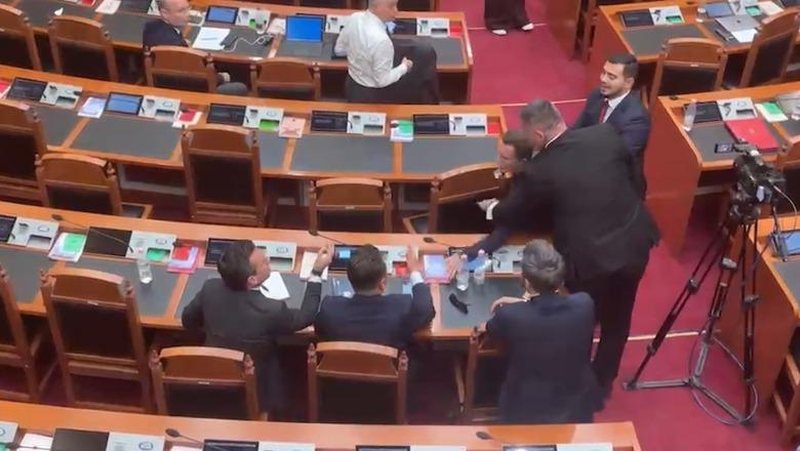
Personal confrontation broke the afternoon’s procedural texture. Socialist MP Erion Braçe and Mundësia leader Agron Shehaj exchanged accusations of a kind the Albanian parliament has seen before but rarely this raw.
Shehaj opened: “You are a petty thief.” Braçe crossed the floor to Shehaj’s bench. “That thief business you said once before, you made yourself look ridiculous, you came and apologised.” Shehaj: “No, I did not apologise. You are a petty thief. You are petty in everything.” Braçe appealed to the chair: “Mr. Speaker, take measures. Did I go to the petty thief, or did he come to me?”
Balla intervened from the rostrum with an accusation of his own, directed at Shehaj. “You are a shakedown artist. You went after a businessman. The same way you did to your own party when you stole the data.” The reference is to public accusations against Shehaj, dating from his time in the Democratic Party, of having taken voter list data when he departed. Shehaj has rejected those accusations previously. No ruling was made from the chair.
IPARD: A Suspended Programme Presented as a Deliverable
The day’s most substantive exchange came when Partia e Lirisë MP Tedi Blushi put a direct question to Agriculture Minister Andis Salla on the European Union’s Instrument for Pre-Accession Assistance for Rural Development.
“Can you give an explanation to all farmers as to why, for the third year in a row, the EU is not opening IPARD funds? Every farmer is asking this question today. No matter how you twist and turn, I do not believe you will be honest. Because you cannot say that this money has gone into Rama’s pocket. Justify the salary Albanians pay you, go out and give explanations to Albanians about IPARD funds.”
Salla’s reply: “IPARD is a matter that is under investigation by other bodies. We have completed all the procedures that have been requested of us regarding the IPARD component, and very soon IPARD, within the year, will be in the hands of Albanian citizens and farmers. 146 million euros in total will be available for farmers to apply.”
On the record of Thursday’s sitting, those two sentences are what the minister said. Against the documented state of the programme, they require context the exchange itself did not supply.
IPARD II disbursement to Albania was suspended by the European Commission in August 2023, following findings by the European Anti-Fraud Office (OLAF) of corruption, favouritism, and political interference in the programme’s implementation. A Commission review identified 33.5 million euros in irregularities in Albania alone, the largest figure among the seven Western Balkan beneficiary countries, and greater than the totals identified in Serbia, Montenegro, or North Macedonia. The “other bodies” Salla referenced without naming are, on the public record, the investigating and audit authorities of the European Union itself.
The 146 million euro figure Salla presented is the IPARD III programme envelope for Albania for the 2021 to 2027 period, as originally programmed. The 2025 European Commission Progress Report on Albania stated explicitly that the country is not prepared to begin implementing IPARD III, citing the need to increase capacity and supervision. Finance Minister Petrit Malaj committed to a 2026 opening of IPARD III in an appearance before the parliamentary Economy Committee in November 2025. Salla’s Thursday statement therefore repeats a commitment the government has already made on the record, and frames as a deliverable a figure that is the ceiling of a programme still not accredited to begin.
The comparative picture is not flattering, though it is not unique either. North Macedonia’s IPARD III disbursement was itself suspended by the Commission in late 2025 after the arrest of the head of the country’s rural development payments agency in a bribery case. Serbia’s IPARD III programme, with a 288 million euro envelope, is proceeding. Albania’s position is that of a country whose preceding IPARD cycle was cut off by Brussels over fraud findings and whose successor cycle is not yet accredited to open, while the responsible minister presents the full programme ceiling as a within-year promise.
What the chamber did not establish Thursday: whether the procedural requirements Salla says Albania has completed are the ones the European Commission is actually demanding; which calendar quarter of 2026 the minister envisages for disbursement; and why the figure quoted publicly is the 2021 to 2027 total rather than any smaller amount tied to a specific accredited measure.
Porto Romano: A 400 Million Euro Tender, A Finalist Withdrawal, No Reopening Date
Infrastructure and Energy Minister Enea Karakaçi fielded the Porto Romano interpellation in Prime Minister Edi Rama’s place. Rama, travelling in Italy and Spain, had delegated the matter. Mundësia’s Erald Kapri, whose Durrës constituency includes both the existing port and the Porto Romano site, pressed Karakaçi on the tender’s collapse and on the capacity of the replacement facility.
The sequence Karakaçi outlined: two procurement rounds have been run. Five international companies applied to the second. One advanced to the final stage. That bidder withdrew. The tender was cancelled. No new round has been scheduled.
Kapri’s substantive concern was not the procedural collapse but the engineering of the replacement. “The construction of this project is at risk because of the destruction of Durrës port, whether by removing the current port to turn it into a construction site to sell apartments, or with the new port of smaller capacity. There is a problem here.”
Karakaçi rejected the capacity charge with specific figures. The existing Durrës port, he said, cannot be expanded beyond its current footprint, and its maximum capacity is 200,000 containers. The Porto Romano design provides for 600,000 to one million containers. He additionally committed that the existing port would not be decommissioned before the replacement was operational. “Phase two begins only after the Durrës port is transferred to the successor port. As such, at no point will Albania be without a port in Durrës.”
What Karakaçi did not provide was a reopening date for the tender, a timeline for the replacement, or an explanation of the final bidder’s withdrawal beyond noting it was within the bidder’s rights. When the original tender was cancelled earlier this year, Rama publicly suggested that “external factors” did not want the port built. Thursday’s exchange added no clarity on who those factors were or whether the assessment still stood.
Vjosa: Pollution, Hydropower Contracts, and a Tourism Counter
Democratic MP Tritan Shehu raised the condition of the Vjosa river during debate on ratification of a technical cooperation agreement with Germany for the Green Vjosa regional development project. His charge was that the river, now designated a national park and nominated for UNESCO status, is being killed by hydrocarbon pollution upstream.
“The issue of the deep contamination of the Vjosa, the destruction of ecosystems within it, of living beings, and the turning of the Vjosa into a real danger to humans. This is the truth. I have raised it for a long time, and throughout these years there has only been deterioration of the Vjosa’s waters. As for the agreement you have brought with Germany, I am saying I will vote yes, because it must be voted yes, even though through you it will have the opposite effect. Have you seen the petroleum filling the lower part of the Vjosa? The petroleum sludge is toxic, it has highly toxic elements. Have you seen that there are no more fish in the Vjosa?”
Environment Minister Sofjan Jaupaj’s response ran in two directions. On the current state of the river, he cited 200,000 rafters and bathers last year and passage of biodiversity assessments for UNESCO and national park designation. On the historical record, he landed harder. “In 2023, we cancelled 26 hydropower contracts that had been granted by the democratic government for construction across the entire Vjosa basin. Before making false declarations, let us analyse where you were when you attributed 26 hydropower contracts along the entire Vjosa river and its tributaries. Contracts which were cancelled with the declaration of the Vjosa as a National Park in 2023.”
The ratification itself, for the Green Vjosa regional development project financed under German technical cooperation, passed with 88 votes in favour. Shehu voted for it as he had promised.
Agricultural Support: Berisha’s Diesel Demand, Salla’s Counter-Number
Sali Berisha, Democratic Party leader, opened the day’s substantive policy exchange by demanding the restoration of untaxed diesel for farmers and, separately, for public transport. His framing was comparative and pointed: “I challenge every person and every Albanian to find a single EU member state that does not subsidise diesel for farmers. On the contrary, Germany increased this subsidy this year, and other countries can too. To go and declare, just because they are socialists and you can tell them anything, that Europe no longer subsidises diesel, is a cynical act, a deception of around forty percent of Albanians, which to tell the truth is the part that sweats the most.”
Salla’s reply pivoted from diesel to the broader support envelope. The 2026 scheme, he said, allocates 52 million euros from the state budget, up on the previous year. A minimum of 15 million euros has been set aside for ten percent compensation of every invoice, which the minister estimated would produce 45 to 50 million euros in direct payments. Total government support for Albanian agriculture this year, he said, would exceed 100 million euros. The scheme, he added, had been aligned with EU methodology and would cover holdings from one square metre up to 300 and 400 hectares.
Salla did not directly answer whether the diesel subsidy would be restored. The 100 million euro aggregate figure was offered as the counter. Whether that envelope performs the same economic function for a farmer as untaxed fuel at the pump is a separate question the exchange did not reach. Taken together with the suspended IPARD envelope, it means that virtually all of the publicly cited agricultural support figures currently circulating in Albanian political debate are either state-budget line items or EU funds not yet disbursed.
The Arlis Fire and the Building-Safety Question
Democratic MP Jorida Tabaku and her colleague Besart Xhaferri both raised the Tuesday fire at the Arlis complex in the Farmacia 10 area of Tirana, which destroyed an apartment building and produced no fatalities largely by accident of timing.
Tabaku’s argument was structural. “It was luck that there were no victims, but that does not mean this story has ended well. Residents escaped narrowly. This is a warning, and it is the second fire in a short time, not in the coincidence of an effect but in the manner in which these fires spread and go out of control. A construction and control system does not work today, it is criminal. On paper, everything meets standards. In reality, a construction that does not have the minimum logic of safety. A facade that allows the spread of flames. A structure that, instead of protecting, exposes residents to risk. How is it possible for a building to pass all legal filters, for no one to have seen it, or for someone to have seen it, granted the permit, and not reacted?”
She cited the volume of construction permits issued in Tirana through 2025 as 9.9 million square metres, and called for a joint working group, a damage assessment, and a full investigation covering permitting, inspection, construction standards, and workmanship. “We cannot wait for victims to understand what is wrong.”
Xhaferri reinforced the demand with a concrete procedural proposal: an urgent agenda item on the safety of thermal insulation across Albanian construction, and the formation of a parliamentary inquiry commission to examine the Arlis fire specifically. Neither proposal was adopted Thursday. Neither was formally rejected.
The thermal cladding question Xhaferri raised is the one most likely to generate lasting regulatory consequence if pursued. It is also the one the chamber is least likely to pursue without external pressure.
Integration: Tabaku’s Transparency Complaint, Berisha’s Lobbying Charge
Tabaku pressed the morning’s most sustained political argument on European integration transparency. Her complaint was that the negotiation process is being run as a closed technical exercise, with the opposition denied the substantive information published as a matter of course by comparable candidate states. “This cannot be a process that is conducted through PowerPoint presentations. It is a political process, and Albanian citizens must know what is being negotiated on their behalf.” She cited Serbia’s practice of publishing negotiating positions for parliamentary and public debate and contrasted it with the opacity of Albania’s own process.
Foreign Minister Ferit Hoxha’s response accepted the general principle. “Any discussion about Albania’s membership is welcome. I agree with the need for more communication in the framework of transparency. We are engaged, in a national process that will continue for integration. I agree that in this process we are together to build, no one is excluded or superfluous.” The agreement-in-principle did not translate into a disclosure commitment.
Berisha, holding a press availability outside the chamber, made the charge sharper. “Albania is the only country that negotiates based on corrupt lobbying rather than on the fundamental principles set by the EU for the integration process. France, with its corrupt lobbying, manages to completely exclude Albanians from the integration process. If the Serbs, the Macedonians, receive precise information after every meeting in Brussels, the Albanian government does not publish even a single word from those meetings that decide the fate of the integration of all Albanians. The opposition finds out through its friends in the COELIA meetings because the government provides no notification.”
The accusation of corrupt lobbying is a substantive claim. Berisha did not substantiate it Thursday with specific evidence, and the government did not respond to it on the floor.
The Diaspora Summit: Propaganda or Success
Democratic MP Ina Zhupa challenged the framing of last week’s Fourth Diaspora Summit as a national consultation. Her charge: the event was conceived and executed as a propaganda exercise, the opposition was not invited, and the parliamentary Diaspora committee was sidelined. “You turned it into a propagandistic summit.”
Hoxha defended the summit as the broadest substantive engagement with the diaspora to date. “Never before has such a wide spectrum of issues that matter to us and the diaspora been addressed. The diaspora is a continuation of Albania abroad, we want them as actors. We have held dialogue. Never before have there been such panels.” On the exclusion charge, he conceded ground on process without conceding the principle: “I agree with the need for more communication. No one is excluded or superfluous.”
The Agenda Correction: Balluku, Spiropali, Venghu Still Listed as Ministers
A small administrative error exposed a larger awkwardness. The Assembly’s order paper listed Belinda Balluku as a minister among the day’s speakers. Balluku was dismissed as Deputy Prime Minister and Infrastructure and Energy Minister in the last cabinet reshuffle and is currently under investigation by the Special Prosecution Office Against Corruption and Organised Crime.
Democratic MP Klevis Balliu, holding the printed list aloft, asked the obvious question. “In the order of the day, you have included Belinda Balluku as minister: inform us whether she continues to be a minister, whether she still receives a salary.” The list also carried Elisa Spiropali, the former foreign minister, and Pirro Venghu, the former defence minister, in ministerial roles. Both have since moved.
The error is clerical. Its political resonance is that the majority’s administrative apparatus had not yet caught up with its own ministerial reshuffle weeks after the change.
Public Services: The Korreshi Inventory
Saimir Korreshi, the Democratic MP from Lushnja, delivered the session’s most concrete catalogue of local-service failures. The list, addressed to Energy Minister Karakaçi and, in absentia, to Health Minister Evis Salla: electricity lines in Lushnja villages dating from 1945 with insulation so degraded that, in Korreshi’s characterisation, voltage drops when a washing machine and an electric vehicle charger are used simultaneously; the Lushnja mammography unit not functioning; ultrasound equipment producing images Korreshi compared to photographs taken without flash; no obstetric ultrasound available for use during birth, with patients routed to Fier; no lift in the Lushnja paediatric ward, leaving women giving birth to navigate stairs between floors; no functioning fire service in the city.
Karakaçi’s substantive response addressed the electrical infrastructure: new substations were being built in the district. His procedural response was to register, politely and sharply, that Korreshi had described charging an electric vehicle from a mobile phone socket. “I would have suggested you make a proper application to take the charge to the electric vehicle, since there is a different price too.” Korreshi’s rejoinder moved the exchange from technical advice to political charge, but the electrical code point landed.
The Ministry of Health subsequently responded in writing outside the chamber: the Lushnja hospital is under reconstruction and services have not been interrupted. Whether the mammography unit specifically is operational at present is a separable question the written response did not fully resolve.
Hydrocarbon Pricing and Vegetable Markets: Braçe’s Two Disclosures
Braçe, in a separate exchange from the afternoon confrontation, praised the Transparency Board’s move to real-time fuel price adjustments but argued the shift exposed sustained prior manipulation. The April period, during which prices remained static for extended stretches despite international fluctuation, was, in his framing, evidence of a cartel. He called for disclosure of pre-tax import prices at Porto Romano and the port of Vlora, and for full fiscalisation of the hydrocarbon sector. The questions were not answered on the floor.
On fruit and vegetable prices, separately, Braçe disclosed customs data showing tomato imports from January to March of roughly 2,500 tonnes at wholesale prices five to six times lower than retail prices Albanian consumers paid. The figure was presented as evidence of abuse in a market without circulating fiscal receipts. No regulatory response was announced.
What the Chamber Actually Decided
Against the disorder, the chamber’s formal output was substantial.
Denar Biba was elected Chair of the Competition Authority Commission by 73 votes, with majority support and, as Balla noted, defections from the opposition benches.
Five international instruments were ratified. Additional Protocol 7 to the Central European Free Trade Agreement on dispute resolution passed with 87 votes. The financing agreement with Cassa Depositi e Prestiti for the rehabilitation of the northern Albanian electricity transmission network following the 2019 earthquake passed with 74 votes. The technical cooperation agreement with Germany on the Green Vjosa regional development project passed with 88 votes. Albanian accession to the 1982 UN Law of the Sea implementing agreement on transboundary and highly migratory fish stocks passed with 88 votes.
A separate draft law amending the 2021 law on the Republican Guard was withdrawn from the order of the day at Balla’s request and rescheduled for 23 April. The opposition had framed the amendments as a favour being done to the Prime Minister’s driver. Balla rejected the characterisation and defended the Guard as an institution.
The Session’s Arithmetic
Thursday’s sitting produced five ratifications, one commission appointment, and one deferred draft law. It also produced three interpellations that did not happen, an unresolved rulebook dispute, a minister presenting a suspended European programme as a disbursement commitment, a cancelled 400 million euro port tender with no reopening date, an unanswered building safety question following a second fire in weeks, a contested characterisation of the Diaspora Summit, and two separately sourced charges of market manipulation left on the record without ministerial response.
The government’s business moved. Two of the three ministers the opposition had summoned chose not to appear. Between those two facts, Thursday’s Parliament did its work.