After Molotov cocktails are thrown at a repurposed cultural site and opposition leaders decline to condemn the attack, Albania’s latest protest shifts from street mobilization to a broader test of political responsibility and institutional restraint.
by Besa Ruka (Tirana)
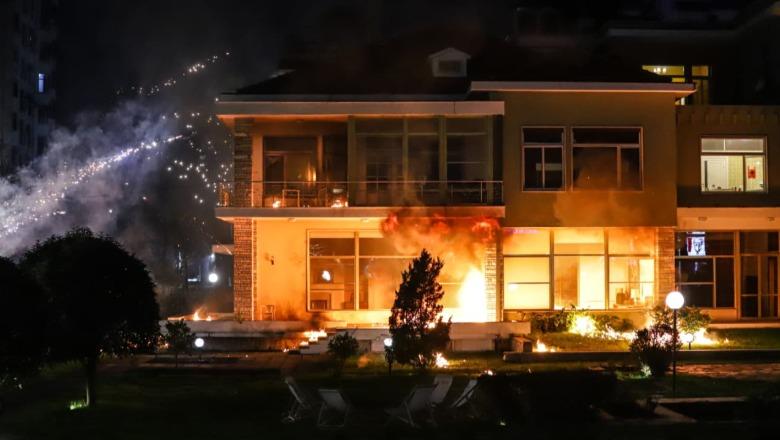
What began as a national protest organized by the opposition Democratic Party (PD) evolved Saturday evening into mobile confrontations across central Tirana, including a Molotov attack on the former residence of communist dictator Enver Hoxha — now repurposed as an arts center — while opposition leaders declined to distance themselves from the incident.
The protest followed a prior advisory from the U.S. Embassy warning American citizens that demonstrations near government buildings could “escalate into violence,” noting previous patterns of rapid deterioration and potential road closures.
By nightfall, that warning appeared prescient.
From Rally to Moving Flashpoints
Unlike earlier opposition rallies this winter, Saturday’s demonstration featured no podium, no formal speeches and no fixed staging area. Instead, opposition leader Sali Berisha led supporters in a moving march through central Tirana.
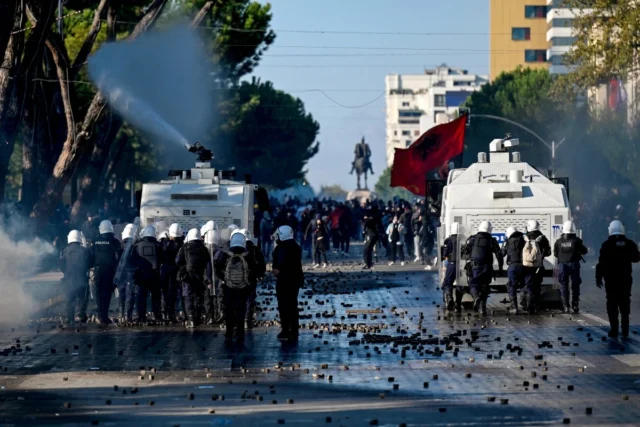
The protest route shifted from the Prime Minister’s Office toward the General Directorate of State Police and later the Tirana Police Directorate, relocating the center of confrontation from symbolic political targets to operational law enforcement institutions.
Along the route, Molotov cocktails were thrown into trash containers and toward at least one private business entrance. Police responded with cordons, water cannons and tear gas after demonstrators breached at least one security barrier near police headquarters.
Drone footage broadcast by local media suggested fluctuating crowd numbers, at times lower than earlier protest mobilizations this winter.
Molotov Attack on Former Hoxha Residence
The most serious incident occurred in the former Blloku district, where multiple Molotov cocktails and pyrotechnics were thrown toward the former residence of Enver Hoxha.
The building, while historically associated with the communist regime, now operates as an arts residency space. Media reports indicated that seven artists and three staff members were inside at the time of the attack, including foreign nationals.
No official casualty figures had been released as of late evening.
Opposition Response: No Distancing
Asked whether he would distance himself from the Molotov attack, Berisha declined.
“I have zero respect for Hoxha’s legacy,” he said, adding that protesters had believed Prime Minister Edi Rama was present at the site. He described the pyrotechnics as directed at Rama and characterized the march as a “peaceful uprising” against what he called a “narco-state.”
When questioned about the reported presence of foreign artists inside the building, Berisha responded: “What were foreigners doing there?”
Democratic Party parliamentary group leader Gazment Bardhi described the attack as “normal” given what he framed as the symbolic nature of the site, arguing that public anger is understandable when citizens perceive echoes of past authoritarianism.
Neither leader issued an explicit condemnation of the use of incendiary devices.
Government Reaction
Interior Minister Albana Koçiu stated that approaching police buildings and public facilities with Molotov cocktails “is not an act of protest but an open provocation.” She rejected the characterization of the march as peaceful, pointing to video evidence of incendiary devices thrown toward officers and property.
Prime Minister Edi Rama, in a separate social media statement, drew attention to images of burning bins and questioned the consistency between Albania’s Western alignment abroad and violent tactics in its capital.
Institutional Implications
Embassies routinely issue precautionary notices ahead of demonstrations worldwide. However, the U.S. advisory’s explicit warning about possible rapid escalation now frames the events in a broader context of concern over recurring confrontation patterns.
Saturday’s protest marks a tactical evolution: less centralized, more fluid and harder to contain. It also introduces a political threshold question.
While Albania’s constitution guarantees the right to protest, the normalization — or refusal to clearly condemn — the use of incendiary devices shifts the debate from crowd management to political accountability.
The presence of foreign nationals inside the targeted cultural site adds an international dimension unlikely to go unnoticed by EU partners and diplomatic missions in Tirana.
For Brussels and Washington, the core issue is not partisan competition but institutional maturity: whether political actors reinforce or erode the distinction between democratic dissent and combustible escalation.
As of 21:00 local time, police maintained a strong presence across central Tirana. No consolidated official figures on arrests or injuries had yet been released.
The immediate test now moves from the streets to leadership: whether future demonstrations recalibrate tactics — or whether escalation becomes the new baseline of opposition strategy.