Molotov cocktails and fireworks hit an international artists’ residence run with France’s Art Explora; the French Embassy condemns the violence as “intolerable,” while the government moves swiftly to replace the top of the police chain.
by Besa Ruka (Tirana)
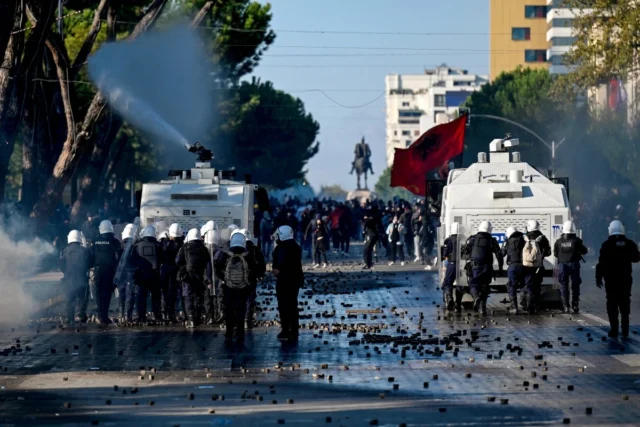
A protest that began as a political march ended at the gates of a cultural symbol — and on the edge of catastrophe.
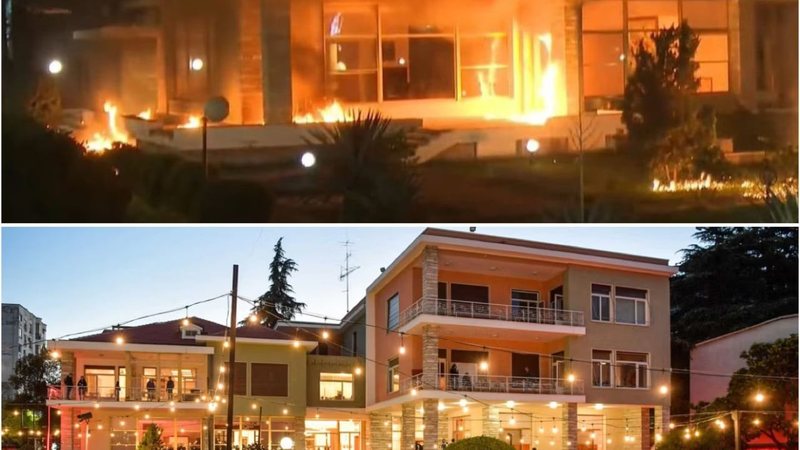
On the evening of February 28, protesters threw Molotov cocktails and fireworks toward Villa 31, the former Enver Hoxha residence now operating as an international artists’ residence in cooperation with the French foundation Art Explora. A fire broke out in part of the building, requiring firefighters to intervene.
What made the episode politically explosive was not only the damage — it was the fact that people were inside.
A residence with residents — not an empty target
Villa 31 is not a closed political relic. It is an active residency program hosting international artists. Albanian media reports say artists and staff were inside during the attack, and that the building’s materials and layout intensified the risk of rapid fire spread.
This distinction matters: in European democracies, there is a hard line between protest and the use of incendiaries against structures where civilians may be present. Albania crossed that line in full view.
France issues an unusually direct warning
The French Embassy in Tirana responded with language that was notably blunt by diplomatic standards, condemning the violence and emphasizing that the residence has operated since 2025 as an international artists’ program managed by a French foundation. The Embassy underlined that endangering residents and causing damage are “intolerable,” and stressed that the right to protest is incompatible with violence.
For Albania, which increasingly markets itself as a safe European destination for culture, tourism, and investment, that condemnation is not a footnote. It is reputational damage with a foreign policy dimension.
The state escalates: arrests, referral, and a break with protest “routine”
Police arrested four individuals in connection with violent acts during the protest, and media reporting indicates that procedural materials were also forwarded to SPAK regarding a PD lawmaker alleged to be linked to organizing.
The signal here is clear: authorities are framing this not as “unrest” but as criminal conduct, with escalation to specialized prosecution.
Rama visits Villa 31 — then moves against his own security leadership
On March 1, Prime Minister Edi Rama visited the site and publicly described the artists as traumatized, casting the attack as an assault on the country’s image and an act that endangered lives.
Hours later came the sharpest internal consequence: the government removed the two top police officials.
Albanian media reported the dismissal of State Police Director General Ilir Proda and Tirana Police Director Elton Alushi, with Sokol Bizhga appointed as acting head of the State Police.
Whether one reads this as accountability or political shock therapy, the message is unmistakable: after Villa 31, “business as usual” policing is not an option the government is willing to tolerate.
What this episode actually changes
This is not merely another tense protest night. It is a threshold event with three immediate consequences:
The protest playbook has changed — incendiaries aimed at symbolic sites are now part of the repertoire, and that forces a tougher state response.
Foreign partners are watching the rule-of-order test — the French Embassy’s language made that explicit.
Institutional pressure shifts inward — replacing the top of the police chain suggests the government is treating public-order credibility as a strategic asset, not a domestic inconvenience.
Albania’s opposition has the democratic right to protest. But Molotov cocktails are not protest tools — they are improvised incendiaries. The Villa 31 attack pushed the country into a category of political risk that European capitals recognize immediately: when street politics begins to flirt with fire, the state either reasserts control — or invites the next escalation.