The honest answer: we still do not fully know
An explainer for the Tirana Examiner
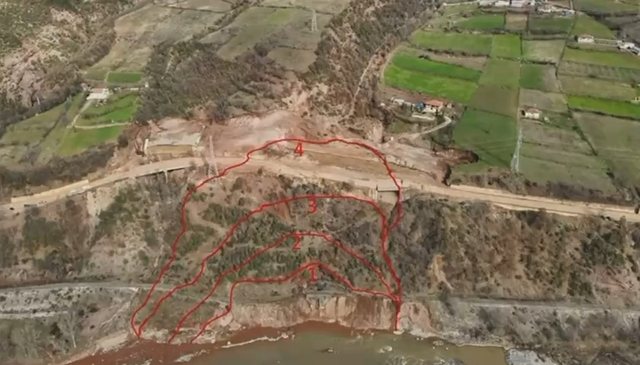
On the morning of February 21, 2026, a hillside at Arrat e Gurrës near Dragostunjë collapsed, severing one of Albania’s most important internal transport corridors.
Approximately 1,500 square metres of terrain slid downward, destroying a section of the national road linking Librazhd and Prrenjas. The landslide also damaged part of the under-construction Corridor VIII alignment, disrupted the Librazhd–Xhyrë railway line, and affected a segment of the regional high-voltage power network.
For eleven days, the southeast of the country remained effectively cut off from the rest of Albania.
Within hours of the collapse, two explanations solidified into political narratives. The government said the cause was natural. The opposition said the cause was corruption. Both conclusions were reached before the geology had been fully examined. And the reality is that neither explanation — at least not yet — fully accounts for what happened.
What the geology suggests
The argument for a natural trigger is not invented.
According to Ardian Bylyku, director of Albania’s Geological Survey, the Arrat e Gurrës slope has long been considered a landslide-prone zone. Rainfall in the region between December 2025 and the date of the collapse was roughly three times the average recorded over the previous decade.
In geotechnical terms, prolonged rainfall is one of the most common triggers of slope failure. As soil absorbs water, pore pressure builds within the slope, reducing the friction that normally keeps earth and rock layers stable. When that pressure reaches a critical threshold, the internal resistance of the soil mass collapses and large sections of hillside can suddenly move.
The Shkumbin valley, where the collapse occurred, is dominated by flysch formations — alternating layers of sandstone and claystone that are structurally vulnerable to saturation. Under heavy rainfall, the softer clay layers can behave like sliding planes beneath heavier rock strata. This type of geology is notoriously susceptible to sudden mass movement once saturation levels rise.
In that sense, the government’s explanation is technically plausible: extreme rainfall could indeed have triggered a landslide on an already unstable slope.
Further evidence suggests river dynamics may have contributed. The Albanian Road Authority’s emergency response plan included temporarily diverting the Shkumbin River to prevent continued erosion beneath the damaged roadway. Riverbank undercutting is a known mechanism in landslide formation: when erosion removes the support structure at the base of a slope, the upper layers can collapse under their own weight.
Taken together, these factors provide a credible natural explanation for the event. But they do not settle the question.
What the geology alone cannot explain
Heavy rainfall may explain why the collapse occurred when it did. It does not automatically explain why it occurred at that precise location, or why the damage was so extensive.
The Librazhd–Prrenjas road had been rehabilitated roughly twenty-five years ago and had functioned without major structural problems during that time. Instability along the corridor began to be reported only after construction started on nearby segments of Corridor VIII. That correlation does not prove causation — infrastructure projects frequently take place near existing roads without destabilising them — but the timing raises legitimate technical questions that require proper investigation.
Among them: Did nearby earthworks alter the stress distribution of the slope? Did material extraction from the Shkumbin River change erosion dynamics? Did construction activity modify drainage patterns within the hillside? None of these possibilities imply wrongdoing. They simply represent variables that a thorough geotechnical assessment must examine before any definitive conclusion can be reached.
Albania’s corruption reflex
The political reaction to the collapse revealed something else about Albania’s public debate.
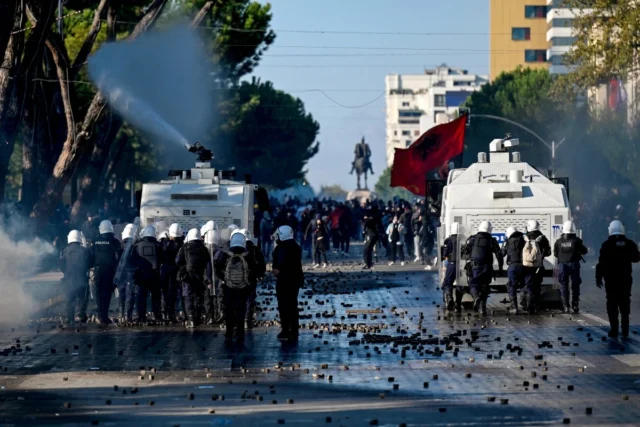
Within hours of the landslide, allegations of corruption began circulating widely. Contractors were named. Tender procedures were dissected. Political responsibility was assigned. All of this happened before geological samples had even been taken.
The reaction reflects a familiar pattern in Albanian political life: the near-automatic assumption that any infrastructure failure must ultimately be explained by corruption. That assumption is not irrational — Albania’s procurement history offers enough examples to sustain public scepticism. But over time the suspicion has hardened into a reflex that often replaces investigation rather than encouraging it. Instead of asking what the geology says, the debate quickly shifts to who won the tender. And the answer to the second question is treated as if it automatically answers the first.
The result is a political environment where conclusions precede evidence. Governments dismiss criticism as partisan noise, while opposition figures rush to frame every accident as proof of corruption — and the space for dispassionate technical inquiry contracts accordingly.
Prime Minister Edi Rama, during a site inspection on March 7, described the accusations surrounding the collapse as a political “mud storm.” The language was theatrical. But the phenomenon it described is real. Albania’s public discourse did reach its verdict on the Librazhd–Prrenjas collapse within hours, well before geological samples had been taken or construction records examined. Recognising that reflex does not mean corruption is absent from Albanian infrastructure projects. It means that serious accountability requires evidence rather than assumption — and that Rama’s deployment of the observation, whatever its political convenience, does not make it wrong.
The procurement questions
With that caveat squarely in place, there are legitimate issues that investigators should examine.
The fourth lot of Corridor VIII near Dragostunjë was awarded to the construction company ANK, managed by brothers Ndue and Agim Kola. Ndue Kola previously served as a Socialist Party member of parliament. Following the collapse, the Elbasan Prosecutor’s Office opened an investigation into possible abuse of office, violations of tender equality, and damage to road and land infrastructure. Prosecutors have also indicated they will review permits related to the extraction of inert materials from the Shkumbin River, an activity that could influence erosion patterns in the surrounding area.
ANK has previously been associated with other controversial infrastructure projects. The company built the Korçë–Ersekë road, where a separate collapse occurred in February 2024. It was later awarded an additional contract worth roughly €29 million for the Elbasan–Qafë Thanë road expansion, despite procurement records indicating that a lower-priced competing bid had been passed over. These facts are publicly documented. What they prove — if anything — about the Dragostunjë collapse itself remains to be determined.
The wider Corridor VIII project has already attracted scrutiny from watchdog organisations, which have warned of corruption risks across several tenders associated with the project. Earlier infrastructure projects along the same transport corridor also experienced serious governance problems: the Tirana–Elbasan highway ran approximately 80 percent over its initial budget, resulting in €44 million in arbitration penalties against the Albanian state. This history provides context. But context is not evidence.
What Rama got right — and where he overreached
During his inspection of the collapse site, Prime Minister Rama made one accurate technical observation. The new Corridor VIII alignment does not pass directly through the section that failed. The landslide occurred on the older national road. That distinction matters and should not be obscured by those eager to attach every piece of bad news to the government’s flagship infrastructure project.
Where his framing strains credibility is in the leap from “the new alignment is not here” to “construction activity played no role whatsoever.” Those are different claims. Active earthworks on an adjacent slope, changes in riverbank stability, and alterations to drainage patterns can affect adjacent terrain even when the precise construction alignment is located elsewhere. Pointing to a map and noting that the coordinates differ from the new road’s centreline does not settle the question.
Nor does dismissing the accountability debate as political theatre. A government confident in the soundness of its project management would welcome a transparent and independent engineering assessment of the site. So far, such a review has not been publicly announced.
What needs to happen now
Several steps are necessary if Albania wants a credible explanation of what occurred.
The geological core samples collected by the Albanian Road Authority should be published in full, allowing independent geotechnical experts to review the findings rather than relying solely on government summaries. The Elbasan Prosecutor’s investigation must proceed without political pressure — neither suppressed by the government nor inflated by opposition narratives seeking immediate political advantage.
For now, the region has been reconnected by a 200-metre temporary gravel diversion, while construction of a 1.3-kilometre bypass road is expected to take at least two months. Whether the failed slope itself will ever be stable enough to support reconstruction remains uncertain.
That uncertainty is not a weakness of analysis. It is simply the current state of knowledge.
The Librazhd–Prrenjas collapse may ultimately prove to be a natural disaster intensified by extreme rainfall. It may reveal engineering mistakes. It may expose procurement failures. Or it may involve a combination of all three.
Until the investigations are complete, the honest answer remains the same: we do not yet fully know what caused the collapse. And acknowledging that uncertainty is the only credible starting point for discovering the truth.