The novelist Beqë Cufaj, Kosovo’s former ambassador to Germany, looked at the protests in Tirana and saw a country being romanticized onto the streets at the worst possible moment. He was right to be suspicious, and the suspicion leads somewhere his short post only pointed.
Ardit Rada (Tirana)
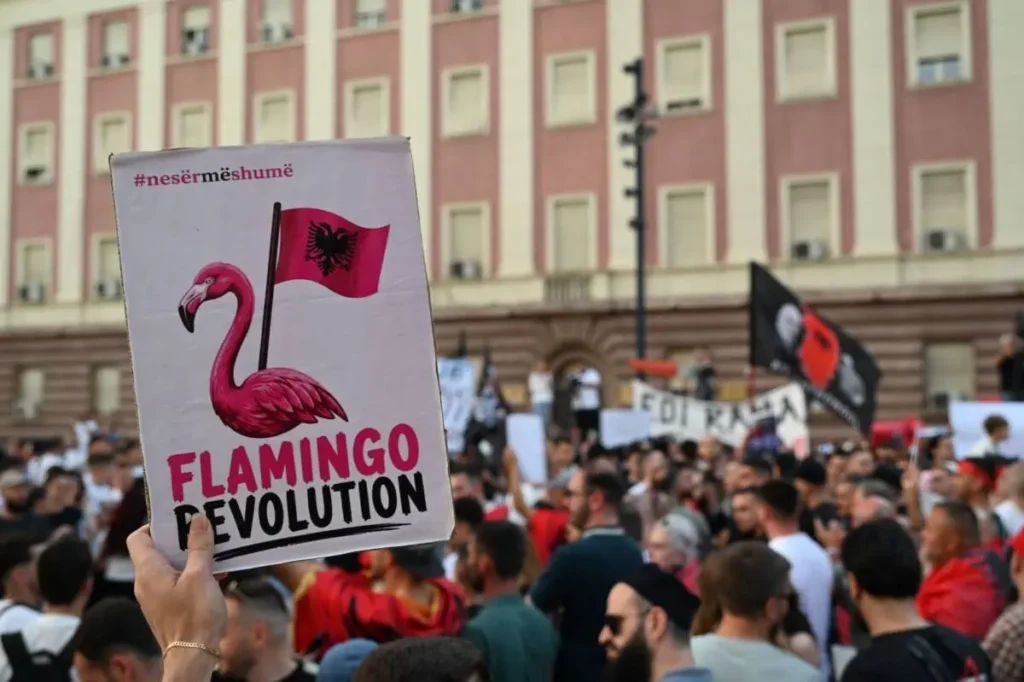
A flamingo makes a good photograph. Pink, absurd, faintly tragic on one leg in front of a line of riot police, it captions itself. A flag carried upside down does similar work. So does a banner that reads not for sale, three words a picture editor in Berlin or Brussels can run without a translator and without the footnote explaining that the sale in question concerns a stretch of coastline near Zvërnec. The Tirana protests have produced a whole season of such images, and the images have traveled. That is the first thing worth understanding about them, and for most of the audience abroad it is also, unfortunately, the last.
Beqë Cufaj noticed the mechanism this week, and he did something most commentators avoid: he handed over the knife before anyone reached for it. He has known Edi Rama for twenty years, he wrote, and he asked to be read in that light. Read this as that. There is a kind of honesty in naming your own bias out loud, and it earns a hearing for what follows. What follows is short. The West loves a Balkan protest. Flamingos, flags, the slogan that fits the frame. Less photogenic, he noted, is the actual event underneath the photographs: Albania negotiating the final chapters of European Union membership, closer than it has ever been. He found it strange to romanticize a country onto the streets at the exact moment it has almost arrived.
He is right that there is a template, and that Albania has been dropped into it. The Western press carries a settled grammar for the Balkan street, refined over thirty years and rarely revised. A crowd, a strongman, a morality play with the cast assigned before the curtain. The crowd is the people; the man at the podium is the past refusing to die; the correspondent’s task is to find the most photogenic face in the square and let it stand for a nation’s conscience. It is a satisfying story and a lazy one, and it flattens whatever it touches. A protest told in this grammar never has to explain who organized it, who paid for the staging, who wrote the slogans that translate so conveniently into English. It only has to look like resistance. Looking like resistance is enough.
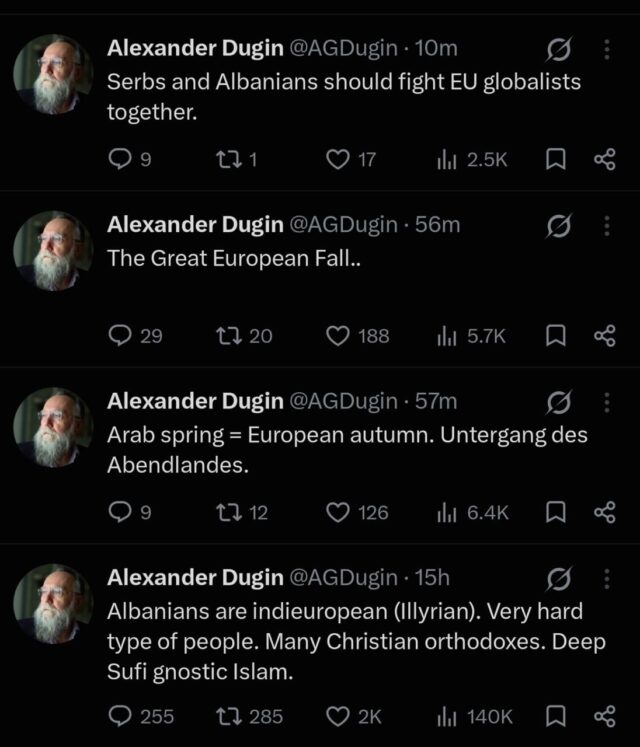
Here the Tirana Examiner declines the invitation. We do not read this protest as a beacon lit by coincidence. The amplification around it has not been organic, and we have spent many hours documenting why. The Iranian networks that Meta removed did not surface from love of Albanian democracy. The Russian-aligned accounts that adopted the flamingo as eagerly as any Tirana student are not invested in the independence of Albanian courts. When a narrative this useful to the people who want Albania kept out of Europe arrives this fully formed, this ready for the wire, the romantic reading is not merely sentimental. It is performing a service, and the beneficiary is not standing in the square.
So the photograph deserves the suspicion Cufaj brought to it. Now the question the photograph is built to keep you from asking.
Does a country reach Europe faster by removing, through the street, the government that engineered the road to it, or by the slower and less photogenic work of dialogue that strengthens the institutions the road is made of? The two answers are not equivalent, and they are not both available at once. The first calls itself courage and ends in rupture: a negotiating team scattered mid-cluster, a continuity that took a decade to build handed to whoever inherits the wreckage, and a gift delivered straight to every accession skeptic in every member-state capital who has been waiting for proof that Albania is not ready after all. The second is unglamorous. It looks like committees and vetting and chapters closing one by one. It does not photograph. It is also the only one of the two roads that has ever actually carried a Balkan country into the Union.
We owe the honest objection its hearing, because it is real. The chapters Albania is closing are not neutral chapters. They are the rule-of-law chapters, the anti-corruption chapters, the chapters on free media and independent courts. A citizen who stands before the prime minister’s office and shouts that the state is captured is not changing the subject from accession; he is, knowingly or not, reciting its table of contents. The grievances are not all invented, and no one serious should pretend they are.
But grant the grievances and the question only sharpens. The remedy for a flawed accession is more accession, not less. The conditionality is itself the lever: the courts grow independent because the process demands it, the prosecutors gain teeth because the chapter requires teeth, the captured institution is pried open by the same standard the protester says he wants. Burn the continuity that powers that machinery and you do not get cleaner institutions faster. You get the machinery switched off, and a decade to build the next one, if there is a next one. To unseat the architect mid-construction in the name of the building is to hand the blueprint to people who never wanted it raised.
Which returns us to where Cufaj began, and a little past it. He did not say the grievances were fictional. He said the timing was strange and the romance was being supplied from somewhere. Both are true, and the second is the part this publication will not look away from. A country can hold a real quarrel with its government and still be worth more, to itself and to everyone who wishes it well, finished than romantic. Albania is closer than it has ever been. That is the least photogenic fact in the country, and it is the only one that will still matter long after the flamingos are folded and put away.