Albania answered the river announcement with Serbia’s own treaty file. The file says more than the statement does.
By Drizan Shala
While Serbia’s president was explaining to reporters in Prijepolje that he threatens no one, Albania’s answer to his river announcement was already in circulation, posted by the country’s Minister for Europe and Foreign Affairs, Ferit Hoxha. The statement records deep concern, and then does something more useful than concern. It reads the file aloud: the Ibër (Ibar) as part of a transboundary water system, the principles of equitable and reasonable use, the obligation to prevent, control and reduce transboundary harm, the duties of cooperation, information and consultation, Serbia’s membership of the UNECE Water Convention since 2010, and Serbia’s acceptance of the Convention’s own mechanisms for settling disputes. One sentence carries the document: “Uji nuk mund të përdoret si instrument presioni politik dhe as si mjet për të ndëshkuar një vend apo një popullsi tjetër.” Water cannot be used as an instrument of political pressure, nor as a means of punishing another country or another population.
Tirana quoted the file politely. The file, read in full, is less polite.
What the statement answers is a week of record. On Sunday in Belgrade, Serbia’s president announced that construction experts and engineers had been called in to study changing the course of the Ibër: “Kada već toliko maltretiraju naš narod… pa ćemo da vidimo šta će da rade Albanci i kako će da se ponašaju.” Since they mistreat our people so much, then we will see what the Albanians will do and how they will behave. On Monday in Prijepolje he said he threatens no one, that he is not Kurti, to go threatening people, and that he is managing watercourses under Serbia’s internal law, and then he repeated the conditional inside the same remarks. The denial arrived with the threat still in it. He also said this: “Tamo gde je jezero Gazivode danas, gde je bilo juče, ne znam da li će biti i sutra ili gde će biti.” Where the lake at Ujman (Gazivode) is today, where it was yesterday, I do not know whether it will be there tomorrow, or where it will be. The construction was not improvised. Eight days earlier, at the memorial cross in Janjila on the Petrovačka cesta, standing beside Milorad Dodik, Belgrade’s head of state had fused the same disavowal to a capability claim, an army he put at fifty times the strength of the JNA, followed at once by we attack no one. The denial as prefix, the menace as payload, twice in eight days.
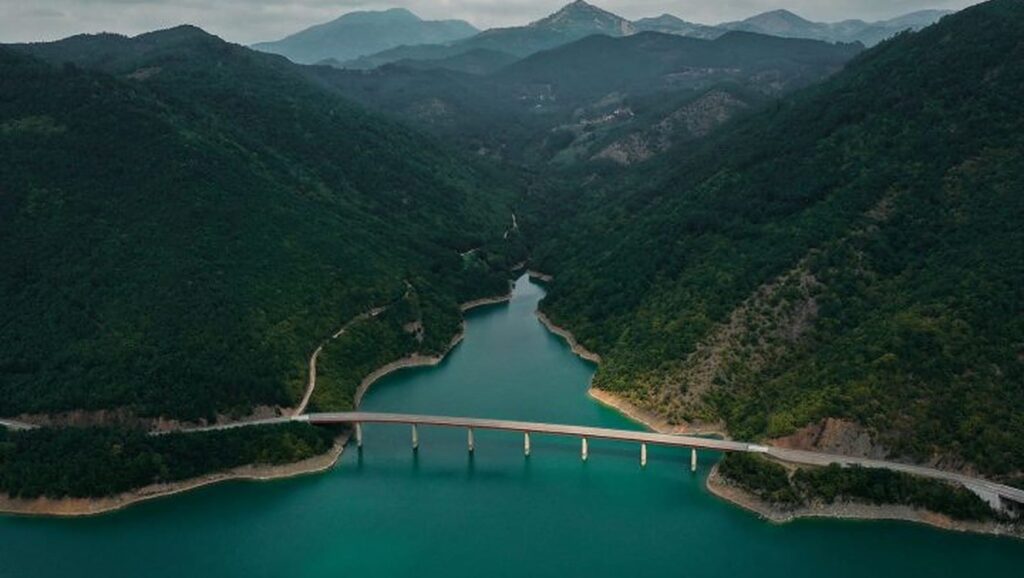
The answer’s first virtue is that it knows what the object is. Ujman (Gazivode) feeds the Ibër-Lepenc canal, an artery of roughly fifty kilometers that carries household water and the cooling water for the power plants at Obiliq; in the World Bank’s own project language, central Kosovo, the capital included, depends almost entirely on this canal to meet its water needs. A conditional project aimed at that water is aimed at a population, and Tirana’s text says so in the register that travels: water security, supply, the environment, the life of another country’s citizens.
The second virtue is precision about the file. Serbia acceded to the Water Convention on 27 August 2010; Tirana names the year. Fewer readers will know what the next clause contains. Upon accession, Belgrade filed a declaration under Article 22 accepting both of the Convention’s compulsory means of settling disputes, arbitration and submission to the International Court of Justice. So the statement’s reference to the Convention’s dispute mechanisms reads like boilerplate and works like an address: it points at a forum, and at a forum Belgrade chose for itself, in writing, sixteen years ago.
The forum’s case law is settled where it matters. The International Court of Justice restated the no-harm rule in Pulp Mills in 2010, and in the Gabčíkovo judgment of 1997 it held that a state which unilaterally assumed control of a shared resource, through works built entirely on its own territory, had deprived its neighbor of an equitable and reasonable share of the river and breached international law. Serbia’s entire defense this week, “rešavam vodotokove na teritoriji Republike Srbije,” I am dealing with watercourses on the territory of the Republic of Serbia, is the argument that lost.
The objection to all of this writes itself: statements of concern are the cheapest currency in the Balkans, and the region’s archives are full of deep concern that changed nothing. Mostly the objection is right. It misses what this text does differently. A protest names a behavior. This statement names a forum, obligations with treaty numbers on them, and a signature Belgrade cannot disown, which converts concern into a path with a courtroom at the end of it. And it asks for things a state that threatens no one loses nothing by providing: transparency, scientific data, a full transboundary impact assessment, consultation with the affected side. The request is the test. Refusal is the finding.
Nothing here depends on whether the river can actually be moved. When the diversion idea first circulated in December 2024, Avdullah Nishori, then on the management board of the Ibër-Lepenc company, called it impossible even on economic grounds, a colossal investment. It circulated then because someone had just attacked the canal with explosives at Vragë in Zubin Potok, on 29 November 2024, an attack Kosovo attributed to Belgrade and no court has resolved. The infrastructure has been struck once, anonymously, and is now named openly, from the top, with a condition attached. An announcement of that kind does its work whether or not a single cubic meter ever changes course.
One more thing the Albanian text registers, perhaps without meaning to. Kosovo’s environment minister, Fitore Pacolli, had already written: “Resurset ujore nuk mund të përdoren si instrument kërcënimi, presioni apo destabilizimi ndaj një shteti tjetër.” Water resources cannot be used as an instrument of threat, pressure or destabilization against another state. Tirana’s text runs on the same words, instrument and presion. Two capitals reached for one legal vocabulary within a day of each other, which is what it looks like when a file passes from a region’s politicians to its lawyers. Albania is, so far, the first member of the Atlantic alliance to answer, and it answered at the level of its foreign minister; the statement is addressed to Belgrade while being written for Brussels and Washington.
Serbia’s president says he threatens no one. Tirana’s answer takes him precisely at his word: a state with no threat in mind has a procedure waiting, sixteen years signed, forum included, built by Belgrade’s own hand. Walking through that door costs a state that threatens no one nothing. What it would cost a state that meant the condition is the measurement Tirana has just proposed.
Drizan Shala writes on security, institutions, and political violence for Kosovo Dispatch and Tirana Examiner. He is a doctoral candidate at the University of Sarajevo.