Albania’s new gender equality framework reaches the UN. The harder work begins at home.
by Rexhina Bici (New York / Tirana)
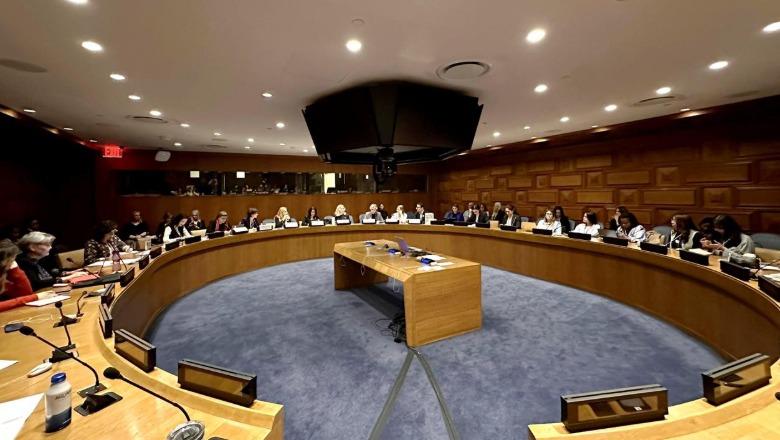
On March 10, in a conference room at the United Nations in New York, Albania’s Minister of Health and Social Welfare Evis Sala said something that sounded, in that setting, almost unremarkable. Gender equality legislation, she told the assembled diplomats and experts gathered for the Commission on the Status of Women’s seventieth session, is not a peripheral instrument of public policy. It is a structural pillar of democratic governance.
The audience — many of whom have been saying precisely this for decades — received it as consensus. What they could not fully see is how contested that statement remains in Tirana.
That Sala was in New York at all is worth noting. Ministers from Western Balkan candidate countries rarely appear at CSW side events co-organized with the OSCE’s Office for Democratic Institutions and Human Rights. That Albania chose to co-host this session alongside Poland — an EU member state — and to send a minister who spoke with evident command of the policy framework rather than reading from prepared diplomatic language, signals something deliberate about how Tirana wants this reform to be seen internationally. Six days earlier, on March 4, Sala had presented the same framework to students and academics at the Faculty of Social Sciences in Tirana, arguing in terms that were notably direct for a sitting minister: equality on paper, she said, is not equality in life. This was not the language of bureaucratic compliance. It was the language of someone who understands what the legislation is actually for.
Albania’s new Gender Equality Law, adopted in 2025 after fifteen years of experience implementing its predecessor, does several things that are genuinely significant. It extends gender equality obligations beyond public institutions to the private sector for the first time. It mandates gender mainstreaming across policy development. It sets a legal floor of 30 percent balanced gender representation in elected and appointed bodies, with progressive movement toward full parity as a long-term strategic objective.
But the provision with the greatest structural weight — and the least political visibility — is the one that formally recognizes unpaid care work as an economic activity.
This is not, as critics have sometimes framed it, an administrative gesture toward sentiment. It is a conceptual reorganization of how the state understands labor. Childcare, eldercare, household management — work that falls disproportionately on women across the Western Balkans and that has never appeared in national accounting systems — is now legally acknowledged as a genuine contribution to economic functioning. The law obliges the government to measure it and incorporate it into budgetary policy.
The implications are not symbolic. In Albania, women participate in the formal labor market at significantly lower rates than men. Wage disparities persist across multiple sectors. These are not mysteries. They are, in large part, the predictable output of a system that required women to perform an enormous volume of socially necessary labor while pretending that labor did not exist. A legal framework that names the problem does not solve it — but it does remove the state’s ability to feign ignorance in the design of future policy.
In New York, Sala outlined four elements the Albanian experience suggests are necessary to make gender equality legislation effective: balanced representation as a legal requirement in public institutions; gender impact assessment integrated into the legislative process; gender-responsive budgeting in public financial management; and stronger institutional coordination and accountability mechanisms. She also made a point that rarely surfaces in diplomatic settings: the law’s passage was accompanied by substantial public debate. That is a careful formulation for what was, in practice, a politically turbulent parliamentary process — but the willingness to name it at all, before an international audience, reflects a minister who is not simply performing compliance.
The international scaffolding around the reform is genuine. At the March 4 Tirana event, UN Women representative Michele Ribotta was explicit: drafting and implementing the Gender Equality Law is an obligation stemming from Albania’s EU integration process, and its ultimate purpose is to expand real opportunities for women and girls. European Commissioner for Enlargement Marta Kos welcomed the reform publicly. The law aligns Albania’s framework with the EU gender equality acquis — a requirement of accession negotiations, but also, increasingly, a floor that Brussels expects candidate countries to exceed rather than merely reach.
This is the paradox that Albanian public debate rarely pauses to examine. A country that is frequently, and not always unfairly, described as lagging European standards has, on the specific question of recognizing the care economy in law, moved ahead of where several EU members stood a decade ago. Women currently hold approximately 36 percent of seats in the Albanian Parliament — above the EU average for legislative representation. Roughly ten percent of the national budget is now planned using gender-responsive budgeting analysis. These are not trivial achievements.
They are also not the whole picture.
Albania has a well-documented pattern — visible in health reform, judicial restructuring, and anti-corruption policy — of adopting legislation that is formally sophisticated but institutionally underperforming. The gap between what the law says and what the state can actually deliver is not unique to gender policy. But it is particularly acute here, because the ambitions of the new framework — measuring unpaid care work, integrating gender impact assessment across government, reorganizing the National Council for Gender Equality — require sustained institutional capacity that has not yet been demonstrated.
Sala, to her credit, said as much in Tirana on March 4. Secondary legislation is still needed. Institutional mechanisms require strengthening. The reorganization of the National Council is pending. A minister who publicly names the unfinished architecture of her own reform, before it has had time to accumulate political credit, is doing something that deserves to be recognized as unusual.
What happens in that gap is the real story — not the law’s passage, which was always the easier part, but the slow and unglamorous work of building the administrative infrastructure that makes a legal commitment mean something to a woman in Shkodër trying to re-enter the labor market after ten years of caregiving, or to a female civil servant in a ministry where gender impact assessment is now nominally required but practically unfamiliar.
The New York side event was, in the language of international diplomacy, a success. Albania presented itself credibly as a country serious enough about gender equality to co-host a session at the UN Commission on the Status of Women alongside an EU member state, and to send a minister who spoke not as a diplomat reciting positions but as a policymaker who has thought carefully about what the legislation is actually trying to do.
That credibility is worth something. It is not, however, the same thing as implementation.
The distance between those two things — between the statement that equality on paper is not equality in life, and the institutional architecture required to close that gap — is precisely the distance Albanian governance now has to travel.
The harder work, as always, begins at home.
About the author
Rexhina Bici is a health policy specialist based in Tirana. She holds a PhD in Health Management from the University for Peace, a United Nations-mandated institution, with research focused on health system governance, institutional reform, and public-policy development. Her work examines health-system modernization, institutional transparency, and the alignment of Albania’s health governance framework with European Union standards.