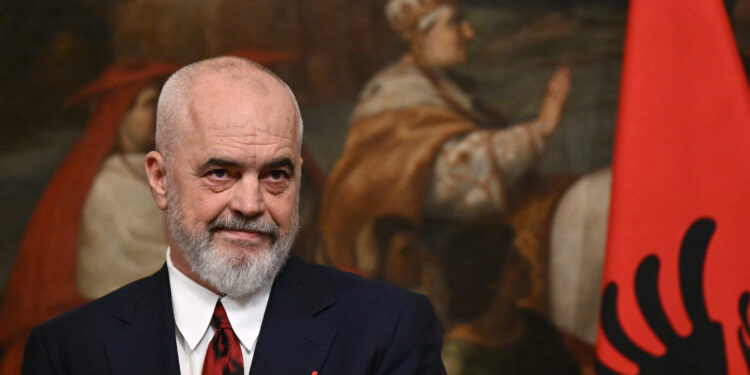
This weekend Edi Rama gathers his ministers for a retreat in Pogradec, armed with two strategic documents about the gap between power and the citizens. He himself appears in neither. This piece fills that absence, with a simple reminder: his legitimacy was born among Albanians, and only there can it be lost.
by Albatros Rexhaj (Tirana)
Where does legitimacy come from: from the Albanian people who vote, or from foreigners? Politicians in Albania have often deceived themselves into believing that their standing abroad, the way they are seen from outside the country, is what decides their political fate at home. In reality, that is the formula of those who sense that something has gone wrong between them and their own base, and who try to fill the void with the foreign factor. Sali Berisha did the same during his years in power. President Bush’s visit, Albania’s accession to NATO, visa-free travel to Europe and a few other things besides were historic achievements for Albania, yet none of them was enough to repair Berisha’s relationship with the Albanian people, and so his fall from power was inevitable.
At the end of this week, Rama will gather his ministers for a retreat in Pogradec, a sector by sector review. Very well. But Rama also owes himself a conversation. If we have truly learned anything, or want to learn anything, from the flamingo movement, then the reflection must not stop at the premise that discontent became protest because the party went missing, because “we had left the street, the neighborhood, the conversation” and others filled the gap of presence. That is, at the idea that the problem is somehow solved by closer presence alone, sector after sector. I have studied Rama’s strategic documents closely, BESA and its annex, along with his interviews and public statements. The things he identifies as the heart of the problem, the rise of expectations, the void left by the withdrawal from the base, the algorithms, all of them stand; his own documents put it better than his defenders do, conceding that “ingratitude is the worst possible name for the citizens’ reactions” and that the protest of expectations “cannot and must not be fought.” But that is not the whole of it. In the reflection Rama is presenting, Rama himself is missing, which is to say his responsibility is. My dissent from the flamingo revolution would be insincere if I stayed silent now, before this attempt at laundering his responsibility.
Now that the middle class, which is to say Rama’s own voters, has withdrawn from the protests, the sycophants are flooding in with the story that Rama’s sin is trusting the wrong people; Rama, in this telling, is entirely good, the bad ones are those beneath him, and so the problem will be fixed with a few cabinet changes on the government’s first anniversary. Should there be cabinet changes? Yes, absolutely, because some ministers and deputy ministers have failed and must go. Should some mayors be refused renomination, a few of them drunks who barricade themselves in their offices and treat their municipalities as private estates? Absolutely yes. But is that enough? No. Because part of the problem is the public perception of Rama himself. If the mayors and certain members of the government are the ugliest picture of arrogance, it is because in their own minds they are imitating Rama. Let there be no misunderstanding: they are not copies of Rama, but I would not call them a distortion either. They are something in between, a dangerous hybrid.
So nothing will change unless Rama himself does something to change the perception of him. And this brings us to a crucial point. If Rama’s only aim is to continue governing, to finish the fourth mandate and in all likelihood secure a fifth, he can easily exempt himself from the problem. If in June Rama was weak, and you could smell it in the fact that he was effectively abandoned, everyone falling silent and waiting to see how things would turn before declaring themselves, today Rama is strong. No force can stop him from purging all internal dissent within the Socialist Party and carrying on with his project of sidelining the other parties into irrelevance. In the end, power is decided by votes, and Rama will win them, because there is no one else to win them. But Rama today should be thinking about more than how to continue governing, since that much is assured; he should be thinking about how he will be remembered by the young generation of Albanians. And the reality is that if the reflection is insincere, Rama will not be remembered as a positive figure. Despite the great works that have been done, something has happened, and Rama’s image has been wounded. Personally I believe the perception of Rama is wrong, but neither can I absolve Rama for the fact that this perception of him, a figure now grey, now dark, took shape at all.
Rama’s problem is not something that personnel changes, a return to the base and better PR can fix on their own. There is also a problem Rama has with Rama, and the way he resolves it will determine how he is remembered after he leaves power. Will he enter history as an autocrat, an arrogant snob, a leader of promise who in the end disappointed the Albanians, or as a positive figure who transformed Albania?
Rama’s people, the ones who genuinely want to help him, who are few, and the ones waiting for their chance to take the party from him, who are many, say that Rama no longer inspires. The flamingo movement suggests there is a truth in this, but it is not the whole truth. The whole truth is that Rama has transformed Albania, and yet, like Moses, who labored his entire life to bring his people to the Promised Land only to be denied the sight of it himself, Rama risks watching someone else take the baton from his hand and finish his work. The difference is that Moses entered history as a positive figure, whereas Rama may be denied even that. Which raises the question: denied by whom? And that question has no simple answer.
I might not have written this piece at all, were it not for Rama’s post on X about his friend Zelensky. He wrote his reaction in English; the intended audience, in other words, was not Albanian.
Recall what produced that text. On 8 August, in Belgrade, an RTS journalist asked the president of Ukraine whether Serbia could continue to count on Ukraine’s support. Note the word in the question: support. The journalist did not simply ask whether the known position still stood; she asked for a pledge of support to Serbia. And Zelensky answered inside that frame, confirming that Ukraine’s position on the non-recognition of Kosovo’s independence “remains unchanged.” The position itself was known from day one and surprised no one; but it is one thing to hold a position, and quite another to promise Serbia, in its capital and before its cameras, that it can count on your support. The president of a country at war could have sidestepped the question with ease, for a country at war can always say that these are matters for after the war. He chose instead to attack Kosovo’s right to exist in the name of Ukraine’s right to exist, and to do so standing with Serbia, Russia’s ally. The same day Rama came out in his defense, I answered publicly, in Albanian: we owe Ukraine and Zelensky nothing, because our solidarity was never a loan awaiting repayment; a little care and respect toward Kosovo and the Albanians therefore honors them, not us.
In short, everything in Rama’s text says that someone among the internationals was unsettled that Albanians had rebelled and spoken their indignation at Zelensky freely. Apparently it was not enough for them that Kosovo’s foreign minister Glauk Konjufca and Albania’s Ministry of Foreign Affairs under Ferit Hoxha, the very next day, on 9 August, and despite the disappointment with Zelensky, reconfirmed the continuity of principled support for Ukraine; they complained to Rama and asked him to discipline the Albanians, because what Albanians had been saying in comments and columns was, apparently, dangerous. To me, Rama’s reaction is no mystery; it is the reflex of a servile streak in Albanian politics that answers YES SIR to every piece of nonsense the foreigners serve up. And it tells me that Rama needs a session of self-reflection with Rama.
The questions Rama should put to Rama are these:
Whose prime minister are you? The Albanians’, or that of foreigners who still look at Albania as a safari?
Where does legitimacy come from? From the consent of Albanians, or from the approval of foreign bureaucrats?
When you address Albanians, should you speak as a self-righteous prick, or as their chief public servant?
Let me start with the last one. Within two days, you labeled your Albanian critics twice with the same vocabulary: on 12 August, after the reactions to your statement that “Serbia has lost Kosovo,” you wrote of “the troll army of Prishtina’s nationalist turbofolk” (“ushtria e trollave të turbofolkut nacionalist të Prishtinës”) and of the nationalist turbofolk of Belgrade and of Prishtina alike; on 13 August, in English, of “folk nationalists” in Tirana and Prishtina. The word nationalist carries the connotation of chauvinism, and in that sense there is no such thing as Albanian nationalism. Unlike our Greek and Slavic neighbors, there has never existed, and does not exist, an Albanian project with chauvinist designs on other peoples. Our misfortune as a people is that every attempt of ours to preserve our physical existence has been attacked as nationalist. The Greeks and the Slavs have seen our physical existence as a threat, and still do, and with that they justify their chauvinist policies toward Albanians.
Edi Rama is quite right when he says that the Albanians of today are no longer the Albanians of 2013, but his analysis leaves out the critical fact that Albanians today are far more patriotic than they were in 2013. If the generation over 45 still carries its inferiority complexes, the young generation of Albanians carries none. And this transformation, this rise in love of country and in the readiness to stand up for it, did not fall from the sky. Its genesis lies in Rama’s dignified stand in Belgrade in 2014, in his dignified stand, free of complexes, before the Greeks, in Albania’s transformation from a black hole of the Balkans into a global destination, and in many good things that have happened over the past decade. I do not understand why Edi Rama now rises to distance himself from his own creation.
And for what? To collect points with a handful of bureaucrats in Brussels and European liberal politicians who are busy wrecking Europe itself with their utopias? Well then, where were they when the flamingo movement erupted? Or were they perhaps against Rama, some of them throwing their full weight behind the protests? What is this urge to deepen the gap with your own people?
Rama would do well to look at who applauds this servile approach, and he will find that the overwhelming majority belong to the generation over 50. That is the generation that lost its faith in the homeland in the nineties. The young generation, the generation that grew up creating the spirit that brought the Rilindja, the Renaissance of 2013, and then came of age nationally in the decade that followed, is irritated by it. Their disappointment is aimed not at Albania but at those who lead it, and that is the entire difference. They are your creation, Edi; they are not the product of algorithms.
Your legitimacy, then, was born of this generation and was no invention of the internationals, and you do not get to trade it now for an absurd servility toward foreigners. You are the prime minister of the Albanians, not a regent appointed by Brussels. Albanians want European integration, but they do not want to lose their sovereignty; they want something in between, something dignified.
And if you decide to do what Albanian politicians ordinarily do, to dig in and persist, then you would do well to remember what these Brussels bureaucrats and European liberal politicians actually think of Albania and of you. To them, Albania is a nest of crime and corruption, and its criminal in chief and thief in chief is you. When they need you for something, like this trick with Zelensky, you are their useful idiot; the rest of the time you are the criminal in chief and the thief in chief.
I think you are neither, not an idiot, not a criminal, not a thief, just as I do not think Albania is what they describe. But the way you keep doing things, what I think does not matter; what matters is what the foreigners think.
Consider some of the experiments they run, SPAK first among them. Your servility, and I will not mince words, is the main factor behind the creation of a structure whose only true counterpart is the Kosovo Specialist Chambers. A juridical monster which you, exactly like Hashim Thaçi in Kosovo, wrote into the constitution, creating a structure in which the line between prosecutor and judge thins to the point of invisibility, and in which the prosecutor, like the Sigurimi of old, holds the power to place anyone under surveillance on his own authorization. And this is no longer a hypothesis. In February 2025, on the order of a special prosecutor and with the approval of the head of SPAK, a judge of the Constitutional Court was watched, photographed and recorded for fifteen days, without any court decision, because Articles 221 and 222 of the Code of Criminal Procedure allow the prosecutor to authorize covert surveillance in public places on his own. And when the president of the Constitutional Court asked in an official letter whether any judge was under investigation, the answer from the head of SPAK, dated 26 February, was that no constitutional judge was a person under investigation and that no criminal report existed against any of them; the surveillance he had approved had ended the day before. As a consequence of your servility, then, we live in a reality where SPAK’s prosecutors can place the judges of the anti-corruption courts and of the Constitutional Court itself under surveillance; blackmail, we hope, has not happened; but the capability has now been demonstrated in practice.
And where is the result of this reform? Has corruption shrunk in the perception of Albanians? No, and that is no news, because so it went in Romania, in Italy and elsewhere. The citizen has no contact with high-level corruption and, frankly, no great interest in it. The citizen suffers corruption at the middle and lower levels, and there nothing has changed. SPAK has produced no result against that corruption, and does not trouble itself to. And do you know why? Because its patrons in Brussels and elsewhere have made it their mission to put you in prison; because if you and those around you end up behind bars, that will stand as proof the reform has succeeded. And so far does this madness go that the suspicions of a SPAK prosecutor are treated as Bible and Quran; the prosecutor needs no evidence that a man is guilty, suspicion suffices. If a SPAK prosecutor suspects someone, that person is not innocent until proven guilty but guilty until proven innocent. This is the terror the foreigners, with your help, have installed. They do not want judicial reform; they want SPAK as a power above all powers. If Brussels and SPAK’s other patrons dislike minister X, it is enough for SPAK to issue a notice that an investigation has opened, and the minister must resign or you must dismiss him. And the most painful part of this story is that the generation you yourself raised has been disappointed so deeply that it stands ready to accept a dictatorship of prosecutors as normal.
And whoever wants the concrete specimen of that dictatorship has it in plain sight, in the cell of Tirana’s mayor. Without entering at all into the guilt or innocence of Erion Veliaj, which only a court can settle with a final decision, the procedural facts suffice: indicted on thirteen counts, in pre-trial detention since 10 February 2025, eighteen months and counting; the full case file reached his cell a year after his arrest; the trial on the merits has been restarted from scratch; and the detention clock has been suspended again and again, even when hearings collapsed over the absences of other defendants’ lawyers, even when his wife could not appear because she had just given birth, a birth for which SPAK itself had granted Veliaj his first leave from his cell in sixteen months: 48 hours. Pre-trial detention, which the law defines as an exceptional measure, has been turned into an advance sentence; and when the sentence comes before the trial, the presumption of innocence has been abolished in practice, just as I described above. The man an entire country knew as your successor is held today not by a court’s decision but by the absence of one.
And in this whole story there is one more absurdity that deserves a chapter of its own: the Albanian opposition, which hopes to take power precisely through SPAK. It does so without reckoning for a moment that tomorrow it too will have SPAK as a power above itself; in the name of reaching office, it is working to unmake the parliamentary republic in favor of a republic of prosecutors. And so far does the madness go that SPAK is now seeking its own armed wing, the special operational group its chief announced publicly at the end of July, full Judge Dredd mode: investigator, prosecutor and armed force in a single body. And the opposition, instead of asking what republic remains after all this, can hardly wait for that very body to clear its path to power.
And here I must say what neither the sycophants nor his haters can bring themselves to say: I believe Edi Rama can inspire again. I believe it because he has done it once, and the proof walks our streets every day. The generation without complexes, the one that stands up for its country and refuses to be taken for granted, is his greatest work, greater than any road and any airport. And anyone who looks closely at when Rama has inspired will notice a regularity he needs now more than ever: Rama has inspired precisely in those moments when he cared least what the foreigners thought. In Belgrade in 2014 he did not speak to please the chancelleries; he spoke because dignity demanded it, and that day he won something no poll can measure. The source of his inspiration has always been one and the same, dignity without complexes, and that source still flows; Rama has simply stopped drinking from it.
So the road back requires no discovery; it requires only that Rama return to his own best self. Speak to Albanians in Albanian, with explanations rather than report cards on their behavior. Begin the reflection with yourself and say your share of the responsibility out loud; your own document says that trust is not strengthened by dodging mistakes but by facing them, and a leader who owns his share does not shrink, he grows. Take your place beside your own creation: be the spokesman of the Albanians before the foreigners, not the spokesman of the foreigners before the Albanians. And carry European integration the way Albanians want it carried, with dignity and without kneeling. No one else on the political scene can do this today. Which is exactly why we ask it of him.
And it falls to you, Edi, to solve the problem Albanians live with every day, corruption at the middle and lower levels, because SPAK has it neither in its mandate nor at heart, and it is there that the citizen touches the state with his own hands: at the counter, with the inspector, over the permit, in the hospital queue, in the municipal tender. This fight requires no new structure written into the constitution; it requires will and governing imagination. Give the ordinary prosecution offices and the inspectorates the devotion you gave the grand reforms, for they are the forgotten instrument of everyday justice. Strip discretion of its terrain: wherever a service cannot move online, publish the waiting list, the selection criteria and the decision together with its reasoning, because small corruption lives only in the darkness of the drawer. Bring integrity testing to the counters and the inspectorates, with public results, and make accountability visible at the level where the citizen suffers, not only on television with ministers’ names. And one last idea, one you already have at home: your own document, Prania Besnike, the Loyal Presence, promises the citizen an answer from the party within 48 hours. Return that promise to where it belongs, make it a legal obligation of the administration, so that the door of the state opens to the citizen without the party as intermediary.
Whose prime minister are you, Edi? Think it through, and begin the Pogradec retreat with yourself. It falls to you to fill the gap with the Albanians. It falls to you to convince the Albanians that you truly are their humble servant.
All of this, of course, if you genuinely care how you will be remembered. If not, carry on. Since we have no one better, we will keep supporting you. But that does not mean we will love you, or that tomorrow we will speak well of you.
Because the choice, in the end, is only one, and it is yours: either you are the leader you promised to be, or you become the foreigners’ bitch, tossed aside like a rag the day they no longer need you.