Tirana Examiner Briefing
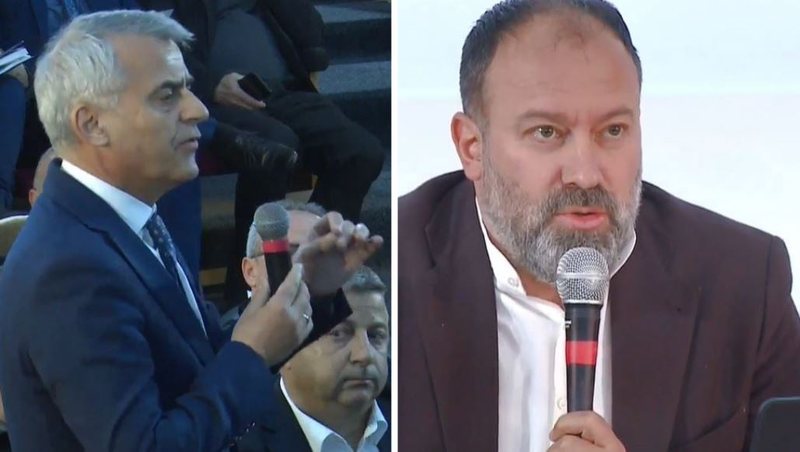
The Special Parliamentary Commission for Administrative-Territorial Reform took its consultation circuit to Gjirokastër on 24 April. Co-chairs Arbjan Mazniku (PS) and Luçiano Boçi (PD) led the session. The Greek minority’s senior parliamentary voice, Vangjel Dule, head of the Unity for Human Rights Party (PBDNJ) and a Gjirokastër native, used the home venue to challenge the framing on which the entire reform now rests. What looked, on paper, like a routine consultative stop in a southern county turned into a small but instructive collision over what local government in Albania is actually for.
The exchange
Dule opened with a categorical objection. “I would like to put forward a couple of ideas, beginning with a categorical rejection of the thesis put by Mr Mazniku, who claims to detach us from the basic notion of space,” he said. “We should not begin from the borders. But nothing in the future can be analysed without keeping in mind the dimension of ‘where’.” He then pressed the point that mattered most to him politically. “What concerns me is something very fundamental. Even if we have an ideal local government in its functions, even if its administration is perfected, even if the borders are ideal, if democracy does not function then we have failed. We are evading democracy, which is representation. Tell me, in this municipality where we sit today, are the former communes of Picar, Antigonë and Lunxhëri represented in the municipal council? Who will carry their voice into the chamber?”
Mazniku rejected the premise rather than the question. “This is a first discussion, we will have the chance to hold others,” he said, “but together with the co-chair of the Reform we wanted to take citizens’ opinions first. Mr Dule said we should discuss territory without competences. I do not say we should discuss territory without competences, because when we speak only about territory, without competences, we go nowhere. We have to be able to actually deliver the service.” He noted he had earlier given the example of road construction. “What about cleaning? What about social services? The question is precisely why it matters to talk about competences, to see whether we have the services and the financial resources for those services. That is why I say the discussion starts from services.”
Dule cut back: “These are sophisms. You cannot abuse with sophisms.” Boçi, the Democratic co-chair, intervened to enlarge the frame rather than to choose a side. “It is natural to have debates and different positions, but local power is representation, service, financial autonomy, democracy and decentralisation. That is where we have to concentrate.”
The closing line of the day, however, came from outside the political class. One of the Gjirokastër municipal councillors observed, almost in passing, that “this is the first time since the 1990s that the left and the right have gathered in one hall, without a fight and without tensions, to discuss something that affects us all.” It was the most generous reading of the day available, and it should not be discarded for being sentimental.
How the hearing came to happen at all
The cross-party tableau in Gjirokastër is recent and was not given. The Democratic Party boycotted the commission’s first meeting, leaving Dule and Edmond Haxhinasto (PL) as the only opposition voices in the room. Boçi’s eventual arrival, the agreement on a calendar and an expert structure, and the willingness to take the consultations on the road are the steps that allowed the second co-chair to claim, in his framing remarks, that “we have managed, after a series of discussions, to be here together with the opposition. I believe very strongly that such a reform can and must be done in cooperation.”
The commission has set itself a fast calendar. A White Paper of proposed solutions is due in March 2026, legislative packages in May, and final approval of a new territorial map in June or July. The new architecture is expected to take effect after the 2027 local elections.
The four variants on the table
Mazniku has previously presented the PS parliamentary group with four working variants for the reform. The first is a functional consolidation of small municipalities into larger ones. The second pairs that consolidation with a meaningful decentralisation of competences and finances. The third strengthens the county tier (qarku), pulling functions upward rather than horizontally. The fourth, and the most explicit signal of where the EU-absorption logic actually lives, is the creation of “strategic regions” purpose-built to manage EU funds. None has been adopted as final. The Gjirokastër debate was nominally about the philosophy of the reform; underneath, it was about which of these four variants the philosophy ends up authorising.
A separate Mazniku claim, made in earlier hearings, deserves to be kept in view: that Tirana “should have a special status” inside the new architecture, on the grounds that it is a municipality serving all of Albania. Whatever the merits, that is a piece of asymmetry the southern counties will read carefully when the map appears.
The EU pitch, and why this is the hinge of the whole argument
Mazniku used Gjirokastër to restate the European stakes in unusually direct terms. “In 2027 we aim to close negotiations with the European Union. Then, in 2028 to 2029, there is a real possibility for Albania to become an EU member. At that moment we will have the chance to draw down a considerable volume of financing through important programmes such as cohesion and the structural funds. But this money does not come on its own. It requires capable local structures, with human and managerial capacities certified by the EU.”
The argument was used, in effect, as the substantive answer to Dule. The reason competences come first, in this reading, is that without them there is no Albanian municipality in 2030 capable of converting cohesion eligibility into actual euros on the ground.
Background: the 2014 reform and the unfinished minority question
Dule’s intervention has a longer history than the room acknowledged. The 2014 reform consolidated 384 local government units into 61 municipalities. PBDNJ opposed the design at the time, and Dule argued, on the floor of the Assembly, that the failure to designate Himara a minority municipality was a breach of minority rights and a future obstacle in the EU accession track. Then Prime Minister Rama replied that Himara would be “treated like any other” municipality and that the reform would deliver better services in health, education and security. A decade later, the Himara dispute has not gone away, and the southern administrative units that Dule named in Gjirokastër are the more granular version of the same complaint: communities folded into larger municipalities where, in their own reading, their voices do not carry into the council chamber. Boçi, when he took the floor, has himself called the current commission’s task one of correcting the failures of the 2015 implementation. That assessment is now close to consensus across the political spectrum, which is why the room in Gjirokastër mattered.
Analysis: what Mazniku’s EU and municipality claims survive, and what they do not
On the 2027 closure target. The headline claim aligns with the official Albanian government position and with the European Commission’s working assumption that Albania, alongside Montenegro, is one of the two realistic frontrunners for finishing the technical phase by the end of 2027. Brussels itself, when opening Cluster 5 on 17 November 2025, treated the 2027 horizon as the operative target for concluding accession talks. Foreign Minister Ferit Hoxha has said publicly that the 2027 target is realistic, while flagging environment, agriculture and transport as the harder files. So Mazniku’s first claim is not a slogan; it is the official line.
The qualification is that “closing technical negotiations” is not the same as “membership,” and the path between them is no longer mechanical. Albania has opened all 33 negotiating chapters but cannot close any of them without a positive Interim Benchmark Assessment Report (IBAR) under Cluster 1, and as of early April 2026 that report remains in an early stage of discussion at the Council Working Group on Enlargement (COELA), with no clear timeline. The 2027 figure is a target, not a forecast. Mazniku presented it as the former, which is fair, but the audience should hold the difference in mind.
On the 2028 to 2029 membership window. This is where the rhetoric runs ahead of the official choreography. Prime Minister Rama’s stated ambition has been to close all chapters by 2027 and become a full EU member by 2030. External assessments from think tanks tracking the file (DGAP among others) treat 2030 as Tirana’s stated membership target, while noting that the path is “convincing but may be fragile” and so far untested by setbacks. A 2028 to 2029 accession would require not only Albanian closure of the technical file but ratification by all 27 member states inside roughly twelve to twenty-four months of that closure, a velocity not seen in Western Balkans precedent and not currently signalled by any member capital. The honest reading is that 2028 to 2029 is the optimistic edge of a window whose realistic centre of gravity sits at 2030, and even that depends on factors entirely outside Tirana’s control.
On cohesion and structural funds. Here the substance is more solid. EU Cohesion Policy is delivered primarily through the European Regional Development Fund (ERDF), the Cohesion Fund (CF) for less prosperous member states, the European Social Fund Plus (ESF+) and related instruments, with €392 billion allocated for the 2021 to 2027 programming period. Membership is what unlocks access to these instruments at scale. Until then, the pre-accession architecture applies: IPA III (running 2021 to 2027 with €14.162 billion across all beneficiaries), the Reform and Growth Facility for the Western Balkans (€6 billion for 2024 to 2027, of which Albania is set to receive up to €922 million), and the Western Balkans Investment Framework. These are real, but they are not cohesion funds. The qualitative jump that membership produces is therefore not a rhetorical flourish; it is the architectural difference between a country receiving programmed pre-accession assistance and a country participating in the EU’s largest single redistributive policy as a full member.
On absorption capacity at the local level. This is the strongest part of Mazniku’s case, and the part hardest to argue against on the record. The commission has cited a figure of around 70 percent of the EU legal framework being implemented at local government level (estimates in EU regional policy literature typically range from roughly 60 to 70 percent), which means that the technical capacity of municipalities is not a side issue but a precondition for anything cohesion policy delivers in practice. The 2014 reform consolidated 384 LGUs into 61 municipalities, and the consensus assessment, including Boçi’s framing of the current commission’s task as correcting the failures of 2015, is that the consolidation did not finish the job. Many of the resulting municipalities still lack the planning depth, the managerial certification and the financial autonomy required to apply for, win and implement EU-funded projects of any meaningful size. Mazniku’s “diskutimi niset nga shërbimet” is, in this light, less a sophism than a statement of where the absorption bottleneck actually sits.
On Dule’s counter-argument. None of the above retires Dule’s point. Picar, Antigonë and Lunxhëri are administrative units with Greek-speaking populations folded into a Gjirokastër municipality where, in Dule’s reading, their voices do not register in the council. A reform that optimises for service delivery and EU absorption while leaving minority representation under-engineered imports a political risk into the next negotiation cycle, not least because minority protection sits inside the same Cluster 1 fundamentals that the IBAR is currently testing. Dule’s framing is not an escape from the service question; it is an insistence that the service question and the representation question be answered in the same document, not sequentially.
The verdict the hearing actually rendered
Mazniku is right that competences and services are the gravity well of the reform, and that EU integration depends on local capacity that does not yet exist at the scale required. He is also speaking somewhat ahead of the calendar when he describes 2028 to 2029 as a real membership window, given that the IBAR has not cleared COELA and the political ratification arithmetic remains untested. Dule is right that representation is not a residual category to be bolted on after borders and budgets are set, and that the southern administrative units he named have a legitimate grievance about the visibility of their voice in the current municipal architecture. Boçi is right that local power is, simultaneously, all five of the things he listed, and that the commission’s task is to refuse the choice between them. The unnamed Gjirokastër councillor was right too: the value of the day was not in any conclusion, because there was none, but in the fact of the room.
The Gjirokastër session will be useful, in retrospect, as the moment when the two competing logics of the reform appeared in the same hall, with names attached, and refused to absorb each other. That is what a consultative process is supposed to do at this stage. Whether the White Paper holds both logics in the same architecture, or quietly subordinates one to the other, is the question the next sixty days will answer.