The moment Berisha speaks without filter is the moment his own apparatus intervenes.
By Ardit Rada (Tirana)
“I emphasized this moment, because if we, in a peaceful armed insurrection, do not show this regime its place, do not bring it down, then not only the port, but Albania itself will be in the greatest collapse.”
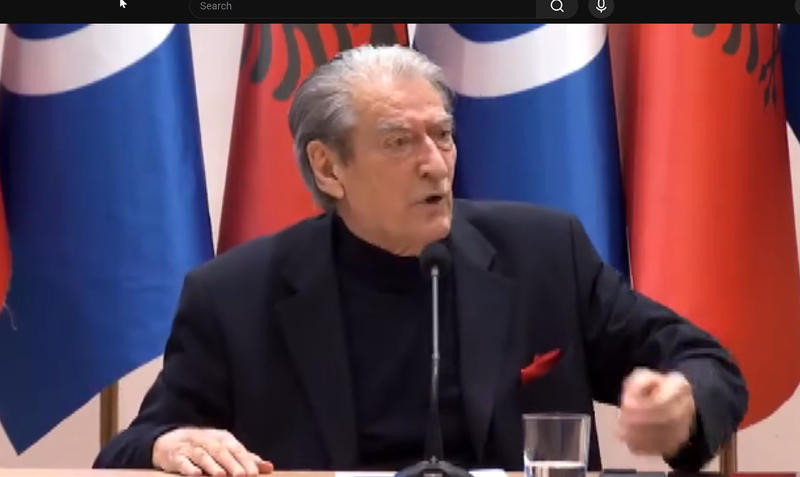
These are the words of Sali Berisha, delivered last night at a roundtable titled “How to Save the Port of Durrës,” broadcast live on Facebook and YouTube, and removed from the recording before the evening was over. The passage no longer appears in the broadcast link. It is also absent from the transcript distributed by the Democratic Party press office.
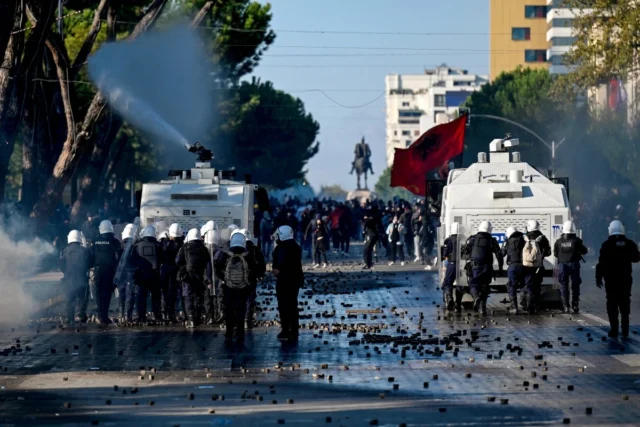
This is not an isolated incident. On 20 February, at a protest in front of the Prime Minister’s Office, Berisha referred to his supporters as “armed insurrectionists.” The formulation “peaceful armed” has now appeared twice in six weeks. It is not a slip. It is a construction.
The pairing of two incompatible terms performs a function. “Armed” supplies the symbolism expected by a mobilized base. “Peaceful” operates as a hedge against Article 219 of the Criminal Code, which punishes armed insurrection with life imprisonment. The phrase is engineered. Its repetition has turned it into part of Berisha’s working political language.
But the words are not the story. The response to them is.
The Democratic Party press office scrubbed the passage from the archived broadcast before the evening ended. It also deleted it from the official text sent to newsrooms. This is not routine editing. It is targeted intervention, used when a principal’s unfiltered words create exposure the organization is unwilling to carry.
The speed matters. The precision matters. This was either anticipated or executed by a team practiced in making such cuts without hesitation. Both interpretations point in the same direction: the apparatus around Berisha has developed operational procedures for managing Berisha.
That leads to the structural question the party does not address in public: when does a political organization edit its own leader in real time?
When it has concluded that the leader, speaking without mediation, produces material it cannot defend.
That conclusion has now been reached twice in six weeks. Two instances constitute a pattern. A pattern constitutes policy, whether or not it has ever been written down. The Democratic Party is, in practice, mediating its own leader before he reaches the public. It has not said this in words. It has now said it twice in action.
There is also a technical layer. The “peaceful armed” formulation is designed to provide legal cover. But the press office, whose function is to protect the leader’s words, did not rely on that cover. It removed the passage anyway. The people tasked with defending the speech did not trust its legal construction to hold under scrutiny.
This is the central contradiction. Berisha speaks as if the formula protects him. His own apparatus acts as if it does not. The gap between rhetorical confidence and operational judgment is now visible, and documented.
The external dimension follows directly. The same figure whose statements are edited in real time in Tirana is presented by party emissaries in Berlin and Brussels as a democratic alternative to Edi Rama. That presentation carries a built-in liability. External interlocutors will not rely on rhetoric alone; they will read behavior. And the behavior is clear: when unfiltered, the leader produces content his own organization will not stand behind.
The Democratic Party is not required to publish its internal assessment of its leader. But when that assessment appears in the public record, through cut broadcasts and altered transcripts, it becomes legible to anyone watching.
The question is no longer what Berisha says.
The question is whether the party will act on what it has already concluded, twice.