The Newsroom
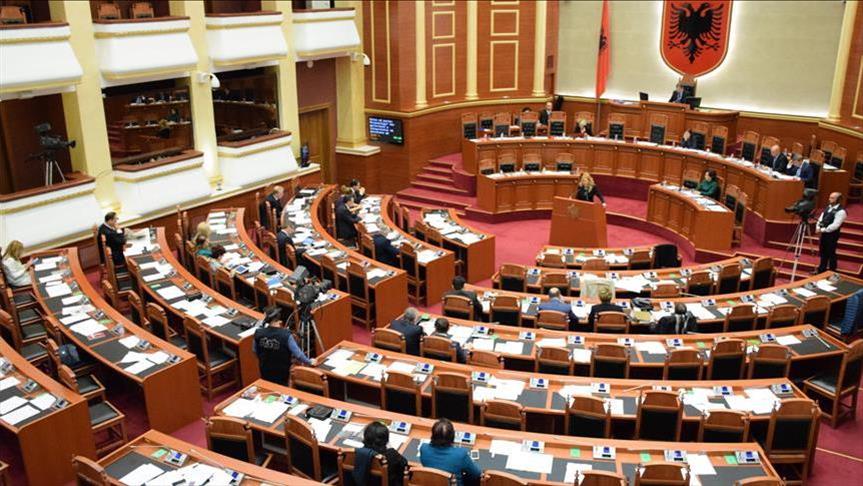
The plenary that convened in Tirana on Thursday ran for the better part of a day before it produced its defining image: a Democratic Party deputy gripping the rostrum past the point of return, a parliamentary speaker counting out disciplinary measures, and an opposition walking out of the chamber as two substantive pieces of legislation waited in the queue. By the time the gavel closed proceedings, the Republican Guard law had been rewritten, a new Education Agency had been created, and the opposition’s own fuel tax bill had been quietly postponed because the people who proposed it were no longer in the room.
The Expulsion
The immediate trigger came after Education Minister Mirela Kumbaro finished her presentation on the draft legislation creating a National Agency for Education Services. Luçiano Boçi, vice chair of the Democratic Party parliamentary group, took the rostrum. He had not formally requested the floor under the rules governing that item of the agenda, which permits one round of debate per measure. Niko Peleshi, from the chair, noted that Boçi had already spoken for ten minutes earlier in the day, and that standing up to “simply say I want to speak, without specifying” did not satisfy the regulation. A first warning followed. A second. Then a five minute recess while the chamber waited for the deputy to vacate the podium. When he did not, Peleshi ordered him expelled.
The procedural dispute was real, but the political content beneath it was plainer. Kumbaro had used her presentation to invoke Sali Berisha’s recent statements on the Albanian-American Investment Fund. Boçi sought to respond, framed as a replica. Peleshi held that Kumbaro had not named Boçi directly, and therefore no right of reply had been triggered. The rest followed from that reading.
The opposition’s position, voiced most sharply by Erald Kapri of Mundësia and later by Freedom Party Secretary General Tedi Blushi, was that the speaker was using the disciplinary mechanism as what Kapri called a “whip” against the opposition. Blushi went further and promised a constitutional challenge, reminding the chamber that Peleshi is “the only Parliament chairman with two rulings against him, at the Constitutional Court and the Administrative Court.” Peleshi replied that no expulsion ruling of his had been overturned. To Kapri, he observed that a deputy who had not been present when the measure was imposed was in no position to testify to its procedural basis.
After the recess, Boçi remained at the rostrum. The deputies of the Democratic Party and the Freedom Party left the chamber. What followed was conducted by the majority alone.
The Republican Guard Law
The first item passed after the walkout was the amendment to Law 33/2021 on the Republican Guard. Seventy-seven votes carried it. The change returns appointment of the Guard’s director general to direct designation by the Prime Minister on the proposal of the Interior Minister, with the appointee assuming the rank of Drejtues Madhor on taking the post. The candidate must also come from within the Guard’s own ranks.
The political arc of the provision deserves close reading. In the spring of 2024 the Socialists themselves had moved the appointment out of direct executive hands. The amendment of that year, sponsored by Socialist deputy Nasip Naço, created an open competition and imposed qualification thresholds including a master’s degree and ten years of experience in the security field. Opposition deputies at the time argued that the competition had been tailored to a specific candidate, and named Ermal Onuzi as that candidate. Onuzi was duly appointed that September. He resigned nine months later. The open competition convened to find his successor collapsed without a stated reason.
Thursday’s amendment, introduced by Socialist deputy Antoneta Dhima, removes the master’s and experience requirements and softens the disciplinary bar. Where the 2024 version required that no disciplinary measure be in force at the moment of selection, the new text requires only that the candidate have received no measure in the last three years. The Socialist rationale, as presented, was normative harmonisation and the avoidance of misinterpretation.
What the change does in practical terms is narrower and more concrete. It restores a personal appointment power to the Prime Minister, removes the procedural friction of competitive recruitment, and lowers the threshold at which a career officer becomes eligible for the top post. It is the second time in under two years that the appointment architecture for this institution has been rewritten. The first rewrite was promoted as a modernisation. The second is promoted as a correction to the first.
The Education Agency
Seventy-six votes carried the legislation establishing the National Agency for Education Services. Kumbaro’s presentation foregrounded an institutional partnership with the Cambridge Assessment Network at the University of Cambridge, described as a multi-year technology and training engagement supporting the agency’s construction. Supervision rests with the Ministry of Education, which will verify implementation of national policy and strategy. The agency will be led by a governing council chaired by the minister responsible for education, with its most consequential decisions, on budget, salaries, and public service tariffs, passing through a second filter of approval by the Council of Ministers.
The architectural choice is familiar. The governing council format has been used for a growing number of agencies reporting into line ministries. It concentrates accountability at ministerial level while preserving the formal appearance of institutional autonomy. The Cambridge partnership lends technical legitimacy; the Council of Ministers filter ensures that the fiscal and salary decisions most visible to the public remain within the executive’s reach.
The Fuel Tax Bill
The third substantive item on the agenda was the opposition’s own draft legislation on national taxes, which would have suspended the fuel circulation levy until March 2028. Socialist parliamentary group chair Taulant Balla proposed that the item be removed from the day’s business, on the procedural ground that its proposers were not present and could not introduce it. The chamber, such as it was, agreed. The bill is postponed to the next session.
The sequence is worth noting on its own terms. An opposition bill, the kind of bill the opposition most wants to debate in public, was not killed but shelved, and the act of shelving was carried out in the opposition’s physical absence by a procedural motion from the majority floor leader. This is the mechanical corollary of walkout politics: what the opposition forfeits by leaving, it cannot reclaim by returning.
A Minute of Silence
The chamber observed a minute of silence for the academician Rexhep Qosja, who died Thursday. The benches on the opposition side of the hall were empty. Balla used his floor time to criticise the absence, framing it as a moral failure that the Democratic Party “does not deserve to bring upon itself.” The remark was, inevitably, heard through the filter of partisan positioning, but the underlying point carried some weight. The bojkot as a tool of political protest has steadily widened its scope, and it has now consumed ceremonial moments that once sat outside the political frame.
The Interpellation Hours
The hours before the expulsion were occupied by ministerial interpellations. Four ministers responded to questions from the opposition, ranging from the KAYO military production agreements to pharmaceutical shortages at the Oncology Hospital and governance issues in the education sector. The Democratic Party’s recurring complaint was that the majority uses interpellations as theatre while blocking genuine accountability on matters that remain under active investigation.
Two exchanges from those hours deserve separate mention.
Saimir Korreshi raised the condition of Lushnja Hospital. His description was blunter than the usual register of the chamber: thirteen medications are reported as missing, and the rabies vaccine, he said, is not the subject of an active tender. His line, “if dogs bite you, there is no tetanus shot; you go rabid,” is the kind of formulation that does not translate well into policy language, but it conveys the condition of provincial healthcare procurement with more precision than a procurement report would.
Tritan Shehu and Taulant Balla then sparred over Prime Minister Rama’s Barcelona appearance. Shehu’s procedural objection, whether Rama attended as head of government or as party leader, is a familiar line in Albanian political argument, where the distinction between the two hats is frequently blurred in the Socialist operating style. Balla’s response combined a defence of the Barcelona visit as part of the progressive alliance network in European social democracy (he named the German SPD, the Spanish prime minister, and Italian opposition leader Elly Schlein) with a forward announcement: Albania will host the NATO Summit. “Raise your head, Tritan,” Balla told his counterpart, “because Trump is coming.” The announcement, floated elsewhere over recent weeks, was restated from the floor with a confidence that treated the matter as settled.
A secondary exchange concerned the draft law on freedom of establishment and the provision of services. Shehu complained that two legislative texts had been bundled into one relational document, a procedural confusion he attributed to the bill’s own sponsors. Balla pressed the opposition on whether they would vote for the legislation at all, noting that their public position in Brussels on approximation laws rarely matches their behaviour in the committee room. The question was left unanswered.
The Koman Port
Marjana Koçeku, deputy from Shkodra, used her floor time to raise the condition of the Koman Port, which she described as unready for the tourist season on account of waste accumulation and infrastructural deficit. She requested a concrete plan for expansion, a dignified reception space, separation of goods and passenger traffic, basic sanitary infrastructure, and a safe navigation zone. The request went on the record. Whether it receives a concrete response before the season begins is a separate question.
Synthesis
Thursday produced two substantive legal acts, one procedural postponement, one expulsion, and a walkout. The two acts that passed share a common structural feature. Both concentrate executive discretion. The Garda amendment restores direct prime ministerial appointment to a sensitive protection service; the Education Agency centralises service delivery under ministerial chairmanship, with Council of Ministers sign-off on the most visible decisions. Neither is remarkable in isolation. Read together, within the broader pattern of institutional design choices over the past eighteen months, they describe a government that prefers compact appointment architectures and narrower accountability perimeters.
The opposition’s walkout removes a procedural check on that preference. It also removes the opposition’s own legislation from the floor. The fuel tax bill was shelved on Thursday because its proposers were not in the room to present it. This is the recurring cost of the bojkot: it produces clean video for party communications, and it forfeits the ground on which the opposition’s own bills need to be argued.
The expulsion itself will be litigated, as Blushi promised. It will likely be argued in public on the question of whether Peleshi’s denial of a replica was procedurally correct, and in chamber on the separate question of whether the rostrum blockade that followed was a legitimate form of protest or a disciplinary violation. Both questions have reasonable answers on either side. What is harder to dispute is the outcome. A day that was built around interpellations, ministerial accountability, and two pieces of structural legislation ended with the opposition offstage and the Socialist benches passing the structural legislation alone.
The Qosja silence, attended only by the pink side of the hall, is the image of the evening that does not fit the usual news cycle. It will not be the headline. It is, nonetheless, the most durable of Thursday’s moments.