Tom Rogan’s column has no evidence for its central charge, so it reaches for a stereotype instead. The question worth asking is not what he wrote, but why he holds Albania to a standard he would apply to no one else.
Albatros Rexhaj
There is no obligation to admire what Jared Kushner and Ivanka Trump are building on the Albanian coast, and Tom Rogan, in the Washington Examiner, declines the invitation with some vigour. He is welcome to his disdain. He is not welcome, as the old line has it, to his own facts. His charge is as grave as charges come: that the Affinity Partners development is a laundering machine for the narcotics trade, and that the president’s daughter and son-in-law are knowingly enriching the worst men alive. A charge of that size carries a small, old-fashioned obligation. It has to be proved. Rogan never troubles to try.
Take his strongest card, the sanction levied in November against Luftar Hysa and his family network, which the column treats as a smoking gun. Read the designation rather than the use made of it. It was issued under Executive Order 13581 by the Treasury’s OFAC and FinCEN, in concert with Mexico, and it concerns casinos and restaurants across Mexico, with satellite entities in Canada and Poland. It describes Sinaloa money cleaned through Mexican gaming houses. It names neither Sazan, nor Zvërnec, nor Affinity, nor a single brick of the project Rogan means to condemn. The one solid fact in the indictment is an arrow, and it points to Mexico.
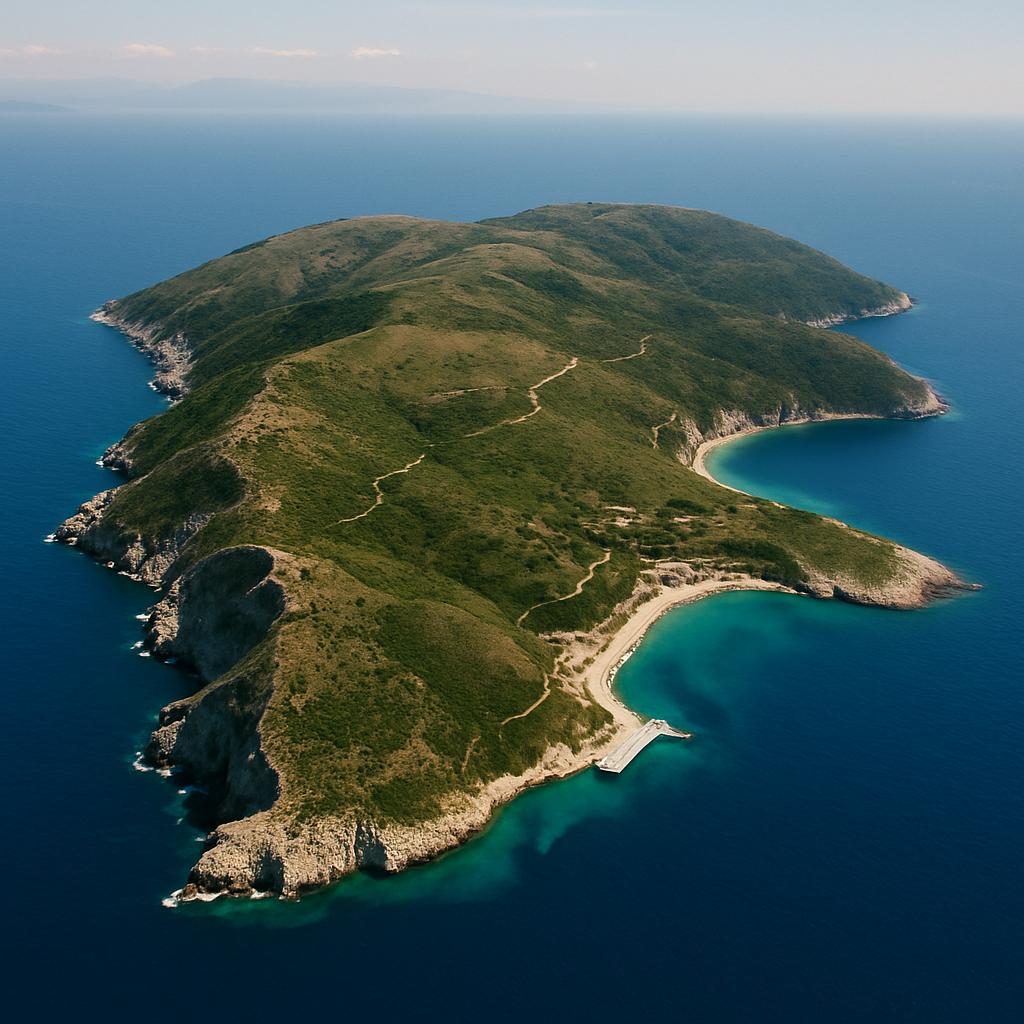
The rest is looser still, and loose in a telling way. He christens the ELN the “National Liberation Party,” a body that has never borne that name; he means the National Liberation Army. He enters the FARC as a present-day adversary nearly a decade after it disarmed under the 2016 accord, when only its splinters remain in the field, and neither group belongs among the cartel designations he is applauding. He fixes tens of thousands of protesters to Sazan, an empty island offshore, when the demonstrations, the fenced wetland and the disputed titles sit at Zvërnec, on the mainland. These are not the errors of a man who checked his work and stumbled. They are the errors of a man who felt no need to check it.
And why would he? Strip the column to its load-bearing claim, that criminal money is flowing into this project and its developers know it, and then put the question a prosecutor puts and keeps putting: where is the evidence? Not the mood, not the reputation, the evidence. Which account, which transaction, which company, which name? Rogan offers not one. What he offers in its place is the certainty that in Albania it could not be otherwise.
That certainty is the true engine of the piece, and it runs on one of the oldest assumptions about the region. Albania, the reader is quietly invited to assume, is a country where money is dirty by default and where allegations require less proof than they would elsewhere. Rogan all but says it outright: ask any objective expert, he writes, and there is “no question” the money reaches organised crime. No question, and so, conveniently, no evidence owed. Take the presumption away and the column has nothing left to stand on.
A column can be wrong by accident, and we have now seen the accidents. The graver fault is not an accident. It is the standard he chose.
The curious thing is not that Rogan asks whether organised crime launders money through property. It does, in Albania as elsewhere. What deserves attention is the standard he keeps for this one country. Criminal proceeds have washed through the property markets of Miami, London, Vancouver and New York for decades, and no serious writer concludes that every tower in those cities is a front until its builders prove otherwise. The standard disappears the moment the subject is Albania. A standard applied to one nation and withheld from the rest is not analysis. It is prejudice with a dateline.
Whatever Rogan intended, the result is straightforward. A conservative publication has run a piece that invites its readers to see Albania not as an ally but as a criminal enterprise, and by extension to treat any major investment there as suspect from the outset.
None of this makes the column a conspiracy, and I allege none. The failure is simpler, and worse. Rogan was not too hard on Albania; hard and well-founded things can be said about it, and this publication has said them. He mistook a stereotype for evidence and an allegation for proof. A charge of that magnitude deserved more than insinuation. It deserved evidence. The column never produced it.