Ardit Rada
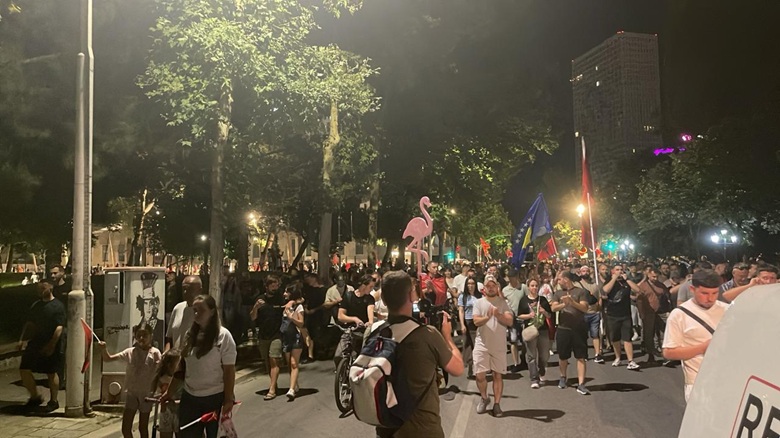
Begin with the goats. On the eighteenth night of protest in Tirana, a herd of them stood penned behind a portable fence on the boulevard in front of the prime minister’s office, while their keepers held up signs about the coast and the rivers and the mountains. Nearby, cardboard flamingos paraded. A pensioner took the microphone and was heard. Then the crowd marched, sat down in the road, rose, sang in the main square, and went home to sleep. By morning the avenue belonged again to the traffic.
A reasonable person might call this farce, and on the surface it is. But strip away the costume and you are left with the rarest thing in political life, rarer than honesty in a minister or modesty in a victor: a government that watched thousands of its citizens call for its humiliation, night after night, and did not reach for the truncheon. That is not a small thing. It is the threshold a country has to cross before it can call itself free, and most of the countries that ever existed never crossed it. The measure of a free country has never been the contentment of its people, for the contented are merely those who have not yet been provoked. The measure is what happens to a man, or a grandmother, or a college student, who stands in a public square and tells the powerful, to their faces, that they should be in prison.
In most of human history the answer has been simple, and it has been written in blood. Power treats the assembled citizen as a threat to be dispersed, not a sovereign to be heard. The instinct is older than any ideology and indifferent to all of them; it has worn the red of the commissar and the black of the colonel and, in our own decade, the respectable gray of democracies that should know better. We have seen the footage from capitals far grander than Tirana: the kettling, the rubber rounds, the journalists shoved to the pavement, the official statement afterward regretting the necessity. Restraint is not the natural condition of authority. Restraint is an achievement, and a perishable one, and it must be renewed every single night that a crowd appears.
Albania renewed it eighteen times.
Consider the alternative, because it is not hypothetical and it is not far away. Look north and east to Serbia, where in this same cycle of unrest the streets filled and the state answered differently, with force enough that the European Union’s own enlargement commissioner, a woman not given to melodrama, declared flatly that Belgrade had a problem and that the violence and the heavy hand of the police had to stop. The same official, surveying Albania, said the opposite: that the right to protest was being honored. One frontier separates these two verdicts. It is the frontier between a state that fears its people and a state that, however grudgingly, recognizes them as its masters. Geography did not draw that line. Choice did.
And here is the part the choreographers of the Tirana protest may not fully grasp, absorbed as they are in their flamingos and their goats: the spectacle is not the point, and neither, finally, is the coast at Zvërnec. Causes come and go. A pipeline, a forest, a stolen election, a price of bread; the grievance is the occasion, never the substance. The substance is the permission. A society that lets its citizens be ridiculous in public, lets them bring livestock to the gates of power and chant for the jailing of their rulers and block the ring road with their bodies, and lets them do it again the next evening unbruised, has answered the only question that ultimately distinguishes a republic from everything else. It has decided that the people may be wrong, may be theatrical, may be a nuisance, and are still, irreducibly, free.
That permission is worth more than any single development project, and it is more fragile than it looks on a calm night. Tyranny rarely arrives announcing itself. It arrives the first evening the goats are turned back at the fence, the first time the microphone is cut, the first march that does not make it home intact, and a country tells itself that this once, for this cause, in these unusual circumstances, the old rule may be suspended. Albania, for eighteen nights, declined the suspension. Whether anyone official was watching is beside the point. The thing was true whether or not it was witnessed, the way a man’s character is true in the dark.
Let no one mistake this for a verdict on how Albania is governed. A state can leave the street alone and still be rotten in the rooms the street never enters. Liberty is not one thing but many, and a government may honor the loudest of them while quietly starving the rest. But the order runs only one way. A republic that tolerates the crowd may still fail in a dozen rooms the crowd will never reach. A republic that clears the crowd by force has already failed in the doorway, and whatever it builds behind that door is built on sand.
So let the cynics have their laugh at the cardboard birds. The birds will be forgotten. What deserves to be remembered is the discipline beneath the carnival, on both sides of the police line, and the plain civic fact it demonstrated to anyone, anywhere, willing to learn it: that a people may shout down its government in the streets and wake the next day to find the government still bound by law and the people still at liberty. Most of the world has never seen this. Much of the world has forgotten it. A small country on the Adriatic spent eighteen ordinary evenings reminding the rest of Europe what it looks like.