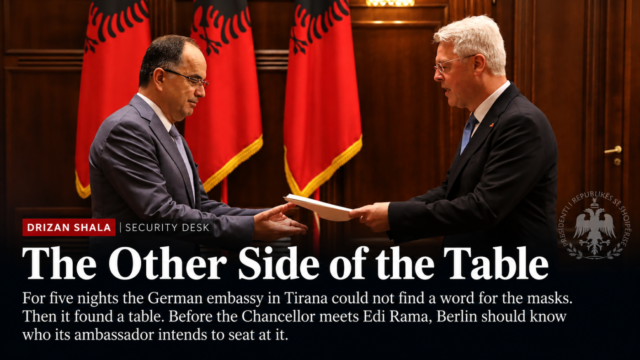
Edi Rama went to Berlin and made a serious, sincere offer. Albania has done the work, and it means the choice. The trouble was the table he made it to. Berlin treats membership as a favour it can defer without end, and a leader as capable as Rama should stop mistaking what Berlin is willing to take from Albania for any commitment to Albania’s place in Europe.
The Editorial Board
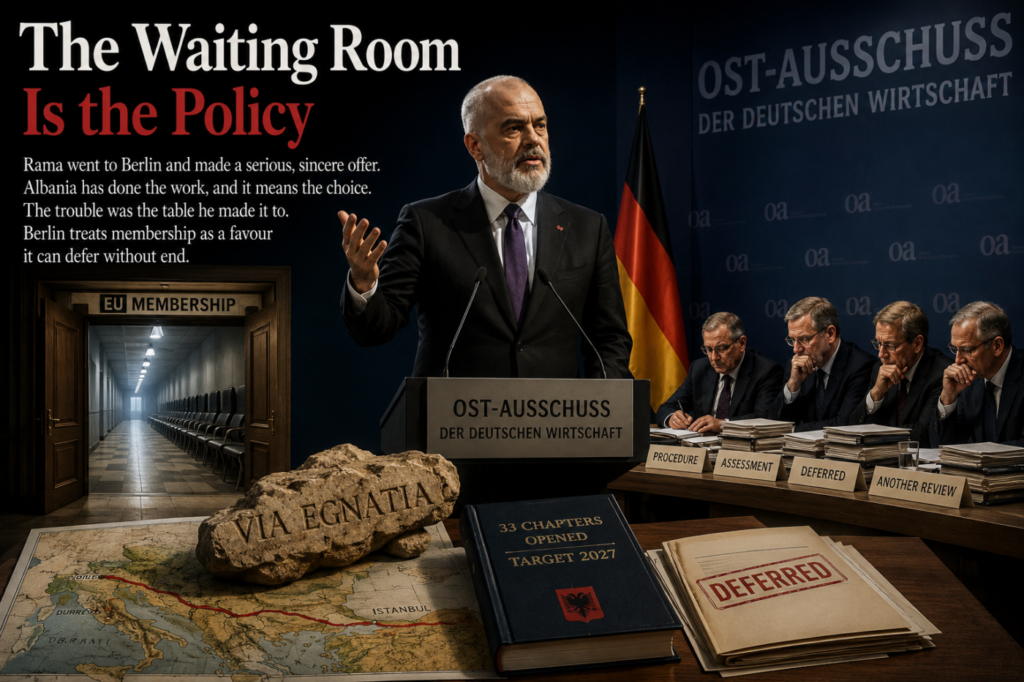
Edi Rama stood in Berlin and reached for Helmut Kohl, and he had every right to the gesture. Kohl decided that the division of a continent was unacceptable and acted on it without waiting for anyone’s permission, and in that German hall, on that evening, the only person speaking in Kohl’s register was the Albanian. Rama brought the canvas with the empty space at its centre, the Via Egnatia running through the soil that still carries Europe’s corridors and its minerals, enlargement framed as investment rather than charity. He brought thirty-three negotiating chapters opened faster than any candidate in the history of the process, a 2027 target, a state in the middle of remaking itself. He came, in plain terms, as a partner who has done the work and means the commitment. Whatever quarrel this newspaper has, it is not with the Prime Minister. The seriousness was his alone.
A negotiation has two sides. Only one of them arrived in Berlin having moved, decisively and under the rules the other side set. Albania has moved, visibly and at speed, and the question the evening was too polite to ask aloud is whether the other side intends to move at all, or merely to be admired for the privilege of receiving offers. Rama named the danger himself when he said that gradual integration cannot become perpetual postponement. He is correct, and that sentence is the whole matter. But postponement is not Albania’s to end. It is Berlin’s to choose, and Berlin has spent the better part of a decade choosing it.
Look at the conduct rather than the brochure. Berlin sells a process built on merit and criteria, a ladder a country climbs by its own effort. Then watch what the process actually does. The assessment drifts loose from the criteria. The goalposts slide back the moment a candidate draws near them. The Commission certifies, and the capitals defer, and a state that has done everything asked of it watches its file frozen by a quarrel inside a parliament that is not its own. Rama described the machinery precisely, when he said the region stays trapped between the objective assessments of the Commission and the subjective anxieties of member states. He offered the line as a lament. It reads better as an indictment. A rule that is merit on the page and pure discretion in the room is not a demanding rule. It is a dishonest one.
An examiner who lets it be known that the highest mark is reserved for himself is not testing anyone. He is staging a hierarchy and calling it standards. And there are no examiners and no candidates at this table. There are sovereign states that turned toward Europe when they could have turned elsewhere, and a Union, and a Germany above all, that refuses to admit the turning is a gift to Berlin as much as to Tirana. By the Union’s own fashionable talk of strategic autonomy, by Rama’s own image of the missing link, the Western Balkans are not applicants knocking at a European asset. They are the asset. Which makes the permanent antechamber not merely unjust to Albania. It makes it self-defeating for Berlin, an examiner so busy guarding his grade that he is failing his own exam.
The cruelest possibility is the one the speech itself opens. Rama did not only name the waiting room. He proposed a door out of it. Give us seats before vetoes, participation before commissioners, strategic integration before the formal grant of membership. It is the most original idea in the address, a way to make the region useful to Europe now rather than after some date that keeps receding. And it is exactly the idea Berlin has the most reason to embrace, for precisely the wrong reason. Participation without membership hands Berlin the corridors, the market and the alignment while the vote that would cost Berlin something stays forever over the horizon. The asset is integrated, the obligation is deferred, the date never comes. Offered in good faith as an escape, the formula can be received as an upgrade, because a waiting room with better furniture is still a waiting room, and a tenant who has agreed to be useful while he waits is easier to keep waiting, not harder. In Berlin’s hands the remedy becomes the most durable form of the disease.
There is exactly one place where the speech gives ground, and it is worth marking only for what it proves. When Rama says the European choice is not about funds, he is stooping to answer a charge no serious nation should dignify with a reply. He should not have to. That a leader of his standing reaches for the denial at all is not a failure of his nerve. It is the measure of how thoroughly Berlin has trained an entire region to arrive apologising for wanting in. The flinch is not Rama’s. It is Berlin’s achievement, and it is the most revealing thing in the room.
The conclusion is plain, and it is not comfortable. Albania should keep the European choice. It is right, it is sovereign, and it is Tirana’s to make and no one else’s to grant. But Tirana should stop extending to Berlin a good faith that Berlin’s conduct has never returned. Berlin’s willingness to use Albania’s corridors, its coastline, its market and its young engineers is not a commitment to Albania’s seat, and it should no longer be read as one. A counterparty who takes the benefits of Albania’s alignment while withholding the seat is not a partner. He is a beneficiary of Tirana’s patience. Rama went to Berlin in good faith, and good faith is an honourable thing to bring. Opposite this particular table it is also a strategic error, and the first duty of a serious state is to stop making it.
Rama closed by asking whether Europe is ready for its next Helmut Kohl moment. The honest answer is the hard one. Berlin was never looking for one. A Kohl moment would empty the waiting room, and the waiting room is the policy, not its failure. The courage summoned in that hall was real, and it was Albanian. The men across the table answered it with procedure. That is the entire story of the evening, and it should be read in Tirana exactly as it happened. The Kohl in the room was the guest. Berlin sent clerks.