A response to the open letter of eleven UK based Albanian associations
By Ardit Rada (Tirana)
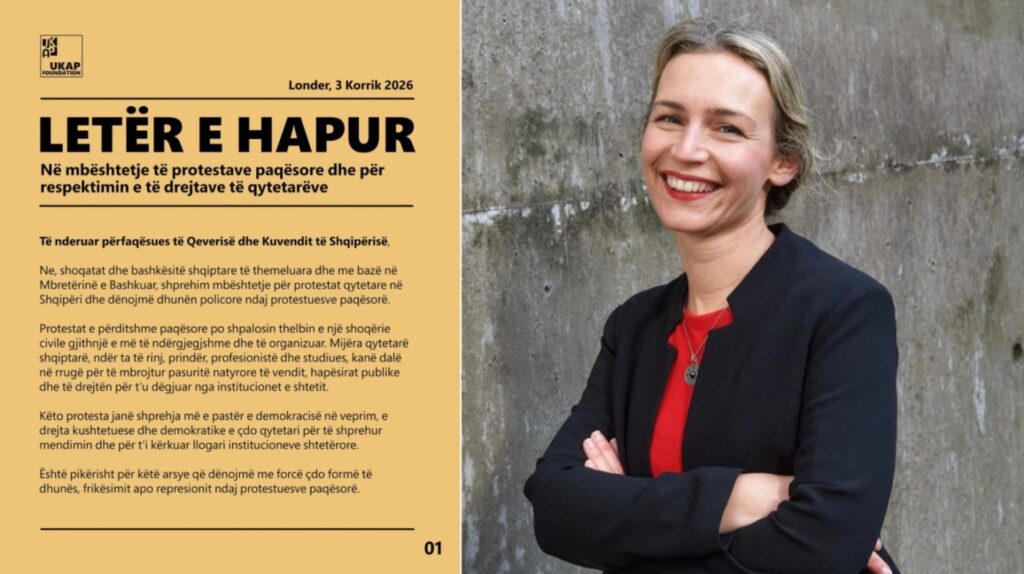
Eleven Albanian associations in the United Kingdom, among them the student societies of Cambridge, LSE, UCL and Edinburgh, have addressed an open letter to Albania’s Government and Parliament. Lea Ypi shared it, which is why you have read about it. The letter supports the protest movement now past its thirtieth day, condemns police violence against peaceful demonstrators, and presents four demands: full transparency on environmental laws and contracts, accountability for the sale or concession of state assets, the primacy of the public interest in economic policy, and genuine dialogue with civil society.
The letter is sincere and signed by people this country should want engaged in its affairs. It is also, on three of its four demands, factually behind the situation it addresses. Because its signatories include legal scholars and doctoral researchers, and because the diaspora’s voice carries weight in the capitals where Albania’s accession is decided, the letter deserves what solidarity statements rarely receive: a fact check. We offer one here, along with an account of what the letter gets right that its authors may not have intended.
Demand one: transparency that has a URL
The letter demands full transparency regarding laws, decisions and contracts affecting the environment and natural assets. Albania has had a statutory public consultation regime since Law 146/2014, which requires draft legislation to be published for comment before the Council of Ministers decides whether to propose it at all. The portal is public and searchable. The Ministry of Environment’s section lists the draft decisions on protected landscapes and environmental zones the letter is concerned with.
One detail should trouble the signatories more than the rest. The 2024 amendments to the territorial planning law, a text at the origin of this protest cycle, went through that consultation window and attracted no comments. None from the organizations now marching, none from the associations now writing. The amendments to the protected areas law, the movement’s central legislative grievance, were subsequently reviewed by the Constitutional Court and upheld in 2025, in a judgment that examined the adequacy of the consultation itself.
A demand for transparency mechanisms that exist, addressed by organizations that did not use them when it counted, is not a strong opening. If the signatories believe the laws are wrong, the honest formulation is that they oppose the laws, not that the laws were hidden. They were not hidden. They were ignored, including by the letter’s own constituency.
Demand two: the state asset that does not exist
The letter demands accountability for the sale or concession of state assets, with public scrutiny and parliamentary oversight. Concession procedures in Albania are public by legal design, since publicity is a precondition of competitive bidding, and Law 119/2014 entitles any citizen to official information without stating a reason. But the demand has a more immediate problem. The property at the center of the original dispute is private. The government has asserted this from the first day of the protests; this newspaper has now examined the cadastral record independently, a step the Zvërnec file’s contested history made necessary, and the record confirms it. No state asset has been sold. No state asset has been conceded. The letter’s second demand describes a transaction category that does not apply to the case that produced the protests. A letter built on a specific controversy owed its readers the specific facts of that controversy. The letter offers a general principle instead, and general principles are what people reach for when they have not done the file work.
Demand three: a principle nobody contests
The third demand, that the public interest be the foundational and nonnegotiable criterion of economic development policy, is one no government in Europe has ever declared itself against. As drafted it is unfalsifiable and therefore unanswerable. If the signatories mean that specific contracts have sacrificed public goods to private interests, the demand should name the contracts, the clauses and the harm. That is a serious allegation with serious procedures attached to it, including a special prosecution office that has shown itself willing to freeze accounts first and take criticism later. An open letter is precisely the instrument with the standing to make such allegations concrete. This one declined to.
Demand four: the one that survives
The fourth demand, genuine and constructive dialogue, is where the letter stops being wrong. The government offered dialogue in the protest’s opening days; we reported it then. But its most recent formulation defines dialogue as something not conducted with loudspeakers, eggs and violence against police, a condition that makes the offer available only to a movement that has already dispersed. An invitation priced at dissolution is not an invitation. On this demand the signatories have identified a real deficit, and they should press it with dates, names and a proposed table rather than a paragraph of aspiration.
The same applies to the letter’s condemnation of police violence, which we neither endorse nor dismiss. The government’s position, that its police have exercised no form of violence whatsoever across thirty days of nightly confrontation, is an absolute claim, and absolute claims about a month of filmed street conflict are cheap to make and expensive to maintain. The signatories, for their part, assert violence against peaceful protesters without documenting a single incident, date or name. Both sides are asking to be believed. Neither has earned it on the current record, and a letter from eleven organizations with university resources behind them was well placed to earn it, with a documented annex, and did not.
What the letter accidentally proves
The letter delivers one finding its authors did not intend. Every formal mechanism their letter demands exists in Albanian law: consultation regime, information rights, judicial review of both the constitutional and administrative kind, a reformed judiciary currently demonstrating its independence at the government’s expense. And yet eleven diaspora organizations, including several run by people trained in law, either did not know this or did not believe it mattered. That is the actual story. Albania’s problem is not an absence of procedures. It is a consultation portal that a law capable of filling the streets for a month could pass through without one comment, because a decade of formal compliance has taught citizens that the portal is where opinions are archived rather than heard. The European Commission’s progress reports have recorded this gap between architecture and function for years, in the careful language reserved for candidate countries.
The diaspora letter mistook that gap for a void and demanded architecture that already stands. The government, citing its statutes, mistakes the architecture for an answer. Both are arguing past the same fact: the mechanisms exist, and nobody trusts them enough to use them. The signatories in London, Cambridge and Edinburgh can do something about that, and another letter is not it: comments on the portal, submissions in the consultation windows, documented incident files, a named delegation for the dialogue they demand. The instruments are real. Use them, publicly and on the record, and if they prove to be decoration, you will have demonstrated something no open letter can. That would be solidarity with evidentiary weight. Albania has enough of the other kind.