Renada Bici (Tirana Examiner Legal Desk)
On Friday, the Coordinating Group of the protest movement delivered a formal declaration to the State Police and to the embassies of friendly states. It invoked Article 47 of the Constitution, cited the monitoring of the Albanian Helsinki Committee, and accused the police of disproportionate force on July 2: tear gas without warning, blows against demonstrators, violence against persons already neutralized. It demanded a public accounting, an independent investigation, and the release of the arrested. It closed by calling on citizens to protect the peaceful character of the movement and warned, in advance, that any violence would be the work of infiltrators and provocateurs.
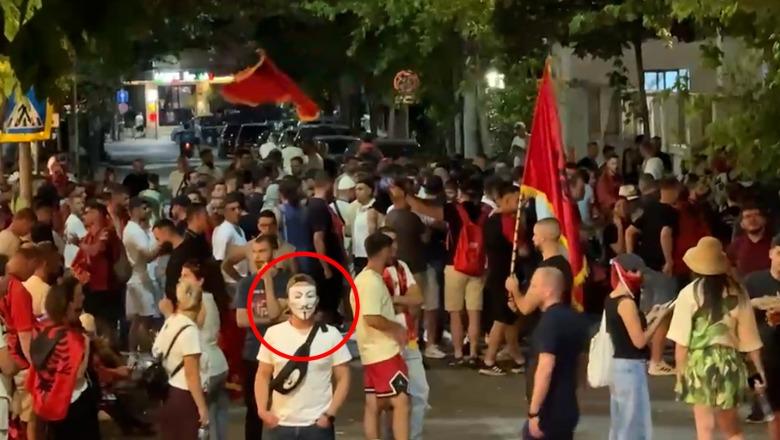
On Saturday, at a quarter to midnight, a group of men, several of them masked, attacked Police Station No. 3 on Rruga Mine Peza with stones and sticks, broke its windows, tore open its door, and forced their way into the reception area of the building where the 21 arrested demonstrators are held. The police answered with a cordon and with water. This morning at nine, the 21 appear before the Tirana court for their security measures, and the movement has announced a protest outside.
Two documents, then, one signed and one unsigned, delivered forty-eight hours apart by the same movement to the same address. The first is a legal complaint. The second is its answer, written by hand on the door of a commissariat. The question the country must now hold steady, because neither the government nor the movement will hold it for them, is what the second document does to the first.
The answer of the law is: nothing. The answer of politics is: everything. Both answers are correct, and confusing them is the error toward which the entire week is now pulling.
Begin with the law, because it is the shorter argument. Whether the State Police used force unlawfully on July 2 is a question of fact about July 2. It will be settled by footage, medical records, timestamps, and the testimony of identifiable officers and identifiable demonstrators, or it will not be settled at all. Nothing that happened on Rruga Mine Peza on Saturday night can enter that file. A crime committed by a complainant after the fact does not amnesty the conduct he complained of, for the same reason that police misconduct on Thursday would not have licensed the attack on the station on Saturday. Wrongs do not settle each other’s accounts. A legal order that lets them is not administering justice but keeping score, and a score, unlike a judgment, never closes.
This publication has already ruled on the largest part of the July 2 question, and rules the same way today. The blockade of the Kuvend was announced in advance, its purpose was obstruction, and under Kudrevičius its protection as assembly ended before the first canister was fired. The complaint’s central charge, gas deployed without warning, is at its weakest exactly where the movement plants it, because every standard the Coordinating Group cites suspends the warning requirement where violence is already in progress, and fifteen injured officers place that question beyond argument. The letter pleads July 2 as a peaceful assembly attacked by the state. The record shows an unlawful obstruction answered in sequence, each police escalation following one from the crowd. On the macro claim, the tape runs one way, and no letter to any embassy will run it backwards.
But a proportionate operation is not an indulgence for every act inside it. The law assesses force person by person, incident by incident, and the complaint contains one allegation for which no context supplies a defense: violence against persons already neutralized. No doctrine of proportionality covers striking a man who is restrained, and there is no exception for a chaotic day. If such an incident occurred, it is on video or it is not, the officer is identifiable or he is not, and the Ombudsman’s inquiry, opened after July 1 and still standing, is the instrument built for precisely this question. That allegation was serious on Friday morning. It remained exactly as serious on Sunday morning, and any suggestion to the contrary, from any ministry rostrum, should be recognized as the mirror image of the movement’s own logic: the belief that the sins of one side are payment for the sins of the other.
So much for the complaint. Now the complainant, because here the letter convicts itself twice, first by its address and then by its sequel.
Consider the address. In a state of laws, a complaint about police force has a route, and the route is marked: the Ombudsman, the oversight structures of the police, the prosecution, the courts, and in the last instance Strasbourg, which will not open a file until domestic remedies have been exhausted. Embassies appear nowhere on it. They command no investigation, release no detainee, discipline no officer. A declaration delivered to them is a political act wearing legal citations, and its unstated premise is that Albania’s institutions are so captured that the only tribunal left standing is the diplomatic corps.
That premise is the movement’s founding thesis made procedural, and the record of this very week refutes it. The movement’s grievance against the state was heard by the state, immediately and in the open. The Ombudsman reached the July 1 detainees within hours, opened an inquiry into the conduct of the police, called the intervention disproportionate on preliminary assessment, and visited the injured officers in hospital the same evening. The Helsinki Committee monitored and published. The July 1 detainees walked free the same afternoon, and the most prominent among them described his treatment in custody, publicly and unprompted, as correct and within the law.
This morning the 21 arrested on July 2 stand before a judge, inside the constitutional deadline, in courts vetted by the very reform the European Union has certified. Every organ the letter implicitly pronounces dead was in motion before the letter was written, and the letter engaged none of them. No criminal referral to the prosecution. No formal submission to the Ombudsman’s open inquiry. No petition to any body with the power to find a fact or order a remedy. A complaint about the state of laws that bypasses every organ of the state of laws is not a complaint. It is a verdict, pre-written, on institutions that were at that very hour ruling in the complainant’s favor.
Let it be said, because symmetry demands it, that addressing the internationals is not in itself a sin. In an accession country the embassies are genuine stakeholders in the rule of law, and the Helsinki Committee copies them as a matter of routine. The failure is not that the letter reached the embassies. The failure is what it never attempted first. The movement demanded a state of laws and skipped the state, going directly to its guests, and a guest, whatever else he offers, cannot issue a judgment. He can only form an impression. Which brings us to Saturday night, and to the impression that was formed.
The Friday letter was, in truth, addressed to no police station. Its architecture shows its audience: the constitutional citation, the Helsinki Committee as independent witness, the self-description of thirty-five days of peaceful, democratic, and European protest. It was a claim of standing. It said: we are the party in this dispute that does not break things, and we ask the institutions of the democratic world to weigh the conduct of the party that does. That standing was the movement’s single accumulated asset, five weeks in the building, and it was spent in one night by men whose faces we are not permitted to see.
The letter foresaw them. It warned that violence would come from infiltrators serving the system. That defense exists, and Saturday supplied it a genuine witness: the demonstrator with the megaphone who stood before the crowd at the station and pleaded with it to withdraw and resume the march, and was refused to his face. The movement’s conscience was present on Rruga Mine Peza. It was also outvoted. Here the provocateur thesis meets its limit, because a framing asserted in advance is not evidence after the fact. On Friday the infiltrator was a presumption the movement could offer its readers. On Sunday it is an allegation the movement must prove, with names, with footage, with something, and the burden does not shift back until it does. A movement that answers to no one, as this publication wrote of July 2, cannot restrain anyone. It now discovers the corollary: a movement that cannot restrain anyone cannot exculpate itself by pointing at its own crowd.
There is a final irony, and it belongs in the record. The complaint accuses the police of disproportion. The attack on Station No. 3 produced the cleanest case of proportionate force this crisis has yet supplied: men breaking through the door of a commissariat, answered with water and a cordon, no baton charge, no gas, no injuries reported. The movement demanded that the police demonstrate restraint under provocation, and on Saturday night, before the cameras, the police did. Every ambassador who received the Friday letter watched Saturday’s footage, and diplomats do not need editorials to draw the comparison. The movement chose its tribunal, and its tribunal has now seen both exhibits.
What must follow is symmetrical, and the symmetry is the whole of it. The men who attacked the station must be identified and prosecuted individually, under evidence, in the reformed courts, exactly as this desk demanded for the blockade. And the Ombudsman’s inquiry into the police conduct of July 1 and 2 must proceed to a public conclusion, exactly as if Saturday had never happened, because in law it did not. A state that prosecutes the door and shelves the inquiry will have converted a won argument into a lost one, and handed the movement, at its weakest hour, the only gift that could restore it: proof that the complaint was buried with the complainant.
The distinction is not a lawyer’s refinement. It is the load-bearing wall. Complainants come and go; movements disgrace themselves and governments overreach; the question of what the state’s armed agents may do to its citizens outlives every crowd that raises it. The country will need that question answered honestly long after it has forgotten who broke the door, and the measure of its institutions this week is whether they can convict the one and investigate the other at the same time, without pretending that either verdict pays for both. Those answers live in the offices the letter never visited. They were open on Friday. They are open this morning. The movement knows the address.