by Skënder Minxhozi (Tirana)
At the World Cup in South Africa years ago, a background noise like the buzzing of bees accompanied the matches, following the entire game. These were the famous African vuvuzelas, simple instruments like whistles that produced an uninterrupted, monotonous sound. For many watching on television it was an acoustic nuisance, but in fact it was a feature that gave that whole tournament color and folklore.
A similar monotonous and repetitive sound has been created during these World Cup days by Tirana’s 35-day protest, with its identical slogans, its calls for prison, the chasing of MPs down the street with flour and eggs, but here and there also with the destruction of police cars, attacks on police stations, and a hum of bile online appealing for the violent overthrow of the government, for blood and confrontation. The flamingos have been entirely replaced by the boulevard’s vuvuzelas.
This aggressive and emotional sector of the protest is seriously affecting that portion of angry protesters who seek a way out of the economic and social crisis, a state fairer to the citizen, a fight against corruption, and new rules of the game in a political system that appears calcified by the longevity of the leadership running it.
Even graver for the fate of this movement, formed by many hands at once, is the fact that more than a month after it began, the protest still has no representative figure or panel. It only broadcasts; it cannot receive. If the government or the major political parties wanted to communicate with it, this would be impossible so long as it remains unknown what the face of the protest is, who its leaders are who give shape and form to the anger of the square. Even when 80 representatives of the protest gathered to discuss this, the main news to emerge from the meeting was the quarrels and conflicts over the right of representation.
Nevertheless, to escape this embarrassment, a position seems to have taken shape from the voice at the protest’s center which says that the protesters do not want dialogue with Rama, only his resignation. They add that they want Berisha gone too. So a month-old movement without a head and without a mouth seeks to flatten the entire Albanian political system without articulating a single political idea or thesis beyond the word “resign”!
At this point the protest has raised the bar of its final objective exponentially. It demands the overthrow of the ruling class, not dialogue with it. This is an entirely respectable objective for a political and civic movement, but as such it is also extremely challenging for the movement’s own organizers.
Dialogue with the government would give the protest time to organize its ideas and identify its leaders and priorities. Fixation on the idea of Rama’s departure in ultimatum form leads directly to a calculation of forces on the boulevard, not to tables of compromise. And here the protest has already collided with the same bottleneck at which the main opposition remained stuck for 13 straight years facing Edi Rama. The dilemma of the protesters today is Lulzim Basha’s dilemma yesterday, and Sali Berisha’s after 2021: how, concretely, do you bring down the socialist majority? How do you force into resignation socialists who only a year ago won more than 80 parliamentary mandates?
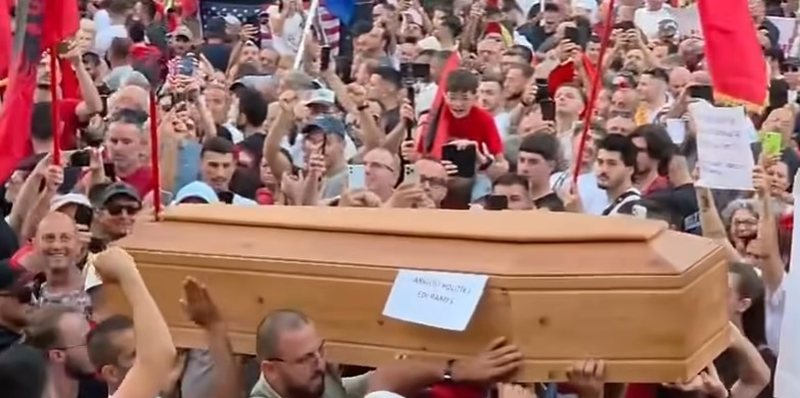
The protest claims to have found the path to achieve this, and that path is increased popular pressure that will force Rama to leave office. Saturday’s protest was smaller in number than the one two weeks earlier, while the daily protests of the last two weeks have been an evening stroll through the city with a number of protesters that would not trouble even Tirana’s municipal council, let alone the central government. Edi Rama’s metaphorical coffin, beyond leaving a bad taste for the impartial and providing exaltation for the extremists, hardly frightened the prime minister on the very day of his birthday. It was a figuratively macabre invention that does the protest more harm than good. A new Albania with a coffin at its side is a rather difficult image to make you jump for joy.
If the pressure of the square is the only path the protest offers for uprooting the traditional political system, 35 days are enough to understand that they have gotten the tactics wrong and that they are repeating themselves, boring people and burning off in a vacuum the popular energy they had accumulated. A protest that wants to be something that leaves a mark, rather than a seasonal venting of frustration, must build a political project, not blow vuvuzelas through the streets of Tirana. A government is not brought down by listening to speeches from whoever happens to pass by the podium and happens to be friends with the sound guy. Because with this behavior, even those who in the early days expected the government’s swift end because of the protest are now starting to ask themselves whether it is worth leaving the house to hear once again the same things they had already heard the day before on the boulevard.