Serbia’s minister stood at Khamenei’s funeral because Tehran judged that he had earned the place
Drizan Shala
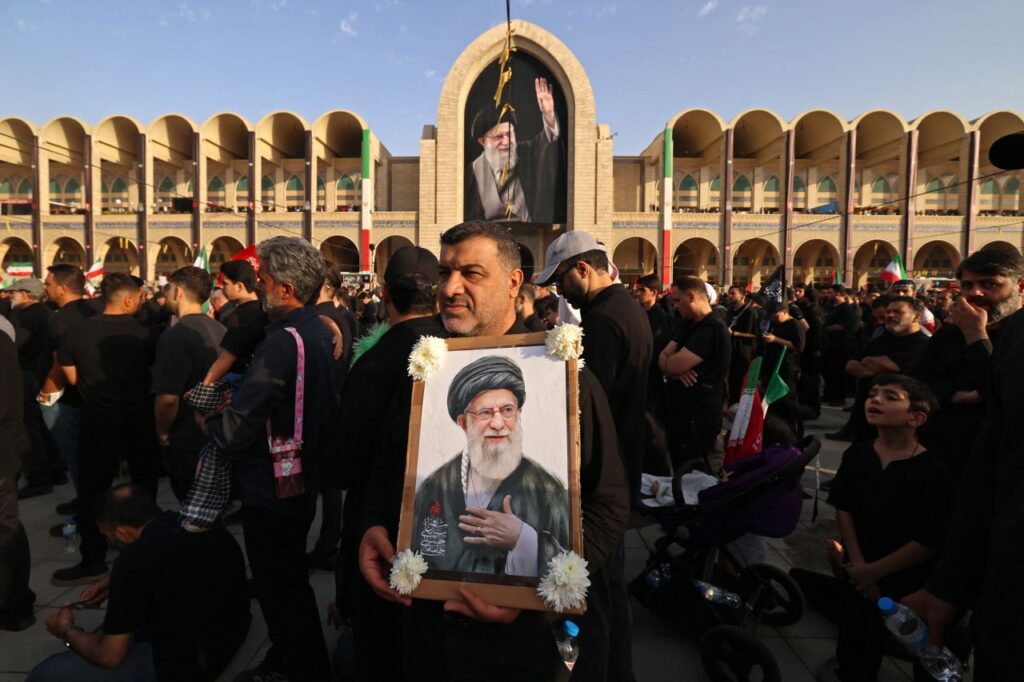
On the third of July, in the vast hall of Tehran’s Grand Mosalla, the coffin of Ali Khamenei lay draped in the flag of the Islamic Republic, flanked by the smaller caskets of the family members who died with him in the strike of February 28. Around the coffins moved the guests Iran had chosen to receive. Dmitry Medvedev, sent as Vladimir Putin’s personal envoy. The prime minister of Pakistan with his army chief. The Taliban’s foreign minister and its deputy prime minister. The president of Iraq. A delegation from Hamas. Ziyad al-Nakhalah of Palestinian Islamic Jihad. And, representing the Republic of Serbia, its minister of information and telecommunications, Boris Bratina.
His presence was reported as a curiosity, and in Belgrade’s pro-European circles as an embarrassment. Both readings undersell it. What Bratina’s attendance signifies becomes visible only when the analysis begins at the other end, with Iran’s decision to let him in rather than Serbia’s decision to send him. This was not an open funeral. It was a sorted one.
Iran’s foreign ministry spokesman, Esmaeil Baghaei, explained the sorting mechanism in public and without embarrassment. No European country was formally invited. States that had taken what Tehran deemed an inappropriate position on the American and Israeli strikes were excluded, while those in attendance, he said, were standing on the right side of history. A guest list assembled on those terms amounts to a finding. Tehran reviewed the wartime conduct of every government on earth, applied its own test, and issued invitations to those that passed. Serbia passed.
That finding deserves to be read against another set of certificates, issued by a different capital over the preceding two years.
In February 2024, on the same day a weapons shipment departed Belgrade for Israel, Benjamin Netanyahu telephoned Aleksandar Vučić and called him a true friend, thanking him publicly for support delivered in word and in deed. In September 2024, Isaac Herzog stood in Belgrade and told his hosts the same thing in the second person. When Gideon Sa’ar arrived in the Serbian capital to launch what the two governments styled a strategic dialogue, he thanked the president and government for their friendship, and his counterpart Marko Đurić answered that Serbia regards Israel as one of its greatest friends and key strategic partners.
The substance beneath the language was never sentimental, and it sits in customs records. Investigations by BIRN and Haaretz documented Serbian arms exports to Israel rising from 1.4 million euros in 2023 to 42.3 million in 2024, a thirty-fold increase sustained through the entirety of the Gaza war and delivered on at least twenty flights identified between Belgrade and the Nevatim military airbase. Vučić never denied the traffic; he advertised it. Serbia, he noted, was the only country in Europe exporting arms to Israel after October 7, and he recounted with a defense minister’s pride how a request received from Israel on the evening of October 8 was licensed, assembled and moving within four days. The title, in short, was made of ammunition rather than alignment.
Which is why it could be suspended the way a contract is suspended. In June 2025, days after Israel opened its campaign against Iran, Vučić announced at a press conference that Serbia had halted all arms exports to Israel and was redirecting production to its own army. He characterized the strikes as a violation of international law and reached for the analogy Belgrade produces in every argument it is losing, the NATO campaign of 1999, placing Iran rhetorically where Serbia once stood. A friendship denominated in 155 millimeter shells was paused by the supplier, unilaterally, the moment the customer went to war with a country Belgrade preferred to keep.
Serbia’s defense of all this is coherent, and it should be stated honestly rather than caricatured. Condolence diplomacy is not alliance; ministers attend funerals of leaders their governments never embraced, and diplomatic history is full of stranger processions. The halt in arms exports can be framed as a legally principled response to a war of choice, consistent with Belgrade’s stated attachment to international law. Vučić has never repudiated the pro-Israel record, and told the Jerusalem Post as late as this year that Serbia would always respect the Jewish people and Israel. On this reading, Belgrade is simply a small state doing what small states do, keeping every channel open and every door unlocked.
The reading fails on a single fact, and the fact belongs to Tehran. This funeral was closed to governments that merely kept their doors unlocked; by Baghaei’s explicit criterion, attendance was reserved for states whose position on the war Iran judged appropriate. The honor went to the approved, not the neutral. Neither France nor Germany was there, and no member state of the European Union was, because none was asked. Georgia and Armenia attended, but their situation is not comparable; both sit pinned against Iran’s border and depend on its corridors. Among the candidate countries of the European enlargement process, among the governments that sat in Brussels the previous week discussing clusters and chapters, exactly one qualified for the Grand Mosalla. And the qualification was Iran’s assessment rather than Serbia’s claim, rendered after four months of observing Serbian conduct in wartime, and rendered in Serbia’s favor.
So the question is not whether Belgrade is hypocritical. The charge is cheap, Belgrade has survived it a hundred times, and it moves nothing. What matters is what the two certificates, read together, reveal about the thing they both certify. Jerusalem examined Serbia and pronounced it a true friend. Tehran examined the same country, across the same period, and pronounced it a fit mourner for a leader killed by Israeli and American bombs. Both examinations were rigorous in their way, and both were passed. A government cannot be substantively aligned with the state that fired those missiles and the state that buried their most prominent casualty at the same time. It can be commercially and diplomatically useful to both, and usefulness is the only quality the two examiners could plausibly have been measuring in common.
There is a third capital that should treat Tehran’s finding less as irony than as an audit item, and it is Jerusalem. Israel’s side of the ledger deserves the same honest statement Belgrade’s received, because the case for the relationship is real. Haaretz has reported Elbit packages worth as much as 1.6 billion dollars, beginning with the 335 million dollar contract for PULS rocket artillery and Hermes 900 drones, with deliveries running to the end of the decade and a drone production facility planned outside Belgrade. The strategic logic behind those contracts is an old one and has worked for Israel elsewhere: sales of that scale are supposed to buy influence in a capital that would otherwise drift entirely toward Moscow and Beijing, influence of a kind that the unpaid loyalty of smaller partners never purchases.
The logic assumes the influence can be exercised. Whatever leverage the contracts bought did not prevent the export halt, did not soften the 1999 analogy, and did not keep Bratina out of the Grand Mosalla. Leverage that survives all three of those tests without being used is better described as revenue. And the revenue flows from a state whose military doctrine has never been ambiguous about where it looks. That doctrine names its neighbors as the threat, its buildup concentrates along Kosovo’s border, and its recent operational record includes Banjska, where an armed group killed a Kosovo police sergeant in 2023 and whose organizer, Milan Radoičić, confessed on Serbian territory and has never been extradited. Munitions for the PULS family reach up to 300 kilometers. From Serbian soil, the mid-range options already put Prishtina, Mitrovica and the whole Ibar valley inside the envelope; the upper end reaches into Albania.
The states inside those arcs happen to be the region’s actual Israel-aligned governments, the ones whose alignment required no invoice. Albania severed diplomatic relations with Iran in September 2022 after the Homeland Justice operation crippled the state’s own digital infrastructure, government portals and border systems included, in what remains the first known rupture of diplomatic relations over a cyberattack, and it has absorbed years of Iranian intelligence activity as the price of sheltering the Iranian opposition at Ashraf 3. Its prime minister answered the strikes on Iran not with a lecture on international law but with a public call to designate the Revolutionary Guard a terrorist organization. Kosovo recognized Israel and opened its embassy in Jerusalem when almost no one else would, paying for the decision in goodwill across the Islamic world at the precise moment it was fighting for every recognition it could get, and it publicly backed the American-led action against Iran. Neither government sent anyone to the Grand Mosalla, and neither could have. By Baghaei’s stated criterion, both failed Tehran’s examination, which is the only compliment Tehran knows how to pay.
Seen from Jerusalem, the ledger does not flatter. The governments that paid in alignment hold no title, no strategic dialogue and no Elbit production line. The government that paid in ammunition holds the title, the contracts, the dialogue, and now a certificate of appropriate conduct from the Islamic Republic, issued over the grave of a man Israeli munitions helped kill. If Israel’s regional policy is designed to reward alignment, it is misfiring by its own criteria; if it is designed to reward cash flow, it is working as designed, and Jerusalem forfeits the right to be surprised by where its customer stands on the day of the funeral. Either way, the policy is due an assessment, and the guest list is the obvious place for the assessment to begin.
There is a Brussels coda, supplied by the Serbian analyst Srđan Majstorović, who noticed the calendar. One day before Bratina paid his respects in Tehran, Serbian officials were in Brussels at an event titled, without apparent irony, Serbia’s Reform Momentum. Vladimir Međak added the granular detail that completes the picture: Bratina is the minister responsible for Chapter 10 of Serbia’s accession negotiations, digital transformation and media, inside Cluster 3. The same portfolio, in the same week, presented reform credentials to the European Commission and condolences to the Islamic Republic. Neither audience was lied to. Each was shown the version of Serbia it had contracted for.
And then there is the matter of which minister Belgrade chose, because the choice carries its own signature. The innocent reading is protocol economy: a junior minister is senior enough for Tehran to count and junior enough for Brussels to discount, and the rank may well have been hedging. The portfolio was not. Of every ministry available, Belgrade sent the one that governs the information and telecommunications space, and that space is the domain in which Iran has actually attacked a state in this region. The strike that ended Albania’s relations with Tehran arrived through government networks, not through airspace, and for Tirana the Islamic Republic remains above all an information-warfare adversary, the state it contests in code and in the narrative sphere rather than on any conventional front. Serbia’s response to the death of that state’s leader was to dispatch the minister of exactly that battlefield.
The man himself sharpens the signature. Bratina holds his professorship at the Faculty of Philosophy of the University of Pristina, displaced to North Mitrovica, which is to say that his academic career is conducted inside Kosovo. He came to government from the ultranationalist movement Naši 1389 and helped found the People’s Movement for the State, the organization built around Vučić. In 2009 he burned the European Union flag at a Belgrade rally marking the anniversary of the NATO campaign. In office he has described the journalists of N1 and Nova as outposts of foreign agencies, argued that they and Radio Free Europe should be taken off the air, and told students this April, on their own commemorative day, that the police have “the right to beat and kill” them. This is the custodian of Chapter 10, the instrument through which Serbia certifies media freedom to the European Commission, and this is the official who stood at the Grand Mosalla. Belgrade had anonymous state secretaries available if it wanted the gesture to mean nothing. It chose this one.
That is the finding, and it required no investigation to produce, because every element of it was announced by the participants themselves. Netanyahu named the friendship. Vučić priced it. Baghaei defined the guest list. Bratina walked through the door. The only work left to the observer is to place the statements side by side and notice that they describe one country, one policy and one product, sold continuously, in every direction, at prevailing market rates. Israel called Serbia a true friend. Iran, with its own criteria and its own war dead, has now formally agreed.
Drizan Shala writes on security, institutions, and political violence for Kosovo Dispatch and Tirana Examiner. He is a doctoral candidate at the University of Sarajevo.