Albania has taxed them at the same rate since it first had a VAT. The 2027 package is the most European thing Tirana has put before the Assembly on tax in a decade.
By Bekim Besimi (Venice)
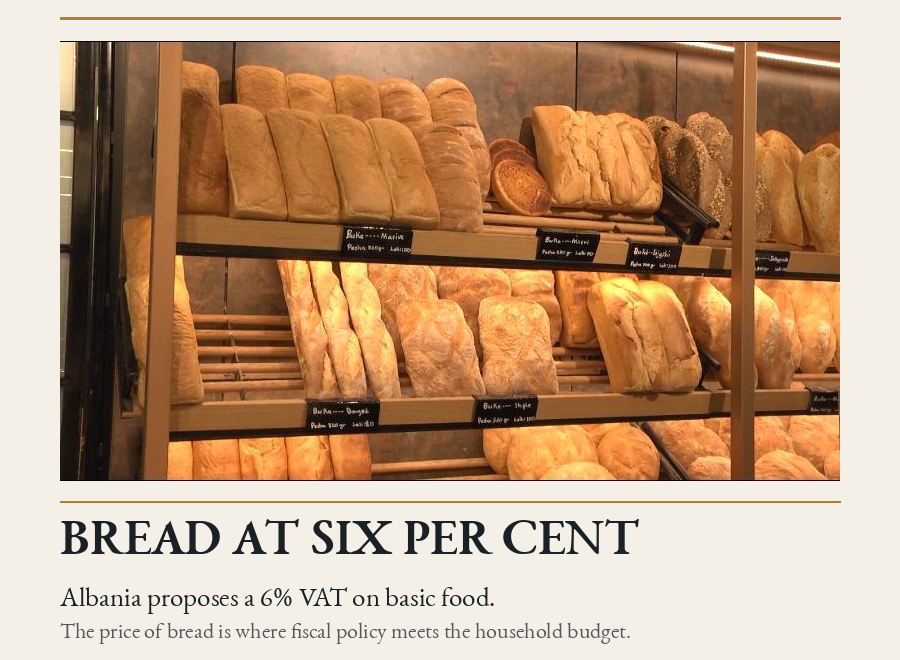
In the shop under my flat in Venice, a loaf of bread carries 4 per cent VAT, the hotel across the canal charges its guests 10, and the phone shop on the corner adds 22. Most of the European Union runs its value-added tax that way: the state takes less from what people cannot avoid buying and more from what they choose to buy. Albania is the exception. Bread, milk, eggs and cooking oil carry 20 per cent, the same rate as a television. Kosovo taxes basic food at 8, Serbia at 10, Montenegro at 7, North Macedonia at 5. Tirana taxes it at the full rate and calls the result a modern tax system.
The package the government adopted on 28 October and sent to the Assembly would end that. Under the VAT bill, bread and flour, milk and yoghurt, eggs, rice, pasta, oil, chicken, beef and pork, basic fish, fresh fruit and vegetables, legumes, sugar and infant food go to 6 per cent from 1 January, below Kosovo, Serbia and Montenegro and a point above North Macedonia; hotels go from 6 to 10, the Italian rate. The Ministry of Finance costs the food cut at 12.8 billion lek a year, roughly 1,500 lek a month per household if retailers pass it through in full, and considerably more for the family that spends most of its wage on exactly those goods. The standard rate rises one point, to 21, and brings back 10.6 billion. Read the two figures together and the mechanism is plain: the household that lives on the basket gains, the household that spends on everything else pays a fraction more, and the Treasury comes out two billion short. That is redistribution done through the till, which is the only place it reaches everyone.
I have spent twenty-seven years watching Albanian budgets from across the Adriatic, and the thing that distinguishes this one from its predecessors is that it is paid for. The deficit is 68 billion lek, about 2.3 per cent of GDP on the ministry’s own figure, inside a budget that passes 10 billion euros for the first time. The finance minister told the Assembly’s economy committee that the fiscal measures net out at zero, or about 300 million lek short. The explanatory reports attached to the bills bear him out: the VAT bill costs 1.6 billion, the income-tax bill brings in 1.8, the fuel bill costs 5, and the lowering of the VAT registration threshold, a Council of Ministers decision, brings in 4.5 on the ministry’s estimate. The Balkan habit is to announce a cut on television and find the money in next year’s borrowing. This package finds it in the same year, in the same texts.
The business associations are already calling the threshold an attack on small enterprise. A turnover of 10 million lek, about 110,000 euros, is one of the highest VAT registration thresholds in Europe; Italy’s flat-rate regime stops at 85,000 euros. The International Monetary Fund has asked Tirana to bring it down for years, the minister said as much in committee, and the case for it is the invoice chain as much as the revenue: a firm outside VAT cannot deduct what it pays and its customers cannot deduct what they buy from it, so the 17,500 businesses between 5 and 10 million lek have lived as a gap in the fiscal record through which larger companies passed their costs. The zero profit tax on small business stays in force until 2029. These firms join the same system as everyone else, which is what joining the European Union will require of them in any case.
On capital the package does something I did not expect from this government. Dividends have been taxed at 8 per cent while interest, rent, royalties and capital gains carried 15 and salaries up to 23, and owners who could pay themselves in dividends did. The bill unifies investment income at 15, the same rate as Serbia and Montenegro, and adds a clause treating “advances, loans or other forms of financing” [paradhënieve, huave ose formave të tjera të financimit] to shareholders as dividend when they are distribution in disguise. At the same time the profit tax stays at 15, already at the top of the region, after the 27 October draft had proposed 17 and the business associations objected within a day. An economist should welcome both decisions. Profit that is reinvested pays the corporate rate; profit taken out to be spent pays the dividend tax as well, and is then taxed like any other return on capital. The textbook calls that the distinction between the formation of capital and its consumption, and Albania has just put it in a bill.
The third bracket, 30 per cent on the part of a salary above 700,000 lek a month, touches 1,293 people. The relief below it, the 13 per cent band stretched from 200,000 to 300,000 lek, reaches 25,704 earners and is worth up to 10,000 lek a month, the full amount from 300,000 upward. These are the engineers, doctors and managers the country has been losing to Milan and Munich, and a payslip that keeps up to 120,000 lek more a year is a small argument for staying.
The fuel measure is the one people will see first. A litre of diesel in Albania carries four levies: excise of 39.4 lek, a circulation tax of 27, a carbon tax of 3, and VAT at 20 per cent charged on the price and on the three taxes inside it. The circulation tax is worth 26 billion lek a year on the forecast in the bill, and the VAT charged on that tax another 5.2 billion, a tax on a tax. Under the bill both go on 1 January: 32.4 lek of tax off every litre, by statute rather than by a Transparency Board cap that lapses with the next government decision. How much of it reaches the pump the relacion leaves to “international fuel prices, the exchange rate, supply and distribution costs and market conditions” [çmimet ndërkombëtare të karburanteve, kursin e këmbimit, kostot e furnizimit dhe të shpërndarjes, si dhe kushtet e tregut]; the Board’s price caps are the instrument for that. The state recovers most of the money on the vehicle. The annual tax is cylinder capacity times an age coefficient times a fixed rate per fuel; the rate doubles, to 25 lek for diesel and 20 for petrol up to 2,000 cc and 26 and 21 above; cars under three years old, exempt until now, start paying; electric cars pay 15,000 lek flat; trailers pay by weight. The ministry expects 33.8 billion from vehicles against 7.2 today, set against 31.2 billion forgone at the pump, so motorists as a group keep about 4.6 billion. The excise and the carbon tax stay on the litre, so the signal to burn less remains where it belongs.
The charge moves from the litre burned to the vehicle owned, and that shift has winners and losers the table attached to the bill does not hide. Anyone who drives a lot for the car he owns comes out ahead. A ten-year-old 1,600 cc petrol car will pay 7,680 lek a year under the new table; what its owner weighs against the pump is the increase over today’s bill, and he recovers it after somewhere between 120 and 240 litres, depending on the coefficient he has been paying, a few weeks of commuting either way. A twenty-year-old two-litre diesel will pay 32,000 and needs between 500 and 1,000 litres to cover the increase, so the pensioner who keeps the old Mercedes for Sundays pays more than he saves, and the owner of a new car pays a tax he has never paid. For those whose fuel is their business the gain is large: a haulier’s twelve-litre truck, ten years old, pays 102,960 lek a year plus a trailer by weight, and saves close to a million on 30,000 litres; buses sit in the lowest coefficient group; a farmer’s diesel is cheaper from the first fill. Transport is a cost inside every price on every shelf, and this is the one measure in the package that lowers it for people who do not drive at all. The charge is collected once a year at the technical inspection, a sum on a receipt; the municipalities’ share falls from 25 to 5 per cent of a base nearly four times larger, 1.72 billion lek against 1.78 today.
Add the pensioners, whose monthly bonus doubles from January, a 20 billion lek line, and the students from families in need, whose stipend rises from 10,000 to 25,000 lek, half a minimum wage, with 0 and 3 per cent loans behind it, and social protection takes 30 per cent of all spending.
Whether any of this reaches the kitchen table is not yet settled. The Assembly must vote the texts, and committee stages have moved numbers before. Retailers must pass the VAT cut through; the report attached to the VAT bill claims only that the lower rate “creates the premises for lower selling prices” [krijon premisa për uljen e çmimeve të shitjes], and the Price Mirror exists for that fight, which it will be. And the detailed product list is a Council of Ministers decision due by 15 January, so what counts as basic fish or basic infant food is still to be written. None of that is a reason to prefer the old arrangement, in which the question did not arise because a loaf was taxed like a television.
Albania has spent a decade being told to become a European economy. If the Assembly passes what is in front of it, on 1 January the country will have a European VAT on bread. That is where most countries started.
Bekim Besimi is an economist and entrepreneur based in Venice. He writes on economics and public finance for Tirana Examiner.