The EU Ambassador may speak for the acquis. He may not settle the facts of a live Albanian dispute. Partnership requires Brussels to address Tirana, not pronounce over it.
by Ardit Rada (Tirana)
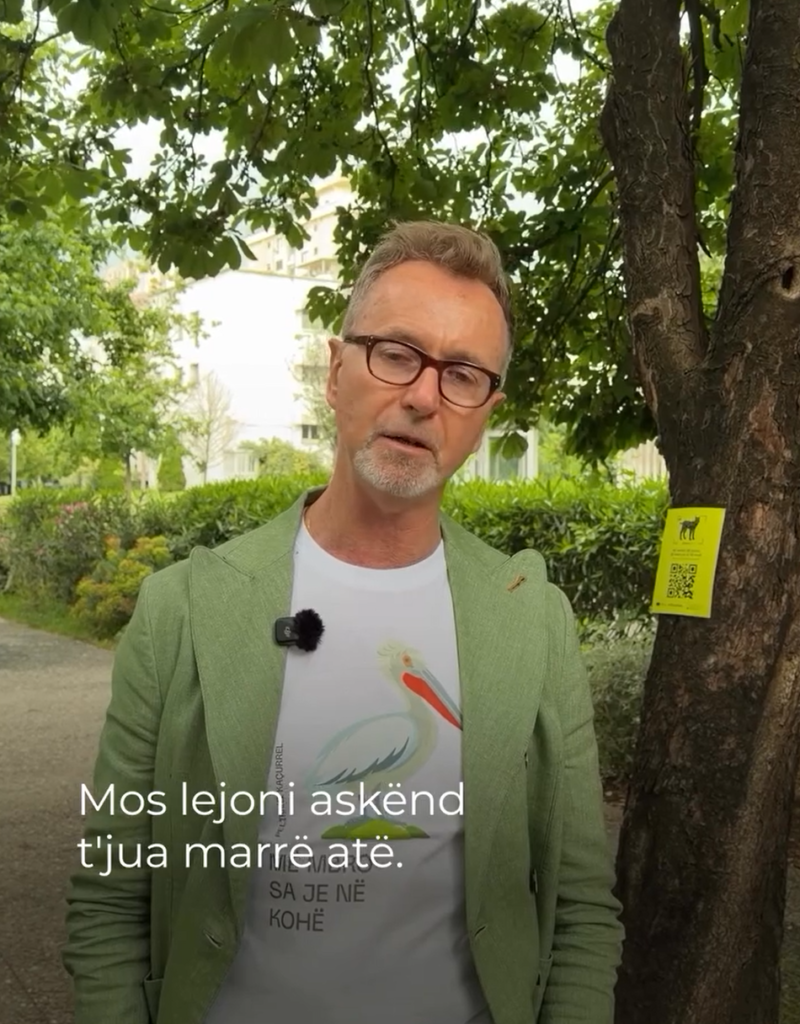
On 24 May, the EU Delegation in Tirana published a video. In it, Ambassador Silvio Gonzato stands in a park, wearing a shirt printed with the Dalmatian pelican of the Narta lagoon and a sentence written in the bird’s own voice: protect me while there is still time. The campaign had been produced weeks earlier, timed to Green Week, built around QR codes on trees and an invitation to think about nature. It was, by the standards of delegation diplomacy, the softest instrument in the case: values, not files; species, not statutes. Nothing in it named a project, a company, or a permit.
This magazine has no quarrel with that video. Let us be precise about why, because the precision is the argument.
Gonzato is not a bilateral envoy whose accreditation ends at the courtesy of silence. He is the Head of the Delegation of the European Union in a candidate country, and the mandate Albania accepted when it sought candidacy includes monitoring, reporting, and speaking publicly on Albania’s alignment with the acquis. Environmental protection is not adjacent to that mandate. It is Chapter 27 of it. The Vjosa-Narta landscape sits under national protected status and under obligations Albania entered freely. An ambassador of the Union who advocates for the values of the acquis in a candidate country is not interfering in its politics. He is performing the relationship both parties signed. The pelican was the job description, worn as a shirt.
The trouble began when the shirt was traded for a gavel.
This week, foreign correspondents put to the Prime Minister a statement they carried from the Ambassador: that the Zvërnec project had been canceled. Rama answered that no project existed and that nothing, therefore, had been canceled, and the exchange curdled into the kind of semantic duel that produces headlines and settles nothing. Set aside, for one moment, which man had the better of it. Ask instead the prior question: how did the EU Ambassador’s account of the project’s status become the evidence journalists carried into an Albanian press room?
The answer is no longer a matter of inference. He told them. And in telling them he crossed the line that separates the two things an envoy can be.
An ambassador may speak for a framework. He may say: the directives require assessment before disturbance; the benchmarks were agreed and the timeline runs to 2027; the protections hold until the chapter closes. Every word of that is his to say, and had he said only that, this column would not exist. What an ambassador may not do is pronounce on the contested facts inside a live domestic dispute: whether a project exists, whether it has been canceled, suspended, or merely paused for breath. Those are precisely the questions now sitting before Albanian institutions. The status of the Zvërnec project is not a fact awaiting a spokesman. It is the dispute itself. The moment Gonzato asserted an answer, he stopped representing the process that exists to produce one.
Two days ago, in these pages, we argued that a Commission spokesperson had compressed a 2027 benchmark into an order for today and passed sentence on a project before any process had produced one. The standard we asked of Brussels then is the standard we ask of its Ambassador now, and it is the same standard, because it was never a complaint about who spoke. It was a complaint about speaking ahead of the process. Precision about what was agreed. Fidelity to the sequence: assessment before disturbance, judgment after assessment. Respect for the timeline both parties set. A candidate is owed that discipline by every officer of the Union, from the Berlaymont podium to the park in Tirana, and the candidate owes the same discipline back. Albania does not get to declare a file untouchable by calling it national interest, and the Union does not get to declare it resolved by calling it canceled. Both moves are the same move. Both substitute a pronouncement for a procedure.
And the two episodes are no longer separable, because together they describe a habit. Within one fortnight, the Union spoke about Albania to POLITICO and about Albania to foreign correspondents, and on neither occasion to Albania. The spokesperson addressed Tirana through a wire service; the Ambassador disposed of an Albanian administrative question over the government’s head, to journalists, who then carried his verdict into an Albanian press room as a fact awaiting confirmation. Partnership is a grammar before it is a policy. It lives in the person of the verb. A partner is addressed in the second person, in the rooms built for the purpose, where the answer can be given to the speaker’s face. Twice in two weeks, Albania was conjugated in the third person, discussed rather than addressed, the object of sentences it was expected to obey but not party to. And this to the candidate that, on 26 May, sat at its eighth Intergovernmental Conference and opened the closing phase of Cluster 1, the furthest point any Albanian delegation has reached in these negotiations. The same fortnight, the same capital: at the conference table, a partner advancing; at the podium and in the briefings, a subject being managed. No single statement establishes an attitude. Two, in the same fortnight, from two officers of the same institution, begin to.
Some will read this as a demand that the Ambassador fall silent. It is the opposite. But first, apply the only test that matters, the one the Union sets for itself. Would the Head of the Commission Representation in Madrid tell foreign journalists that a contested Spanish coastal project had been canceled, ahead of the Spanish courts and the Spanish administration, and expect the week to end well for him? Would the question even need asking in Rome, in Athens, in Zagreb, the Union’s youngest member, whose coast has seen its own disputes? It would not, because no official of the Union speaks that way about a member state’s internal administrative record, ever, and everyone in the building knows it. Members are confronted too, and Hungary can testify to how hard; but they are confronted through the treaty’s own instruments, in proceedings where the member answers to its accuser’s face, and even there no official of the Union settles a member’s disputed facts from a podium. The treatment Albania received this fortnight is therefore not the Union’s standard of conduct. It is the Union’s standard of conduct toward candidates, which is a different and revealing thing, because the entire promise of candidacy, the promise that justifies every benchmark and every concession Albania has made, is that the candidate is a member in formation, owed today the respect it will command tomorrow. An institution that addresses candidates in a register it would never use toward members has not yet decided to believe its own promise. That, and not any directive, is the alignment problem on display this week.
A Union that wants Albania inside it should argue with Albania constantly, loudly, and well, the way one argues with an equal whose membership one actually intends. Silence is what Brussels gives the candidacies it has quietly abandoned, and silence is not what this magazine asks. The demand is simpler and firmer than that. Accession is a negotiation between parties, and a party that wants the process to keep its dignity will address the other side in the second person: to its face, in the rooms built for the purpose, where Tirana can answer. Speak for the directives there, and we will print every word. Speak for the benchmarks, the sequence, the law as agreed, and this magazine will hold Tirana to all of it without flinching, as it has. But speak to Albania, not about it. The facts of Zvërnec, what stands there, what was permitted, what was halted and by whom, belong to the institutions now examining them. The manner of the conversation belongs to both parties, and Albania is done lending its half of it out.
The pelican on the Ambassador’s shirt asked to be protected while there was still time. So does the process. It is younger than the bird, rarer in this region, and far more easily driven from its habitat. The Ambassador, of all people, was sent here to keep it alive.