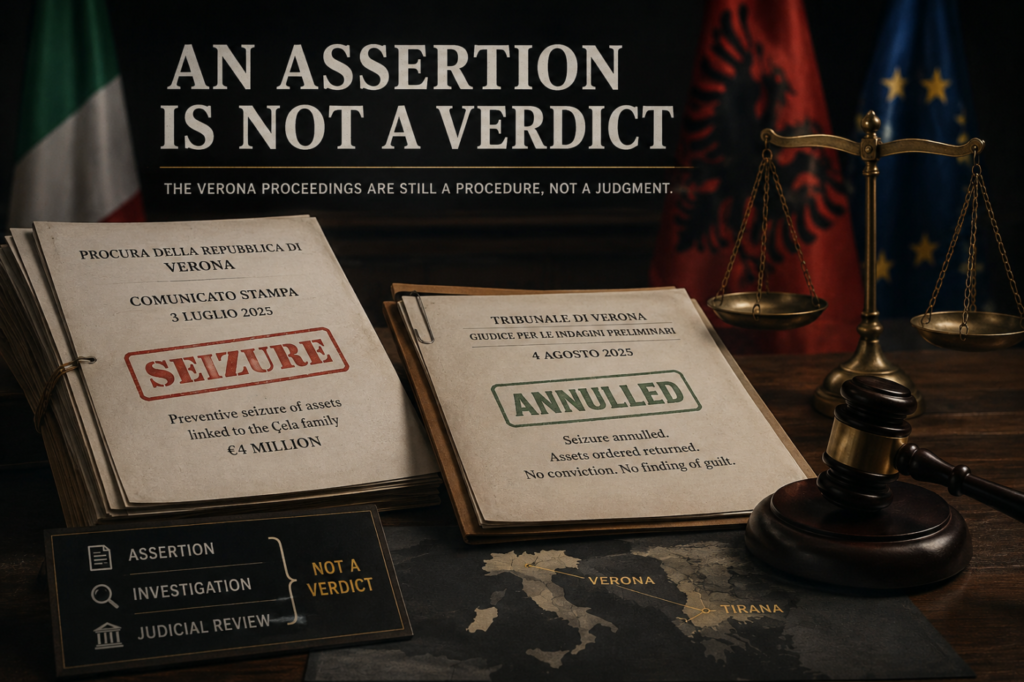
What the Verona proceedings hold for Albania is a lesson in procedure, and almost no one in Tirana is reading the procedure.
A Legal Desk editorial
On 3 July 2025, the chief prosecutor of Verona, Raffaele Tito, presented to the press a preventive seizure his office had obtained against a company of the Çela family of Elbasan, with Altin Dumani, then head of SPAK, joining the conference by video link. The written statement released that morning described the family as a known criminal clan importing South American cocaine for the European market, named one of two brothers said to lead it as an international fugitive, and identified the other, the registered holder of the Verona company’s shares, as a man arrested in Verona in June 2024 on a Belgian warrant that called him “mandante di un omicidio avvenuto ad Anversa,” the instigator of a murder in Antwerp. Four million euros in property, accounts and company shares passed to a judicial custodian that day. ANSA put the operation on the national wire.
One month later, on 4 August 2025, the investigating judge who had authorized the seizure annulled it. Paola Vacca, whose signature sat on the July decree, ordered restitution of everything, and subsequently refused the prosecution’s request to extend its investigation. By the only published account of her reasoning, this week’s reconstruction in L’Arena, the defense documentation established lawful commercial origins for the funds and the absence of any conviction against the family.
The second signature drew no cameras. We have searched the Italian record and can find no contemporaneous report of the revocation anywhere: no wire item, no local coverage, nothing from the outlets that had carried the seizure as a national story. The annulment became public knowledge on 3 August 2026, one year after the fact, in a single article by Fabiana Marcolini of L’Arena, which also disclosed what followed. The family’s company, Meral srl, has filed a criminal complaint against Dumani for calunnia. The Verona prosecution asked the court to archive it. The judge assigned to that request, Enrico Zuccon, declined, and instead directed the prosecution to spend two months establishing what the Albanian side transmitted to Italy and whether it disclosed its own prior decisions closing investigations against the same family.
That is the record. Within a day, the Albanian press had improved on it, and the improvements are the subject of this editorial, because every one of them replaces a procedural fact with a procedural fiction, and the difference between those two things is the entire question at issue.
The proceedings, read as proceedings
Begin with the instrument the commentary has mistranslated. The complaint against Dumani is not for defamation, though “shpifje” has run in every Albanian headline. Calunnia, under Article 368 of the Italian penal code, is classified among crimes against the administration of justice: the knowing incrimination, before judicial authority, of a person the accuser understands to be innocent. The distinction is not pedantry. A defamation complaint would assert that the Çela family’s honor was damaged. This complaint asserts that Italian justice itself was instrumentalized, that a foreign prosecution office fed Italian courts material it knew to be untrue. That is a graver allegation and a correspondingly harder one to sustain, because it requires proof not merely of falsity but of knowledge. Nobody has sustained it. No Italian court has found slander, calunnia, or anything else. The proceeding stands at the stage where a judge has refused to close it unread.
Note also who has stood where. The Verona prosecution obtained the seizure, opposed its revocation to the point of seeking an extension of the investigation, and has now twice positioned itself in Dumani’s corner, first by requesting archiviazione of the complaint and then by arguing, through his defense, that the complaint is a device to render him incompatible with organized crime investigations he leads. The judiciary, by contrast, has ruled against the prosecution three times: Vacca’s revocation, Vacca’s refusal to extend, Zuccon’s refusal to archive. Prosecutors prosecuted; judges checked them. Whoever wishes to hold this case up as a mirror for Albania must first report that division of labor accurately, because the division of labor is the mirror.
What the commentary made of it
The former justice minister Ylli Manjani, in a column published on 4 August, treats Verona as a controlled experiment separating European justice from ours. “In Albania it is enough that an unverified claim comes from SPAK and it is treated as proven truth,” he writes; in Italy, he says, the same claim is considered slander. His column merits engagement because he is a serious commentator and because its central principle is one this desk has defended in print. Its account of the Verona proceedings, however, fails at each of the three points a legal reading has to pass.
He writes that “the same Italian prosecutor who requested the seizure” concluded within a month that the assets were justified and sought the lifting of the measures. The revocation was the act of a judge, over a prosecution that wanted to keep investigating and has resisted the family’s position at every subsequent stage. In a column whose thesis is that prosecutors must answer to judges, the author has assigned the judiciary’s work to the prosecution. He announces a verdict, slander, that no court has reached, in a proceeding whose current meaning is precisely that verdicts await documents. And he frames the origin as a routine Albanian request for legal assistance that Italy examined and found wanting, when the July 2025 record describes a formally constituted joint investigative team in which the wiretaps were Italian, the financial analysis belonged to the Guardia di Finanza’s specialist sections, and the murder allegation was asserted in writing by Verona’s own chief prosecutor under an Italian judge’s authorization. The accusation of July 2025 was an Italian accusation too. The Italian system seized first on it, exactly as ours would have. What separates the systems in this file is that one of them unwound its own decree within a month.
The wire outlets that reprinted Marcolini’s article share the last error wholesale, and add nothing that would let a reader detect it, since none of them consulted the July 2025 record their own translations contradict.
What the family’s version omits
The obligation to read the file runs against the other party as well, and here the Albanian coverage and the L’Arena reconstruction it depends on fall silent together. Marcolini reports that no member of the family had a record of any kind, “nemmeno una multa per divieto di sosta,” not even a parking fine. As a statement confined to convictions it may be strictly true; we cannot audit Albanian and Belgian registries from Tirana. As a portrait it omits what L’Arena itself reported in June 2024: the arrest, in Verona, of an Albanian citizen sought across the Schengen area under a Belgian European arrest warrant for offenses including murder, an arrest matching in city, month, warrant and offense the one the Tito statement attributes to the holder of the Verona company’s shares. It omits the order of Tirana’s Special Court against the same man, issued on SPAK’s investigations, for premeditated murder, weapons offenses, trafficking, corruption and laundering. An arrest is not guilt, and the presumption of innocence protects the Çela family precisely as it protects Dumani. But a family that includes a man extradited on a murder warrant is not a family without a file, and commentary that erases this while denouncing others for converting assertion into proof has abandoned its own standard mid-argument.
Four things remain unknown, and this week’s confident commentary treats all four as settled. The current ownership of Meral srl, and whether it overlaps with the two brothers of the 2025 accusation. The outcome of the Belgian proceedings. The content and dates of the Albanian archiviazioni at the center of the dispute, which no one writing about them has seen. And the accuracy of the Vacca reasoning itself, which exists in public only as one newspaper’s reconstruction from the defense file.
The one live question
Reduced to its legal core, the Verona file now holds a single institutional question, and it is narrow enough to answer with documents. Zuccon has directed the prosecution to establish whether the Albanian authorities, at the moment of transmission, knew of their own decisions closing the investigations against the family, and whether those decisions were communicated to Italy or mentioned anywhere in the transmitted file. International legal assistance runs on the completeness of what authorities send each other; a requesting or transmitting state that forwards its accusations while withholding its own contrary decisions has defeated the mechanism from inside. By L’Arena’s account, the laundering allegations SPAK sent to Italy were allegations SPAK itself had already archived at home.
If the verification bears that out, SPAK will have documented in its own outgoing correspondence the habit its critics allege, and no column will be required. If it shows the opposite, that the archival decisions postdated the transmission or traveled with it, the complaint against Dumani collapses on the documents, which is where complaints should collapse. Either outcome arrives the same way: a file, read by a judge, under a procedure that treated a prosecutor’s assertion as an assertion.
The standard, and the mountain
On the principle beneath his column, Manjani is right, and the argument predates him, in our pages among others. A legal order in which the prosecutor’s claim is one input awaiting proof differs in kind from one in which the claim operates as proof until the defendant dislodges it. The pathology he catalogues is real, and its instances sit in the public record: sequestration functioning as punishment in advance of any finding, pre-trial detention doing the work of sentences, intercepted fragments carrying charges no material evidence accompanies, and a special court whose examination of the special prosecution’s requests too often resembles receipt. None of our objections touch that diagnosis. They touch the file work beneath it, because a diagnosis of this weight deserves a record handled to the standard it invokes, and an argument built on a reversed procedural history hands SPAK’s defenders their cheapest reply, that the critics cannot read a file either.
Albania has asked to be judged by the European standard, and the standard performed twice in Verona this year. A judge unwound her own decree in a month because the documents required it. Another judge refused to archive a complaint against a foreign prosecutor because the documents had not yet been read. Nothing in that standard is hostile to SPAK, and nothing in it lies beyond SPAK’s competence. What the standard cannot accommodate is an institution that treats its assertions as findings and treats scrutiny of those assertions as an assault on justice. The height SPAK has occupied since its creation, from which every question about method is answered by invoking mission, does not exist in the system Albania says it is joining. Prosecutors there work at ground level, where judges read their files, defendants answer them, and sometimes, as in Verona, the file answers back. If Albania wants the standard, its special prosecution will have to descend from the Olympus it has built for itself and stand where European prosecutors stand: under the scrutiny of judges who read their files, and subject, like everyone they accuse, to proof.
The Verona prosecution has until October. So, on a longer clock, does SPAK.
(this editorial is approved for publication by Renada Bici, chief legal analyst of the Tirana Examiner)