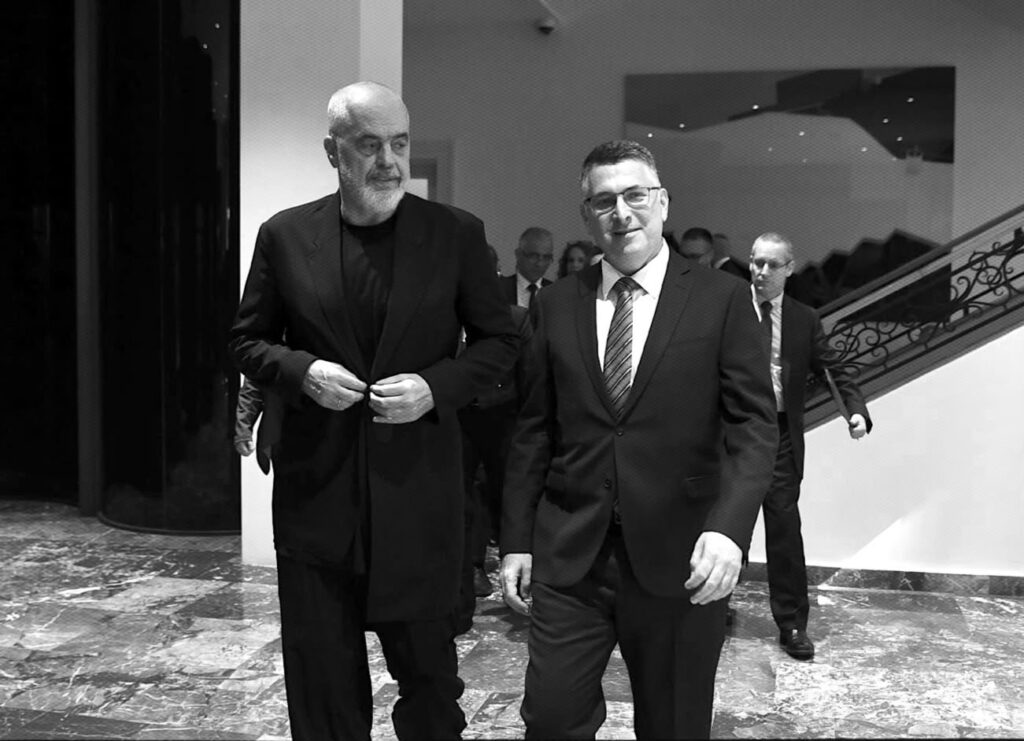
Israeli Foreign Minister Gideon Sa’ar met Prime Minister Edi Rama, Foreign Minister Ferit Hoxha and Speaker Niko Peleshi. Hoxha raised Israel’s recognition of Kosovo and confirmed Albania’s contribution to the Gaza stabilisation force.
Albania and Israel signed a General Cooperation Agreement in Tirana on Monday, widening their partnership across the economy, security, technology, health and tourism. The document was signed by Ferit Hoxha, Albania’s Minister for Europe and Foreign Affairs, and Israeli Foreign Minister Gideon Sa’ar, whose official visit also included meetings with Prime Minister Edi Rama and Speaker of Parliament Niko Peleshi.
Sa’ar arrived late on Sunday evening and began Monday’s programme at the Foreign Ministry. The agreement, concluded between the Council of Ministers of the Republic of Albania and the Government of the State of Israel, sets up a structured mechanism for cooperation in economy and trade, innovation and technology, agriculture, water management, energy, healthcare, education, security, tourism and culture. Sa’ar’s office described it as an expanded government-to-government accord, The Times of Israel reported.
According to the ministry’s account of the meeting, the two ministers discussed bilateral relations and regional and global security, including Albania’s contribution within the Board of Peace. Hoxha reaffirmed Albania’s support for Israel’s security and stressed the importance of a settlement that guarantees lasting peace, stability and security for the whole region.
Hoxha: “the highest point in our relations”
In his statement at the joint press appearance, Hoxha noted that Sa’ar is the third Israeli foreign minister to visit Albania and said the two had agreed that the moment marks “the highest point in our relations”. On X he added that this year is the 35th anniversary of diplomatic relations between the two countries.
Hoxha called security a key pillar of the partnership, listing the fight against terrorism and violent extremism, antisemitism, hybrid threats and emerging risks to national security. He gave particular weight to cyber defence, thanking Israel for helping Albania strengthen its capabilities after the 2022 cyberattacks on the country’s digital infrastructure, which he attributed to Iran and groups linked to it. Albania has kept investing in the resilience of that infrastructure, he said, and will deepen cooperation with Israel in the field.
On Iran, Hoxha strongly condemned what he described as the continuing destabilising activities of Tehran and its affiliated groups, and its recent attacks across the Middle East. He recalled that Albania severed diplomatic relations with Iran because of its policies and actions against Albania and its partners. Albania has also designated Iran a state sponsor of terrorism and the Islamic Revolutionary Guard Corps a terrorist organisation, he said.
Kosovo and Gaza
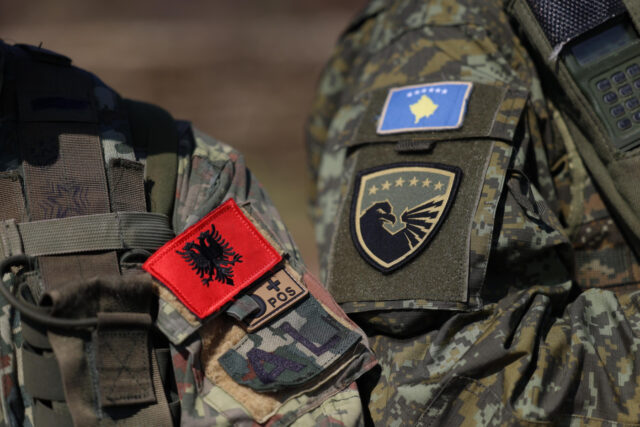
Hoxha said the ministers also exchanged views on the Western Balkans. He told his counterpart that Israel’s recognition of Kosovo, and the close relations the two have since built, form part of shared efforts to strengthen stability and cooperation in the region.
On the Middle East, he condemned the terrorist attacks of 7 October as a massacre of innocent people in their homes, on the streets and in their cars, and said no country could be asked to live with a terrorist threat to its own citizens. The suffering since then, he said, has taken many innocent lives and left deep wounds among both Israelis and Palestinians. It has reinforced the need to ensure Israel’s security first, he said, while making every effort toward a just and lasting peace.
Hoxha said that Albania, under Rama’s leadership, became a founding member of the Board of Peace and has decided to contribute to the International Stabilisation Force, as a sign of its commitment to stability, security and humanitarian efforts in Gaza. The task for the international community, he said, is to help create conditions in which Israelis and Palestinians alike can live in security, dignity and hope.
Economy, tourism and memory
Hoxha said Albania sees considerable room to diversify economic cooperation and is encouraged by growing interest from Israeli businesses and investors, particularly in infrastructure, agribusiness, technology, innovation, energy and healthcare. Tourism, he said, has become an important bridge between the two countries.
Sa’ar said the number of Israeli visitors to Albania had grown from 7,000 to 100,000 a year. He said Israelis feel safe and welcome in the country, that investment tends to follow tourism, and that energy, water, defence and innovation are fields for further cooperation. He recalled that the two governments signed a bilateral health agreement last year.
During the visit Sa’ar also signed an aviation cooperation agreement with Infrastructure and Energy Minister Eneida Kërcaku, i24NEWS reported.
Hoxha described the protection of Jews in Albania during the Holocaust as one of the proudest chapters of the country’s history and tied it to Besa, the word of honour. He said he had shown Sa’ar documents from the period. Albania is advancing two projects to keep that memory alive, he said, the Besa Museum in Tirana and the Jewish Museum in Vlora, conceived as centres of education and culture.
Sa’ar on Albania and Rama
Sa’ar called Albania “a true friend of Israel” that stands consistently by its side, and said Israel would always remember the rescue of Jews by Albanians during the Holocaust. At the press conference he thanked Albania for its stance against terrorism and antisemitism, its voice in international organisations and its position on Iran, according to Shqiptarja.com. He linked the wartime rescue to Albania’s conduct after 7 October.
He said that with elections approaching in Israel it was not the easiest moment to travel, but that the visit was important. Israel votes on 27 October.
Sa’ar also voiced strong admiration for Rama at the press conference. He described him as one of the most extraordinary leaders in the world today and said his leadership, conviction and moral compass carry weight beyond the Balkans, including in Israel’s own region.
Parliament and the Holocaust Memorial
Sa’ar’s second stop was the Assembly, where he met Speaker Niko Peleshi. Shqiptarja.com reported that, unlike on most such visits, the protocol entrance was avoided. In a post afterwards, Sa’ar described Israel and Albania as two democracies with shared values, challenges and interests, and said the two discussed the situation in the Middle East, interparliamentary ties and wider cooperation.
Sa’ar also paid tribute at the Holocaust Memorial in Tirana together with Taulant Balla, head of the Socialist Party parliamentary group. Balla later posted a message of gratitude to the Albanian families who sheltered and saved Jews from Nazi persecution during the Second World War.
One hour and fifty minutes with Rama
Sa’ar met Prime Minister Rama at the government building. The meeting lasted one hour and 50 minutes, according to Shqiptarja.com, and Rama shared images from it on social media.
Writing on X afterwards, Sa’ar noted that Rama has led Albania continuously for 13 years and called him “one of the most prominent and valued leaders in the world today” and a clear, courageous voice internationally. He described the prime minister as an unwavering friend of Israel and said Israel greatly values his commitment to its security and his stand against antisemitism and terror.
Sa’ar said the two held an in-depth conversation on advancing relations between their countries and on the situation in the Middle East and the Western Balkans. He closed by thanking Rama for his personal friendship and for Albania’s friendship with Israel.