By Maringlen Cara (Tirana)
There is a point at which a protest stops being a protest. Tirana crossed it at three o’clock on Tuesday.
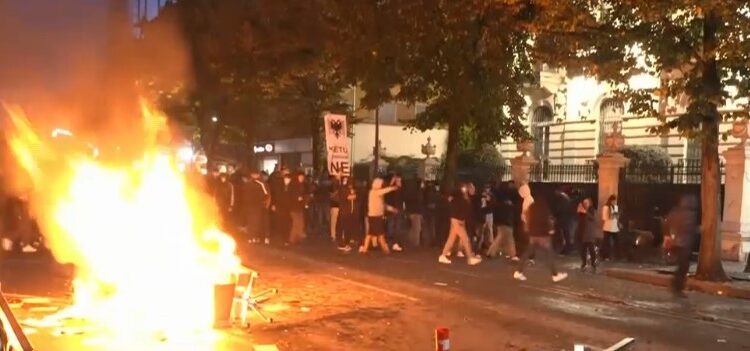
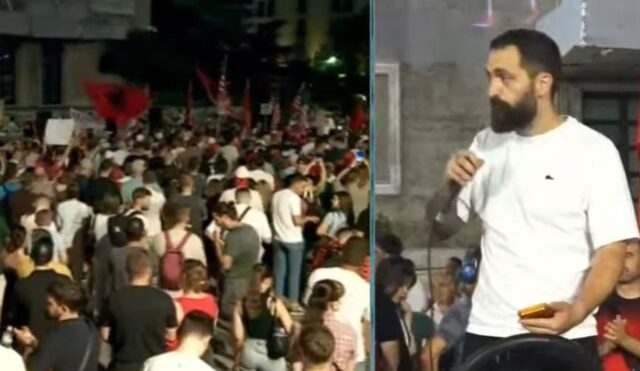
The students came to the Ministry of Education at two, with banners about dormitories and rent. At three a line of young men in black masks moved to the front. They tore the railings from the pavement and threw them at the building. Then paving slabs. Then molotovs. When the police pushed them back they split into two groups, fell back, and came again from the side streets. They went from the ministry to a bank, from the bank to the municipality, from the municipality to the wooden stalls of Pazari i Ri. One of them climbed a pole and smashed the cameras.
That is a plan, carried out by people who covered their faces before they arrived.
A molotov is a bottle of petrol with a wick, and the only thing it is designed to do is set a person on fire. You do not bring one to a demonstration about tuition unless you have already accepted that someone might burn. A paving slab thrown at a line of policemen is thrown at heads. A fire set among wooden stalls in the dark is set where someone may be inside. The people who did these things on Tuesday were not hoping nobody would get hurt. Hurt was the point.
Twenty-six people went to hospital. Six police officers. Two journalists, one with a brick to the head. A foreign diplomat. A boy of nineteen whose thigh bone is broken. By midnight the country was arguing about his leg and four suspended policemen, which is exactly where the people with the molotovs wanted the argument to be.
While the stalls were still burning, pages nobody owns began reporting that two students had been intubated. The state denied it. The denial changed nothing. Two hours later an anonymous account repeated it in capitals and added a dead sixteen-year-old. There was no dead sixteen-year-old. There were no students on ventilators. Somebody invented them, that night, for an audience that had just been sent home.
There is only one reason to tell a dispersed crowd that the police have killed a child. It is to bring the crowd back angrier. A dead student is the one thing that turns a demand for a minister’s resignation into a demand for revenge, and revenge is the one thing a police line cannot contain. Whoever wrote those posts knew that. They were not reporting a death. They were ordering one.
This is what anarchy looks like in its first hour. Not chaos, which is an accident, but a method: push the state until it must use force, make sure the force is filmed, invent the corpse the film did not provide, and come back the next day for the real one. Albania has seen the second day of that method before. In 1997 it ended with the state gone and the country in the hands of whoever had the most rifles. The people who profited were not the people who had stood in the first crowd.
The students who came at two with banners about rent were not part of this. By nightfall they were its cover. The MPs who stood in the street, the party leader who called the police terrorists before the fires were out, the deputies who went to the hospital to be photographed: they can say they did not light anything. They cannot say they did not see what the people beside them had brought.
Nobody died on Tuesday. That was luck, and a country does not get the same luck twice. The next molotov will land on someone. The people who are pushing Tirana toward that night have told us, with a bottle of petrol and an invented corpse, what they want from it.
Maringlen Cara writes on religion, law and public life in Albania and the region. A Catholic and a constitutional conservative, he holds that a church which serves the state stops being a church.