When violence came from the opposition, Tirana’s diplomats spoke within a day. When an anti-government crowd turned on a journalist for the opinions he expressed, the public statements stopped.
By Albatros Rexhaj
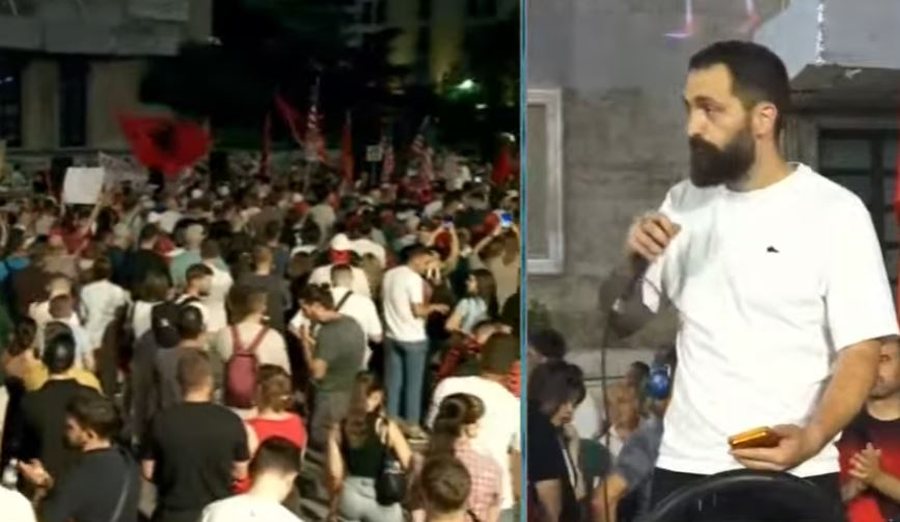
On Monday Bledi Mane was surrounded in central Tirana, called “Rama’s servant” [servil i Ramës] and hit with eggs and, by his account, a stone to the back of the head. Later Gent Progni took a microphone at the protest and explained that Mane had been hit out of turn. Ylli Manjani was first on the list, he said. “Albatrosi” was next. Mane came third.
I am the second name.
The Union of Albanian Journalists condemned the attack that evening. From the European Union Delegation and the embassies in Tirana I have found no public statement, on the attack or on the list.
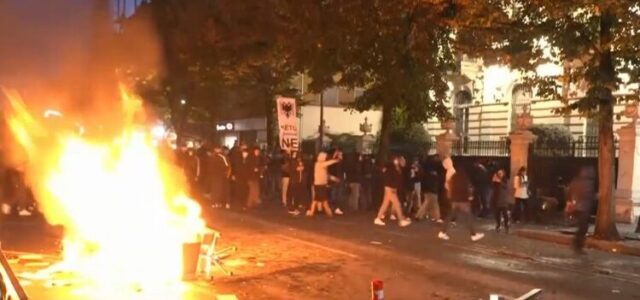
On 1 March, after violence at an opposition rally, the Delegation put out a statement and the German Embassy endorsed it the same day: protest, it said, can never justify violence against people or property. Three weeks later Molotov cocktails were thrown at a Democratic Party protest. The German Embassy answered within a day, and the Delegation supplied the rule in plain language: “all actors must distance themselves from it.”
That was the standard when the violence came from Sali Berisha’s party. The street now belongs to the Flamingo protests.
In July Top News reporter Kleida Muka was obstructed and physically attacked by protesters during a live broadcast. The journalists’ association reacted. I found no embassy statement. On 30 July ten press freedom organisations asked the European Union and the diplomatic missions in Tirana to raise their concerns with the authorities directly and in public. Attacks on journalists, they wrote, must be investigated whether the perpetrator is a police officer or a protest participant, and reporters must be safe “regardless of their outlet, employment status or perceived editorial position.”
Perceived editorial position is exactly what Mane was attacked for. It is what puts a commentator on a list.
Mane has thanked the diplomatic corps for the human solidarity shown to him since Monday. I am glad he received it. I have found no public trace of it. In March the condemnation was posted for the whole country to read. An embassy that condemns one camp’s violence in public and consoles the other camp’s victims in private is applying two rules. That is selectivity, and it needs no proof beyond their own statements.
The Flamingo movement stopped being an environmental protest months ago. Its published demands begin with the non-negotiable resignation of an elected prime minister and his government, followed by a non-partisan “technical” government for twelve months. That is a change of government without an election, demanded from the street. I call it undemocratic. Members of the European Parliament have come to Tirana to join the marches.
I cannot prove what any embassy wants. I can show what each has said and what none has said. When a movement that demands the removal of an elected government starts deciding which journalists and commentators may walk the streets in peace, and the missions that spoke in March stay publicly silent, they invite a suspicion they now have a duty to rebut: that they are no longer merely watching this movement but hoping it succeeds.
They can end that suspicion with a sentence Brussels has already written. All actors must distance themselves from violence. It should be said again this week, in public, with the facts attached: a journalist was attacked, and three citizens were put on a list.
If it is not said, the silence will be read as the answer.