The debate around the reform has become political. The legal question before the Supreme Court is simpler: whether detention decisions must finally be justified by facts rather than formula.
by Elis Zenelaj (Tirana)
More than half the people currently sitting in Albanian prisons have not been convicted of a crime. As of December 2025, 2,569 of Albania’s 4,503 prisoners — 57 percent — are awaiting trial. Whatever the full causal story behind that figure, it is difficult to reconcile with a legal system that genuinely treats imprisonment before conviction as a last resort.
On 9 March 2026, Supreme Court Chief Justice Sokol Sadushi launched a formal procedure to revise a 2011 Supreme Court ruling that, by his own account, has allowed courts to order pre-trial detention in ways neither Albanian law nor the European Convention permit. The United Collegiums — the Supreme Court’s full combined bench — convene on 9 April to rule on the matter.
The legal problem is real and documented
The ruling — Unified Decision No. 7 of 2011 — was intended to harmonise how Albanian courts apply pre-trial detention. In practice, it turned a legal last resort into a default. It told courts they did not need to analyse why alternatives like house arrest were inadequate — only that their chosen measure was appropriate. It allowed individual dangerousness to be inferred from the seriousness of the charge alone, without examining the specific person. And it placed the burden of disproving risk on the defendant, rather than requiring the prosecution to prove it.
The European Court of Human Rights has found Albania in violation of these standards repeatedly. In Hysa v. Albania (2023), the Court found that domestic courts had substituted the gravity of the charge for individualised reasoning, and that their stated consideration of alternatives was purely formal — the right words, with no analysis behind them. In Gëllçi v. Albania (2023), the Court found that a suspect’s voluntary surrender to authorities had simply not been weighed in the detention assessment. In Muçaj v. Albania, courts had invoked flight risk for extended detention without showing how that risk applied to the specific individual. The same structural failure appears across all three cases: formula substituting for fact, offence gravity standing in for individual assessment, alternatives acknowledged but never genuinely considered.
These are not high-profile political cases. They involve a television executive, a man detained over tender irregularities, and a suspect who turned himself in. The legal problem they document predates any current political controversy by years.
What the reform would require
If the United Collegiums revise the 2011 decision as the interim decision suggests, Albanian courts would need to demonstrate — in writing, with reference to specific facts — why this particular person poses this particular risk, and why that risk cannot be managed through a less restrictive measure. The burden of justification would sit with the prosecution and the court, not with the defence.
This does not mean courts could no longer order pre-trial detention in serious organised crime or corruption cases. It means they would have to show their reasoning. A detention decision grounded in specific facts about a specific defendant is both legally sounder and harder to challenge in Strasbourg than one grounded in the nature of the charge.
The political objection and its limits
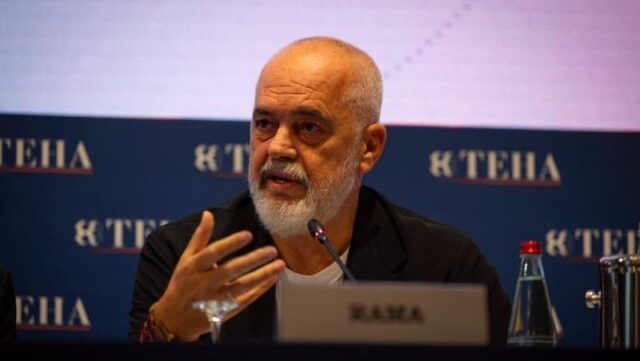
Democratic Party parliamentary group leader Gazment Bardhi responded to the initiative by calling it a “constitutional coup” — a politically ordered move designed, he said, to free corrupt officials and organised crime figures currently in prison on Edi Rama’s behalf.
The legal deficiencies the interim decision identifies were documented by the ECtHR in cases with no political profile whatsoever, years before the current detentions. A legally correct reform does not become incorrect because its timing is politically inconvenient, nor does a politically motivated reform become legally wrong because of who initiates it. The questions before the United Collegiums on 9 April stand or fall on whether the 2011 doctrine is compatible with Albanian law and the Convention. That was true before Veliaj was arrested and will remain true after.
What to watch on 9 April
The United Collegiums could revise narrowly — adjusting the language of the 2011 decision without changing how courts approach detention in practice — or substantively, establishing a clear methodological framework for what legally adequate detention reasoning must contain. The difference between those outcomes matters enormously. The first would change the words. The second would change the practice.
That is the question worth watching. Not who benefits, but whether Albanian courts will finally be required to do the analytical work the law has always demanded of them.
READ THE ANALYSIS OF OUR LEGAL DESK