The euro has slipped below the number this magazine pressed the Economy Minister on a month ago. As the currency chart becomes the loudest exhibit in Albania’s dirty money argument, we turn the Hard Talks chair on our own economist and ask whether his arithmetic survives 92.4.
by Besart Ruka (Tirana)
Introduction
The screenshot arrived on a Sunday afternoon, from an exchange application updated at four minutes past two: euro bought at 92.4 lek, sold at 93.5. The official rate opened August at 93.36, the lowest the Bank of Albania has ever recorded, and fell again midweek. The euro has lost 3.5 percent against the lek since January and more than four percent in a year. One month ago, in this format, we put the number 94 to the Economy Minister as the country’s most political statistic. The market has since carried the argument below the question we asked.
The myth has kept pace. Gjergj Erebara’s June essay carries a sharpened exhibit built on the central bank’s own purchases, the opposition has restated the thesis on television, and the Prime Minister has now joined the argument personally, in a July speech we will quote to our guest in full. The seasonal peak of the appreciation, meanwhile, arrived on schedule, in the exact window between late July and the middle of August where it always arrives.
This edition of HARD TALKS breaks the format’s habit. The chair usually faces outward. Today it faces our own columnist, because a magazine that presses ministers owes its readers the same treatment of its house economist. Bekim Besimi argued in these columns five weeks ago that the dependency myth does not survive arithmetic. We have spent the month assembling the strongest case that it does.
The Interview
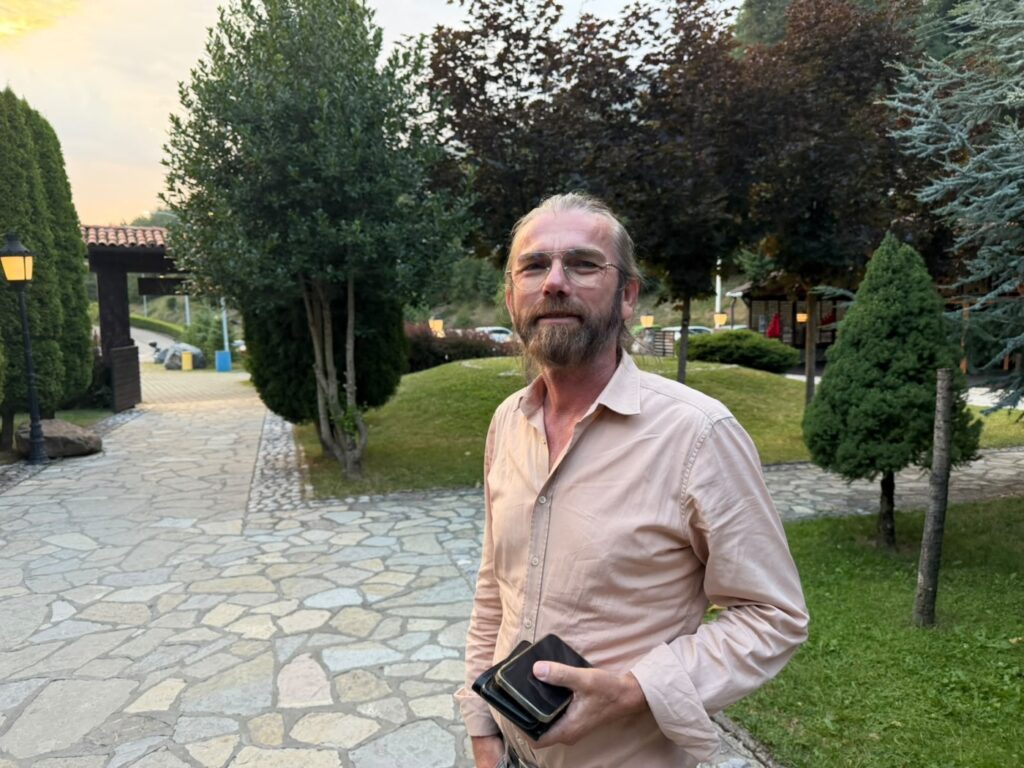
TIRANA EXAMINER: You have watched Albania from Venice since 1999. You are an economist, an entrepreneur, an artist. Your formative political memory, by your own account, is dinner with a Socialist prime minister, and you now defend the currency’s rise under a Socialist government. Why should a seamstress in Berat trust the view from a palazzo?
BESIMI: She should not trust the view. She should check the division, which works the same in Venice as in Berat, and I will come to it. But since you have opened my biography, let me finish it properly. I dined with Fatos Nano five times, in Trieste. What imprinted on me had nothing to do with his party. Two sentences did it. Albania is a land of tremendous potential, he told me, and no leader can ever do enough. I have applied the second sentence to every government since, including this one, and I intend to apply it again before we finish today. As for distance: I began watching this economy when a euro cost 140 lek. The appreciation is a conclusion two decades of data forced on me. Loyalty had nothing to offer. I live in Italy.
TE: Then take the strongest exhibit against your conclusion, because it has been upgraded since your last essay. Erebara’s argument now runs on the central bank itself. The Bank of Albania bought nearly a billion euros in 2024 and a similar figure in 2025, and the lek not only refused to weaken, it kept climbing, which he reads as showing, in his words, “forcën reale të strukturave kriminale,” the real force of the country’s criminal structures in the international drug market. The state’s own bank fought the flow and lost. What was it losing to, if the criminal money is the rounding error you claim?
BESIMI: It was losing to tourism, and it was never fighting. Read what those purchases were. A central bank in a shallow market smooths a current it has already diagnosed as legal and structural; it does not build a dam against it. The flow that overwhelmed the smoothing is itemized, transaction by transaction, in the balance of payments, 5.7 billion euros of travel receipts, more than a billion in remittances, foreign investment setting records every quarter, and nobody needs a hypothesis for a current the accounts already name. There is a worse problem underneath his sentence, though, and it disqualifies the argument rather than answering it. In Erebara’s construction, the bank’s failure to stop the lek proves the criminals are strong. Had the bank succeeded, the same pen would have written that only official force was holding the dirty tide back, which also proves the criminals are strong. A thesis that wins on both outcomes of the same experiment has stopped being testable, and I stopped reading there.
TE: Then let us run an experiment neither of you designed. Since 2024 this country has been the worst environment for laundering in its history. SPAK sequesters towers floor by floor, its searches reached the Tirana Municipality itself in July, a Deputy Prime Minister stands indicted on eight counts, a former minister’s trial runs on the court calendar this week, the protests on the boulevard are in their third month, and every due diligence desk in Europe prices Albania as suspect. Illicit capital is the most flight prone capital on earth. It exists to move. If it were the marginal buyer setting the lek’s price, the rational response to this environment is withdrawal, and withdrawal has a signature: depreciation. Instead the chart went the other way, through the loudest enforcement period ever recorded, to 92.4 on a Sunday in August. So answer the version your critics will reach for. Perhaps the appreciation continues precisely because they are stuffing money in faster, one last cleaning cycle before the door closes.
BESIMI: The panic hypothesis. Good, because panic leaves a signature too. Money racing a closing door arrives as a spike and then decays, and it arrives on the criminal calendar, which follows indictments, not holidays. Look at the record instead: an appreciation that breathes with the tourist season, peaking every year in the same two weeks of high summer, relaxing when the charter flights stop. Money that moves with the season is holiday money. Then the behavior itself. Your critics need launderers sophisticated enough to overwhelm a central bank yet reckless enough to keep concentrating fresh capital in the one jurisdiction confiscating it floor by floor, when the entire logic of the trade is diversification across jurisdictions. Under enforcement pressure a rational criminal sells his lek exposure. He does not add to it. And when Erebara replies that the money cannot leave because it sits trapped in concrete, he should be thanked, because the reply is fatal to his own mechanism: concrete is a stock, exchange rates move on flows, so trapped money exerts no pressure on the lek at all. Only new arrivals do, and new arrivals are the first thing a rational cartel cuts when the state starts seizing floors. If the inflow had stopped, as the noise should have stopped it, the climb stalls. It did not stall. Either the criminals are irrational, or they were never the buyer. One more thing before you extract it from me. The experiment is natural, not controlled. Record enforcement and record tourism arrived in the same years, the flows are entangled, and a determined critic can claim the legal tide masked a criminal retreat that really happened. Fine. Let him claim it, and let him notice what he has conceded, because a criminal inflow small enough to vanish inside the tourism account without leaving a trace on the exchange rate is my rounding error. He can have the retreat or the potency. Not both.
TE: Here is ground your critics hold with real numbers, so hold your concessions ready. In 2025 Albania exported 346 billion lek of goods and imported 887 billion. That is a coverage ratio of 39 percent. Textiles and footwear are still nearly a third of goods exports and they are being strangled by the very rate you defend. A country that sells 39 lek of goods for every 100 it buys should, on the textbook page, have a weakening currency. The opposition says the appreciation finds no explanation in economic theory. Does it?
BESIMI: The deficit is real, it is ugly, and I will not dress it. A 39 percent coverage ratio is a serious industrial fact and the fason collapse inside it is a human one. But the goods ledger is not the external account. The country’s earnings run through the other ledger, where more than eleven million visitors, the diaspora’s remittances and record investment produce the surplus of foreign currency that the goods deficit never sees. As for theory, the claim that no explanation exists is the one sentence in the opposition’s case I can refute with a library call number. The IMF built an integrated policy framework model with Albania’s name on it, estimated it, and concluded the appreciation is driven mainly by fundamentals. A politician may dislike the finding. He may not report it missing.
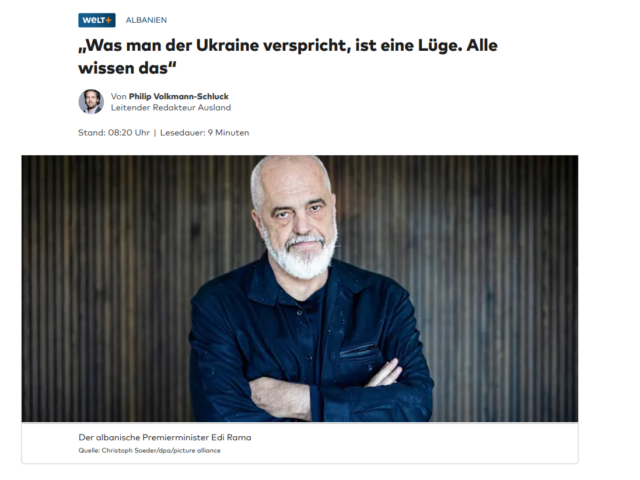
TE: The Prime Minister has now joined the argument personally, so let us put his July performance to you whole. At a business event on the 17th he called the strong lek “a success for the Albanian economy, a stubborn indicator of its growth, in a country where billions upon billions enter every year,” dismissed the narco thesis as nonsense that flatters people who need bad news, and said that if it were true, the warning would come from the international financial channels that watch this economy under a magnifying glass. Meanwhile his own state runs a record half year surplus of 52.8 billion lek, sixty percent higher than last year, pulling lek out of circulation while the euros flood in, and his central bank pursues a declared de euroization strategy. How much of the trophy is engineered by the state that polishes it, and is a Prime Minister who waves the question away as donkey talk entitled to skip the arithmetic his minister promised us in December?
BESIMI: Part of the trophy is engineered, and say it flatly, because nobody in Tirana will. A fiscal surplus of that size is an appreciation policy whether or not anyone calls it one, and de euroization is an appreciation policy that was called one, in print. A government is entitled to both. What it is not entitled to is the pose, and here the Prime Minister has done my critics a favor he does not understand. His magnifying glass argument is correct, the IMF and the ratings channels do watch this economy and have found fundamentals, but a leader cannot cite the magnifying glass on Monday and decline to publish the microscope in December. If the international channels vindicate him, the four numbers will vindicate him faster. Dismissing the question as nonsense while sitting on the answer is how a true position gets to look like a hidden one. A currency’s level is a relative price, it measures nothing about virtue, and the same politicians reading 92 as a trophy would have read 110 as sabotage. Both readings are decoration. The arithmetic underneath is what I defend, and the arithmetic does not require the trophy cabinet.
TE: The reserve has reached 7.8 billion euros, a record, described in one commentary as 130 percent of annual imports, at which point the word reserve is doing a second job. The bank’s purchase plan for 2026 is 330 to 450 million euros, roughly a third of what it bought in each of the two previous years. The IMF tells it to let the rate float and intervene only against shocks that are not fundamental. Has the Bank of Albania surrendered?
BESIMI: It has agreed, which looks similar from a distance. A decade of accumulation had costs the public never priced, carrying costs, balance sheet risk, revaluation losses waiting in the drawer, and the retreat from intervention is the institution accepting its own diagnosis. You do not lean for years against a force you believe to be criminal and temporary. You lean against a force you believe to be structural and permanent, until leaning stops making sense, and then you stop. Watch what the bank does rather than what the myth needs it to do. A central bank convinced the lek was riding dirty money would be tightening surveillance and building the dam higher. This one is stepping back and letting the price speak.
TE: Now the people your price has already spoken to, and you do not get to repeat the minister’s answer. She told this magazine the strong lek priced Albania out of a past, not out of a future. Here is what the present sounded like in March, on the record of the parliamentary Economy Commission: manufacturers testifying that the exchange rate is bankrupting them, that the sector shed some twelve thousand workers last year, and asking the state to fix a rate of 101 to 105 lek for their sector alone and compensate the difference on every registered export declaration. By May the sector had exported 35 million euros less than the year before. The emigrant in Munich sends the same euros home and watches them buy four percent fewer lek than a year ago, a pay cut nobody legislated. Name the transfer, Besimi. Who collects what the seamstress and the emigrant are losing, and through what instrument does one lek of it ever flow back?
BESIMI: First honor what that testimony actually was, because it is the most underreported sentence in this whole argument. The people bleeding, handed the floor of parliament, did not ask for a narco investigation. They asked for a fixed rate and a state paid spread, a compensation mechanism, and remember where the euro stood when they asked. They wanted 101 with the euro at 96. It is at 92 and a half today. Five months, and their request has aged the way requests age in Tirana. The victims themselves diagnosed economics, not crime, and their diagnosis deserves an answer instead of a slogan. So, the collectors. Importers collect, through cheaper inputs. Every household collects at the counter, through import prices that would otherwise have carried these years’ inflation. The state collects and bleeds at once, which its own reports admit, customs revenue down roughly 9.5 billion lek to the falling currencies last year while the public debt ratio slid to 53 percent partly on the cheapening of debt held in foreign money. The gains are large, diffuse and invisible; the losses are smaller in total but they land on people who can point at them, and that is the configuration where democracies do nothing, because the winners are silent and the losers are hoarse. And the instrument you ask me for, the pipe that carries a share of the gain back to Berat and to Munich? It does not exist.
TE: That is an indictment of the government you are defending.
BESIMI: I am defending an exchange rate. Governments can defend themselves, and this one has a commission transcript to answer for. There is a minimum wage, which is a floor, not a redistribution mechanism. The request for one was made in March, on the record, and nothing was built. I can defend the price. I decline to defend the vacancy around it, and if the government wants this interview quoted, it can quote this paragraph.
TE: In the cafés the word is not crime, it is fake. The strengthening is called artificial, the growth called paper, money that never reaches a wage, a pension, a school. You have spent two essays telling these people their mechanism is wrong. Tell us what they are right about.
BESIMI: They are right about the distribution and wrong about the origin, and the two errors are not equal, because theirs is the honest one. When a man says the lek’s strength is fake, he is reporting, accurately, that none of it has arrived at his table. The gains are real and they are concentrated, so from most tables they are invisible, and a prosperity you can see on the skyline but not in your kitchen will always feel counterfeit. The crime story gets attached because a folk theory of unfairness needs a villain with a face, and a balance of payments cannot supply one. I would only ask the café one thing. Keep the grievance and drop the costume. The grievance, at least, is addressed to someone who can act on it.
TE: Falsifiers, in both directions, because this format now has a tradition. The minister put three on the record in July. Erebara has put one on his: without drug money, he writes, the towers stall half finished and the projects of thirty floors shrink. A scenario paper this spring gave majority odds to fragile stability and projected the lek easing toward 105 to 112 per euro by 2028 as the healthy path. So commit. What evidence would make Bekim Besimi stand up and say the dirty money reading of the lek was right?
BESIMI: Write mine next to the minister’s and hold us both to them. First, show me appreciation that decouples from the season, a lek that climbs through November and February with the beaches empty, year after year, and I will concede a buyer the tourism account cannot explain. Second, show me the December report, once it exists, revealing a rising cash share in property and a widening unexplained residual, and I will concede the myth found its numerator. Third, show me the enforcement paradox resolved in the myth’s favor, laundering convictions collapsing while the appreciation persists, the flow continuing after its supposed source has been strangled, and I will reread Erebara with an apology in hand. Until then, note what my first falsifier already does to his thesis. The lek relaxes every autumn when the tourists leave. SPAK does not take winters off, and neither, we are told, do the cartels. If the drug money also vanishes each October, it has begun behaving suspiciously like a hotel bill. On the towers, his prediction is fair and it is now on the record. If the flow he describes is real and the enforcement is working, half finished concrete should start appearing on the skyline within a few years. We will count the stalled floors together. I expect to be counting cranes.
TE: Last question. The minister committed, in this format, to four numbers before the end of the year. It is August. What do you write in January if the report does not appear?
BESIMI: I write that the government forfeited its standing, though not the argument, because the arithmetic survives on the public accounts alone. But a government that declined to disarm a myth when the weapon sat in its own drawer loses the right to complain about the myth, and the Prime Minister’s July dismissal becomes unquotable, since a man who calls the question nonsense while withholding the answer has chosen the myth’s company. This magazine should treat a missed date as a story, not a footnote. And here I keep the promise I made you at the start of this conversation, because Fatos Nano’s second sentence has been waiting for this moment. No leader can ever do enough. He said it to me over dinner as a description of the country’s potential, and I have carried it since as a standard of accountability, and in December it acquires a definition with four numbers in it. A land of tremendous potential does not need a criminal explanation for its currency. It needs a government that never mistakes a strong lek for finished work. Print the date.
TE: Besimi, thank you.