This interview was originally published in German by WELT AM SONNTAG and conducted by Philip Volkmann-Schluck, senior foreign editor at WELT. Tirana Examiner has translated the published German text into English and preserved the sequence and substance of the questions and answers. Because the source published by WELT is in German, the English quotations above are translations of that published text and should not be treated as a verbatim English-language transcript of Prime Minister Edi Rama’s original spoken words. In the question concerning SPAK, the description of the institution as being “under US and EU oversight” is WELT’s wording, not a statement by Rama. Albanien_ „Was man der Ukraine …
The original WELT piece identifies Volkmann-Schluck as the interviewer and notes that the text appeared in WELT AM SONNTAG.
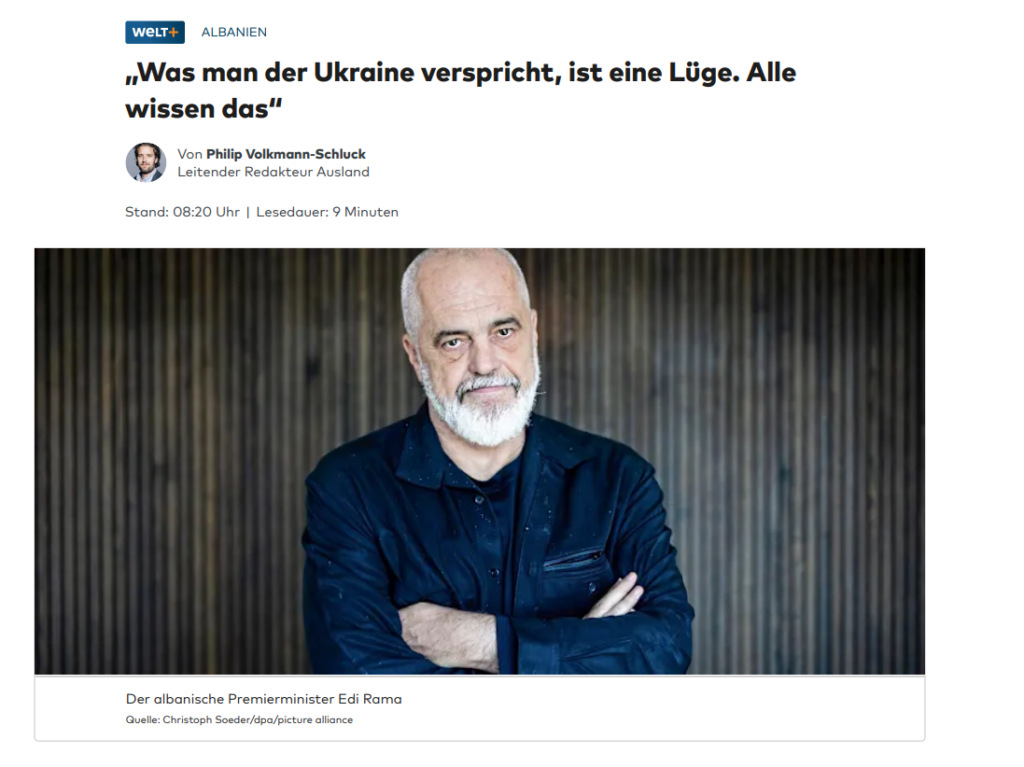
Albania is considered a promising candidate for EU membership. In an interview with WELT AM SONNTAG, Prime Minister Edi Rama speaks about corruption, what he believes Europe must change, the Western Balkans, China and Russia, and why he says the promise being made to Ukraine cannot be fulfilled through the EU’s normal accession process.
By Philip Volkmann-Schluck | WELT AM SONNTAG
English translation republished by Tirana Examiner
Construction noise hangs over Tirana. In Albania’s capital, one grand building after another is going up. The country of 2.5 million people is regarded as one of the most promising of the six Western Balkan countries seeking EU membership by 2030.
The contrasts are sharp. Beneath the glittering facades, citizens of the “Flamingo Revolution” have been demonstrating every evening for months. Many accuse the government of corruption and complain about low wages. The unprecedented protests were triggered by a multibillion-dollar investment project by Jared Kushner, son-in-law of US President Donald Trump, for a luxury resort on the Albanian coast.
Inside the office of Prime Minister Edi Rama, the anteroom holds a collection of propaganda images from the communist dictatorship. Until 1990 Albania was so sealed off from the outside world that it was compared to North Korea.
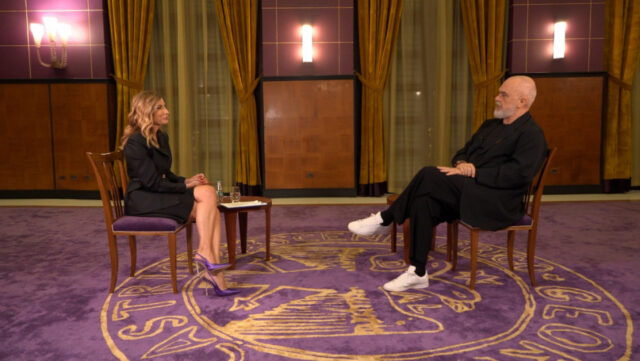
Rama appears for the interview in sneakers and a black sweater. The 62-year-old, who also exhibits internationally as an artist, wants the pictures understood as a warning against falling into stereotypes. Instead of going into his office, the 1.92-metre prime minister sits in one of the armchairs in the anteroom and crosses his legs.
WELT AM SONNTAG: Prime Minister, you compared the European Union to the Titanic heading for the iceberg. Why?
Edi Rama: The iceberg was already identified by the great European Mario Draghi. The EU is less innovative and competitive than other major players, and it lacks the capacity for bold, strategic decisions. Changing nothing turns it into the Titanic.
WamS: And yet you want to join as quickly as possible.
Rama: Not only me. Everyone in Albania wants that. The EU is the most visionary political project ever designed. It has meant that entire generations grew up without war. How can one not want to be part of it, or be so foolish as to say we want to leave again?
WamS: What can Albania contribute?
Rama: With 2.5 million people we are too small for a big effect. But we can strengthen Europe. Right now it is an organism with a dangerous hole.
WamS: What do you mean?
Rama: Look at the map. Countries usually have one border running around the outside. Europe has a second one on the inside. The hole in the middle of Europe is the Western Balkans. There are forces trying to cut us off.
WamS: Do you mean China with its investments, and Russia and Turkey, which want political influence?
Rama: Those are clichés. Yes, Russia is a real threat. But China has no imperial agenda. It is simply a reality that everyone has to deal with. Turkey poses no danger in the Western Balkans. I see only fraternal interference for stability and peace.
WamS: Chinese loans almost drove your neighbour Montenegro into state bankruptcy.
Rama: We do not have that problem in Albania. Our relationship with Beijing is more distant because we had a close bond in the worst phase, during the Cultural Revolution. But today I admire China. The diligence, the meritocracy. Europe should not shut itself off, but regain the ability to be in contact with everyone.
WamS: Back to the hole in Europe. What is the danger, then?
Rama: An open belly is bad. Infections, wounds, decay threaten. Russia is a virus. Radical Islam is a virus. Crime is a virus. Commission President Ursula von der Leyen has seven children. We are also seven, seven states that want into the EU. Is it better to let children grow up in the family, or to leave them outside until they are grown? Of course a child at the table has fewer rights. It cannot demand everything. But out there the risks are high. One child makes friends with Russian gangsters. Another becomes addicted to Chinese toys. The third discovers extremism and blows up the neighbourhood.
WamS: 2030 is named as a possible accession date. Chancellor Friedrich Merz has offered to speed up the process, for example with gradual access to the EU internal market. Would that help?
Rama: Your chancellor and Europe as a whole must rediscover the courage of Helmut Kohl. When the Wall fell in 1989, Kohl did not say to the East Germans: now you have 33 negotiating chapters, then we will take you in. He said: we are all in the same boat.
WamS: Should the EU overlook problems for geopolitical reasons?
Rama: The EU should demand even more homework from us. But we want to be part of it. Look at Ukraine. What is being promised to it is a lie. On the regular accession path, with all the criteria, it will never be admitted. Everyone knows that. What would be realistic is to bring Ukraine to the table now and grant it full membership through a performance-based process.
WamS: Even today, with 27 members, the EU finds it hard to take decisions. What happens if it grows further?
Rama: Of course it would be a risk to admit new countries that can block decisions. In any case I would argue for abolishing the veto. If Europe has to compete with China, the United States and India, it is absurd that one member can stop everything.
WamS: Corruption is still a problem in Albania. Your intelligence chief was arrested, and there are many other investigations and judgments. What are you doing about it?
Rama: Albania was a country in which corruption was the system. Today Albania is a country in which the system fights corruption. We are in the final phase of cleansing the country.
WamS: The anti-corruption body SPAK, under US and EU oversight, is going hard after senior officials. Is it working?
Rama: In part it is painful. Not all proceedings meet European standards, in my view. Albania has the highest rate of people in pre-trial detention on the continent. But that is part of a hard, unavoidable process. We should get recognition for it.
WamS: There are voices demanding political responsibility from you, given the arrests and convictions in your circle.
Rama: Before I took office, since the state was founded in 1912, not a single minister in Albania had ever appeared before an independent prosecutor. I am proud that our country is now able to hold people to account, wherever they are. That is my political responsibility.
WamS: But trust is clearly lacking. For months citizens have been demonstrating outside your government building. The trigger was a planned investment project for a luxury resort by Jared Kushner, the US president’s son-in-law. The protesters accuse you of selling Albania.
Rama: We live in a world in which someone is always upset. Every democracy suffers from that. The protesters have legitimate concerns, which I do not dispute. But they are driven by lies and conspiracy theories.
WamS: This project is about four billion dollars, a gigantic sum. With your contacts to the US president you contributed substantially to it. Where do you draw the line between economic diplomacy and a system that depends too much on your personal relationships?
Rama: You too are a victim of a narrative that is repeated over and over. When all this started, Trump was no longer in office. He could have gone to prison or back to the White House. Besides, there is still no final contract. We are still negotiating. The environmental impact assessment is also still running. And these are actually two separate projects. One is on an island that is publicly owned. Only eight percent of that island may be built on, and the island remains public. The other is on a peninsula that is privately owned. If you brought foreign capital to Germany, would you say Germany was being sold off at a giveaway price? Would you say Germany belongs to the Germans? I represent the interests of my country, and I will continue.
WamS: Why, then, is the project criticised internationally?
Rama: It is the long shadow of Donald Trump, which has brought all the world’s media and the entire left here. I told my Democratic friends in America: if you cannot beat Trump in America, do not come to Albania to take revenge. That is not fair.
WamS: How did you initiate the project? In the EU one would need a public tender.
Rama: Even in the EU you do not need a public tender to invest in a private plot of land. The owners have to sell the property or agree to the development. That is all.
WamS: At 3.5 percent, Albania has high economic growth. Impressive buildings are going up all over Tirana. But wages are low, prices are high. Many people are leaving the country.
Rama: Many young Germans cannot afford to buy a home today either. I started as prime minister with a per-capita income of under 3,000 dollars. Today we are at almost 12,500. Yes, young people emigrate. That is Europe, movement in a large labour market. When wages rise to a comparable level, they will come back.
WamS: What is your economic vision?
Rama: We have sunny weather, which you do not have in Germany. We have fantastic food and hospitality. We have rivers and produce electricity entirely from renewable energy. We will be innovative and grow. The question is not what Albania will do, but Europe.
WamS: What should Europe do?
Rama: A hard demographic winter lies ahead for all of us. The population is getting older. We have to talk about what kind of migration we need and want, but like adults. Anyone who uses the issue as a political football to conjure up bogeymen can win elections in the short term. But that is not statecraft. That is like playing music on the deck of the Titanic.
WamS: Italy built deportation centres in Albania two years ago. Brussels now allows asylum applications to be processed via third countries. Are you offering Germany the chance to build such centres?
Rama: Italy is not only a particularly close partner. It is our European alter ego. But to others we say no, because centres in third countries alone are not the solution. There are far bigger problems. And now artificial intelligence is added to that. While the Chinese and the Americans are sprinting ahead, people in Europe are arguing about a migrant centre in Albania for a handful of migrants. That is absurd.